
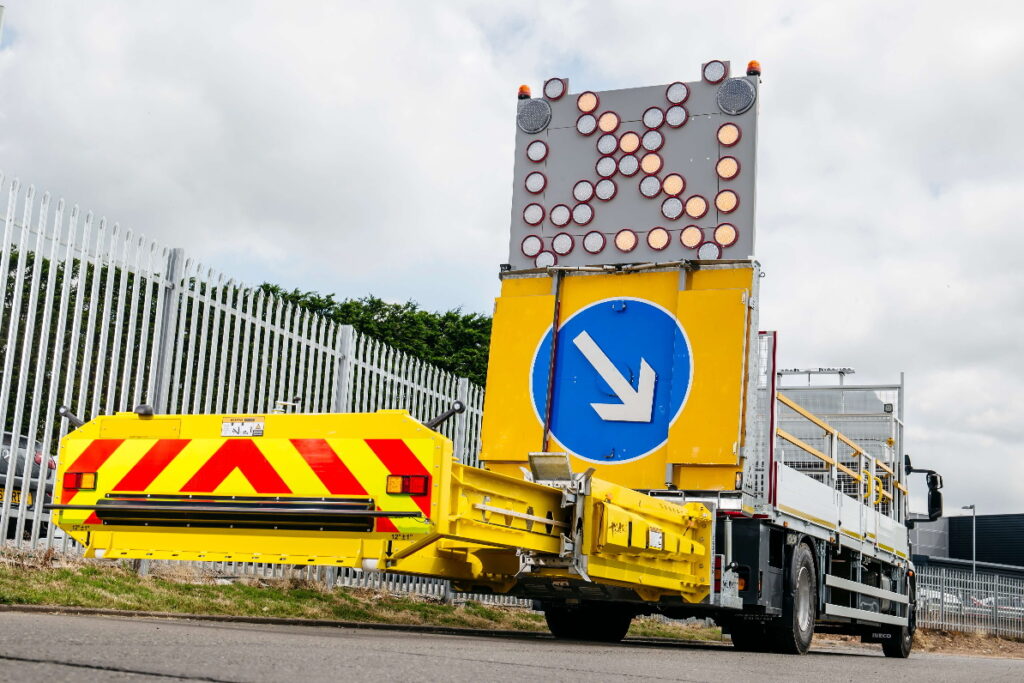
A truck-mounted attenuator (TMA) is required at any roadwork site where workers are exposed to live traffic traveling at speeds that create a significant rear-impact risk. In most jurisdictions, this means any work zone on a road with a posted speed of 45 mph (70 km/h) or higher. The exact requirement depends on local regulations, site-specific risk assessments, and the nature of the work being performed. The sections below answer the most common questions contractors and traffic managers ask before deploying a work zone.
What types of roadwork sites legally require a TMA?
Roadwork sites on high-speed roads where a shadow vehicle or work vehicle is exposed to live traffic typically require a TMA. This includes highway maintenance operations, lane closures on arterial roads, bridge and utility work in active traffic lanes, and any moving or stationary work zone where a vehicle is positioned between oncoming traffic and workers on foot.
In practice, the following site types most commonly trigger a TMA requirement:
- Stationary work zones on highways or expressways where equipment or workers occupy a lane or shoulder
- Mobile operations such as line striping, pothole patching, or mowing that move slowly along a live road
- Lane closure setups where a shadow truck protects the transition taper
- Bridge deck work and utility operations within the roadway envelope
- Incident management operations where responders work near moving traffic
National and regional road authorities publish standard specifications that define which site categories require a TMA. In the United States, the Manual on Uniform Traffic Control Devices (MUTCD) and state-level standard plans are the primary references. In Europe, equivalent national standards apply. Always consult the applicable standard for your jurisdiction before setting up a work zone.
What speed threshold triggers a TMA requirement?
The most widely applied threshold is 45 mph (approximately 70 km/h). At this speed and above, the kinetic energy of an errant vehicle striking a work zone vehicle is high enough that an unprotected impact poses a serious risk of fatality or severe injury to workers. Most road authorities set this as the minimum posted speed at which a TMA becomes a mandatory protective measure.
Below 45 mph, some jurisdictions permit alternative protective measures such as traffic control devices, barriers, or reduced-speed zones. However, many contractors and safety officers choose to deploy a TMA at lower speeds as well, particularly in urban environments with high traffic volumes or poor sight lines. The speed limit posted on the road is the reference point, not the actual speed of approaching vehicles.
It is worth noting that some national standards differentiate between the posted speed and the operating speed of the work zone itself. A moving operation traveling at 5 mph on a 55 mph road still faces the same approach speed risk and therefore still requires a TMA rated for the posted limit.
Does the duration of roadwork affect whether a TMA is needed?
Yes. The duration of a work zone is one of the primary factors that determines which protective measures apply. Road safety standards typically classify work zones into categories such as long-term stationary, short-term stationary, short-duration, and mobile. Each category carries different requirements, and TMA requirements are generally stricter for longer or stationary operations.
For example, a utility crew that stops for 15 minutes on a highway shoulder may be subject to different rules than a paving crew occupying a lane for several days. That said, duration alone does not exempt a site from TMA requirements. If the speed threshold is met and workers or equipment are exposed to live traffic, a TMA is typically required regardless of whether the work takes one hour or one week.
Mobile operations present a specific case. Because the work vehicle moves continuously, it acts as its own shadow vehicle. In these situations, a TMA mounted to the rear of the lead or trailing truck is standard practice and is required by most traffic management specifications covering mobile work zones.
Who is responsible for deciding if a TMA is required on a project?
Responsibility for determining TMA requirements typically falls on the project traffic control supervisor or the engineer of record, working within the framework set by the contracting authority. On government-funded projects, the road authority often specifies TMA requirements directly in the contract documents. On private projects, the contractor’s safety officer or project manager carries this responsibility.
In most cases, the decision follows a structured process:
- Review the applicable national or regional traffic control standard for the road type and speed category
- Consult the project’s Traffic Management Plan (TMP) or Traffic Control Plan (TCP), which specifies required protective equipment
- Conduct a site-specific risk assessment that accounts for speed, duration, worker exposure, and road geometry
- Select a TMA that meets the crash-test standard required for the posted speed (for example, MASH 2016 TL-3 for roads up to 62 mph)
On projects where the contracting authority does not specify TMA requirements explicitly, the contractor still carries a duty of care. Deploying a certified crash protection system is the most defensible approach when workers are exposed to traffic above the relevant speed threshold.
What are the consequences of operating a work zone without a required TMA?
Operating a work zone without a required TMA exposes the contractor, project owner, and responsible individuals to serious legal, financial, and safety consequences. If a rear-impact collision occurs in an unprotected work zone, liability falls directly on the parties responsible for traffic control. This can result in civil litigation, regulatory penalties, and, in some jurisdictions, criminal charges if negligence is proven.
Beyond legal exposure, the human cost is the most immediate concern. Work zone crashes involving unprotected shadow vehicles frequently result in fatalities or life-altering injuries to workers and drivers. Road authorities and insurers increasingly require documented proof of TMA deployment and certification before approving work zone setups.
From a regulatory standpoint, failure to comply with required traffic control standards can also result in:
- Project shutdowns and stop-work orders issued by the road authority
- Loss of prequalification status for future government contracts
- Increased insurance premiums or denial of coverage for work zone incidents
- Fines levied under occupational health and safety legislation
How Verdegro Helps You Choose the Right TMA
We manufacture a range of truck-mounted attenuators designed to meet the compliance requirements that apply across different road types, speed categories, and work zone configurations. Our TMA lineup includes systems tested and approved to both NCHRP-350 TL-3 and MASH 2016, the most current crash-test standard recognized by the FHWA.
Here is a quick overview of what we offer:
- TMA-US 100K and TTMA-US 100K for standard and tandem truck applications on high-speed roads
- LTMA-US 70K for lighter host vehicles where weight constraints apply
- BLADE TMA for operations requiring a compact, high-performance crash cushion
- Optional LED arrow boards, full-color VMS displays, and hydraulic LED-lift masts to build a complete work zone protection setup on a single vehicle
All our systems come with FHWA acceptance letters, giving you the documentation you need to satisfy contract requirements and regulatory audits. Whether you are equipping a single shadow truck or outfitting a fleet for a large infrastructure program, we can help you match the right system to your site conditions and compliance obligations.
If you want to discuss which TMA fits your project requirements, contact our team directly and we will help you find the right solution.