
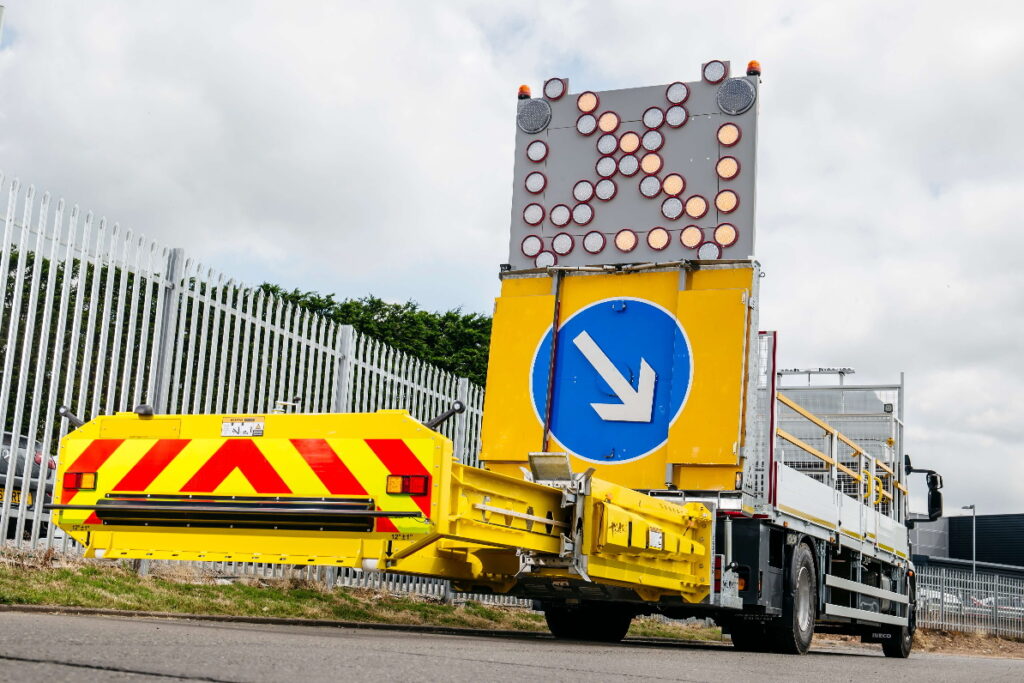
A truck-mounted attenuator should generally be positioned 50 to 100 feet behind the work crew or the nearest worker, though the exact distance depends on the posted speed limit, the type of work zone, and the applicable safety standard in your region. Higher-speed roads require greater separation between the TMA and the activity area to give the attenuator enough space to absorb impact energy effectively. The sections below walk through the key factors that shape this distance requirement.
What factors determine TMA positioning distance?
TMA positioning distance is determined by a combination of road speed, work zone geometry, the type of work being performed, and the crash cushion’s rated performance specifications. No single rule applies universally; the correct following distance results from evaluating these factors together and applying the relevant national or state-level guidance.
The most important factors to consider include:
- Posted speed limit: Faster traffic requires more stopping and absorption distance between the TMA and the work crew.
- Type of work zone activity: Stationary operations (such as milling or paving) may require different spacing than moving operations where the TMA travels slowly alongside workers.
- TMA performance rating: Attenuators are rated to specific test levels. A unit rated to MASH TL-3 is designed to handle higher-speed impacts than a TL-2 unit, which affects how it should be deployed.
- Lane configuration and road geometry: Curves, intersections, and narrow lanes can all influence how much buffer space is practical and safe.
- State or regional traffic control plans: Many jurisdictions supplement federal guidance with their own minimum distance requirements, which you must follow regardless of what the federal standard specifies.
Understanding these factors before deploying a TMA is not just a best practice; it directly affects whether the system will perform as intended if a vehicle strikes it.
What do MASH and NCHRP standards say about TMA distance?
Neither MASH (Manual for Assessing Safety Hardware) nor NCHRP Report 350 specifies a single universal following distance for truck-mounted attenuators. Instead, these standards define the crash test conditions under which a TMA must perform, and practitioners apply that performance data alongside guidance from documents like the MUTCD (Manual on Uniform Traffic Control Devices) to determine appropriate field distances.
NCHRP-350 TL-3 and MASH TL-3 are the two most widely referenced test levels for TMAs used on high-speed roads. A TMA tested to MASH TL-3 has been evaluated against impacts at speeds up to 100 km/h (62 mph), which tells you the maximum impact scenario the unit is designed to handle. This performance rating directly informs how far behind the work crew the unit should be placed; a higher-rated unit gives you more confidence at greater speeds but does not eliminate the need for proper spacing.
In practice, most traffic control plans reference the MUTCD and applicable state standards to set minimum distances, while the MASH or NCHRP acceptance letter for a specific TMA confirms the unit is certified to absorb the expected impact. You should always verify that the TMA you deploy holds the appropriate acceptance documentation for the speed environment you are working in.
How does speed limit affect the required following distance?
Speed limit is the single most influential factor in determining how far behind the work activity a TMA should be positioned. As posted speed increases, the kinetic energy of a potential impact rises sharply, which means the attenuator needs more operational space and the work crew needs more buffer distance to remain protected.
As a general working reference, traffic control guidance typically points toward these distance ranges:
- Under 45 mph (70 km/h): A minimum following distance of around 50 feet is commonly referenced, though local plans may require more.
- 45 to 55 mph (70 to 90 km/h): Following distances in the range of 50 to 80 feet are typical, depending on the work zone type.
- Over 55 mph (90 km/h): Many plans specify 80 to 100 feet or more, particularly for stationary operations on high-speed highways.
These figures are not universal mandates; they reflect commonly applied practice. Your specific traffic control plan, the TMA’s rated test level, and your state or national authority’s requirements will define the actual minimum. Always treat posted speed as the starting point for your distance calculation, not the only input.
What’s the difference between a shadow vehicle and a TMA?
A shadow vehicle is any truck or vehicle positioned between moving traffic and a work crew to provide a physical barrier, while a truck-mounted attenuator is a certified crash cushion system mounted to the rear of a vehicle specifically designed to absorb and redirect impact energy. Not every shadow vehicle carries a TMA, but every vehicle equipped with a TMA functions as a shadow vehicle.
The distinction matters because an unequipped shadow vehicle offers limited protection. If a distracted driver strikes a plain work truck at highway speed, the outcome for both the truck occupants and the work crew can be severe. A properly rated TMA, by contrast, is engineered to decelerate an impacting vehicle in a controlled way, reducing the force transmitted to the host vehicle and the workers ahead.
For high-speed work zones, deploying a shadow vehicle without a certified TMA is generally not considered acceptable practice under current standards. The TMA is what transforms a shadow vehicle into a meaningful protective system.
Can a TMA be repositioned during an active work zone?
Yes, a TMA can be repositioned during an active work zone, and in moving operations it is specifically designed to do so. In moving work zones, such as highway striping, crack sealing, or pothole patching, the TMA vehicle travels slowly ahead of or behind the work crew, maintaining a consistent protective buffer as the operation progresses along the road.
In stationary work zones, repositioning a TMA mid-operation is possible but requires care. Before moving the TMA, the work crew should pause activity if possible, and the repositioning should follow the traffic control plan. Moving the TMA while workers remain exposed in the work area without adequate protection creates a temporary gap in coverage that increases risk.
Key considerations when repositioning a TMA during active operations:
- Confirm that the new position maintains the required following distance for the posted speed.
- Ensure all warning lights, arrow boards, and VMS displays remain active and visible during the move.
- Coordinate with the work crew supervisor so no workers are left unprotected during the transition.
- Check that the TMA is properly secured and all systems are functioning before resuming work.
How Verdegro Helps with Truck-Mounted Attenuator Positioning and Selection
Choosing the right TMA and deploying it correctly starts with having equipment that is certified to the standards that apply to your work zone. We manufacture a range of truck-mounted attenuators, including the TMA-US 100K, TTMA-US 100K, LTMA-US 70K, and BLADE TMA, all tested and approved to NCHRP-350 TL-3 and MASH 2016. These are the most current crash safety standards, and holding FHWA acceptance letters under MASH 16 means our systems meet the requirements for deployment on federally funded roads in the United States.
Here is what our TMA systems offer that directly supports correct and effective deployment:
- MASH TL-3 and NCHRP-350 certification so you can confirm compliance before committing to a traffic control plan.
- Optional LED arrow boards and full-color VMS displays integrated into the TMA setup, reducing the number of separate vehicles you need to manage in the work zone.
- Hydraulic LED-lift masts for improved visibility at high-speed locations where standard warning systems may not be sufficient.
- Durable construction designed for repeated deployment across road construction, maintenance, and incident management operations.
If you are evaluating which TMA is right for your speed environment or need documentation to support a traffic control plan, contact us and we will help you identify the right system for your specific requirements.
Related Articles
- What is a wings add-on used for on a truck mounted attenuator?
- What is the difference between a 70K and 100K truck mounted attenuator?
- What is the difference between MASH and NCHRP-350 for truck mounted attenuators?
- When should you use a truck mounted attenuator instead of a trailer-mounted one?
- What industries rely most on truck mounted attenuators?