
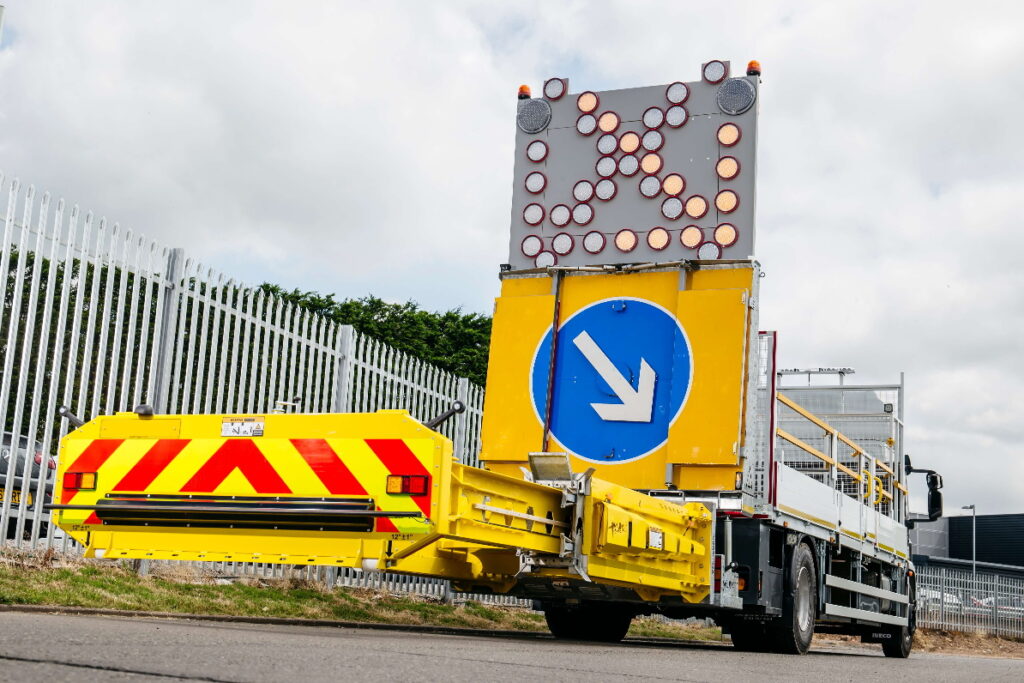
No, truck mounted attenuators do not automatically come with arrow boards included. The two are separate pieces of equipment that serve different functions, and whether they are bundled together depends on the manufacturer, the product configuration, and the specific requirements of your work zone setup.
Some manufacturers offer arrow boards as optional add-ons or accessories that can be integrated into a TMA system, while others supply them entirely separately. Understanding the distinction between the two helps you specify the right combination for your project from the start.
What is the difference between a truck mounted attenuator and an arrow board?
A truck mounted attenuator (TMA) is a crash cushion system mounted to the rear of a work truck. It absorbs the energy of an errant vehicle that strikes the truck from behind, protecting both road workers in the work zone and the occupants of the striking vehicle. An arrow board is a visual signaling device that displays directional arrows or patterns to guide drivers away from a work zone lane. One protects through physical impact absorption; the other protects through advance warning.
The two systems work at different stages of a potential incident. The arrow board acts before a collision occurs, giving drivers enough time to merge and change lanes safely. The TMA acts when a collision happens anyway, reducing the severity of impact. Both address road worker safety, but through entirely different mechanisms.
TMAs are tested and certified to crash safety standards such as NCHRP-350 TL-3 and MASH 2016, which govern how they perform under specific impact conditions. Arrow boards, by contrast, are governed by visibility and signaling standards. The two product categories fall under different compliance frameworks, which is one reason they are typically specified and procured separately.
Are arrow boards typically included with a TMA purchase?
Arrow boards are not typically included as standard with a TMA purchase. Most manufacturers treat them as optional accessories or separate line items. When you buy a TMA, you are purchasing a certified crash attenuation system, and adding an arrow board involves additional integration, mounting hardware, and, in some cases, separate electrical connections to the host vehicle.
That said, many TMA suppliers do offer arrow boards as factory-fitted options, meaning you can order the two together as an integrated unit. This is often the more practical route because it ensures compatibility between the mounting system and the board’s power supply and control interface. Ordering them separately and then attempting to integrate them later can introduce complications, particularly when the TMA has a specific rear-frame design.
When reviewing any TMA specification sheet, look explicitly for whether an arrow board is listed as standard or optional. If the listing simply states “arrow board compatible,” that means you will need to order it separately and confirm fitment details with the manufacturer before purchase.
Why do some work zones need both a TMA and an arrow board?
Many work zones require both a TMA and an arrow board because the two systems address different risk points in the same environment. The arrow board provides early visual guidance to approaching drivers, reducing the likelihood of a lane intrusion. The TMA provides a last line of physical protection if a driver fails to respond to that warning. Together, they create a layered safety approach that neither system achieves alone.
Traffic management plans on higher-speed roads, highways, and motorways commonly specify both. On roads where vehicles travel at 45 mph or above, the consequences of a driver failing to react to signage are severe enough that passive physical protection becomes a regulatory requirement in many jurisdictions, not just a best practice.
Work zones involving lane closures, contraflow systems, or moving operations are particularly likely to require both. In a moving operation, where the shadow vehicle travels slowly while crews work ahead, the combination of a visible arrow board and a rear-mounted attenuator gives the maximum possible protection to workers and to drivers approaching from behind.
What should you check before specifying a TMA with an arrow board?
Before specifying a TMA and arrow board combination, you should confirm compatibility, compliance, and power supply requirements. Not every arrow board mounts cleanly to every TMA, and a mismatch can create installation problems or void the crash-test certification of the attenuator if the configuration differs from what was tested.
Here are the key points to verify before you specify:
- Crash test certification: Confirm that the TMA holds a valid acceptance letter under the applicable standard, such as MASH 2016, and that adding an arrow board does not alter the certified configuration.
- Mounting compatibility: Check whether the TMA’s rear frame includes a factory-approved mounting point for an arrow board, or whether a separate bracket system is needed.
- Power source: Determine whether the arrow board draws power from the host vehicle’s electrical system or from a self-contained solar or battery unit, and whether that is compatible with your truck’s setup.
- Arrow board size and visibility rating: Match the board size to the road speed and visibility requirements specified in your traffic management plan or local regulations.
- Remote control and integration: If you need to control the arrow board from the cab, confirm whether the TMA supplier offers an integrated control system or whether you need a separate controller.
Can an arrow board be retrofitted onto an existing TMA?
Yes, an arrow board can often be retrofitted onto an existing TMA, but you need to verify that the retrofit does not compromise the attenuator’s certified performance. If the TMA was crash-tested in a specific configuration, adding a component to the rear frame may change the mass, geometry, or behavior of the system in an impact, which could affect compliance with the original test standard.
The safest approach is to contact the TMA manufacturer directly and ask whether a specific arrow board model has been approved as a retrofit accessory. Some manufacturers provide explicit guidance on approved retrofit configurations, including the mounting hardware to use and any weight limits that apply. Others may require you to resubmit for testing if the modification is significant.
If your existing TMA is older and was tested under an earlier standard such as NCHRP-350, a retrofit project is also a good moment to assess whether the system still meets current compliance requirements for your market. In 2026, MASH 2016 is the prevailing standard in the United States, and some project owners now require MASH-compliant equipment regardless of when the TMA was originally purchased.
How Verdegro Helps with Truck Mounted Attenuator Configurations
We manufacture a range of truck mounted attenuators that are designed to work with integrated accessories from the start, so you do not have to piece together compatibility after the fact. Our TMA lineup includes the TMA-US 100K, TTMA-US 100K, LTMA-US 70K, and BLADE TMA, all tested and approved to NCHRP-350 TL-3 and MASH 2016. Each system is available with optional factory-fitted accessories, including:
- LED arrow boards mounted and wired as part of the system configuration
- Full-color VMS displays for variable message signaling in complex work zones
- Hydraulic LED-lift masts for elevated lighting and signaling in low-visibility conditions
Because these accessories are specified and tested as part of the overall system, you avoid the certification uncertainty that comes with third-party retrofits. We hold multiple FHWA acceptance letters under MASH 2016, giving you documentation you can present directly to project owners and compliance reviewers.
If you are unsure which configuration fits your work zone requirements, or you want to confirm whether an arrow board can be added to a TMA you already own, contact us and we will walk you through the options.
Related Articles
- How do you select safety vehicles for different road maintenance tasks?
- Why is Verdegro's truck mounted attenuator called Armadillo?
- What is the safe following distance behind a truck mounted attenuator?
- Are truck mounted attenuators mandatory on highways?
- How do you choose the right truck mounted attenuator weight class?