
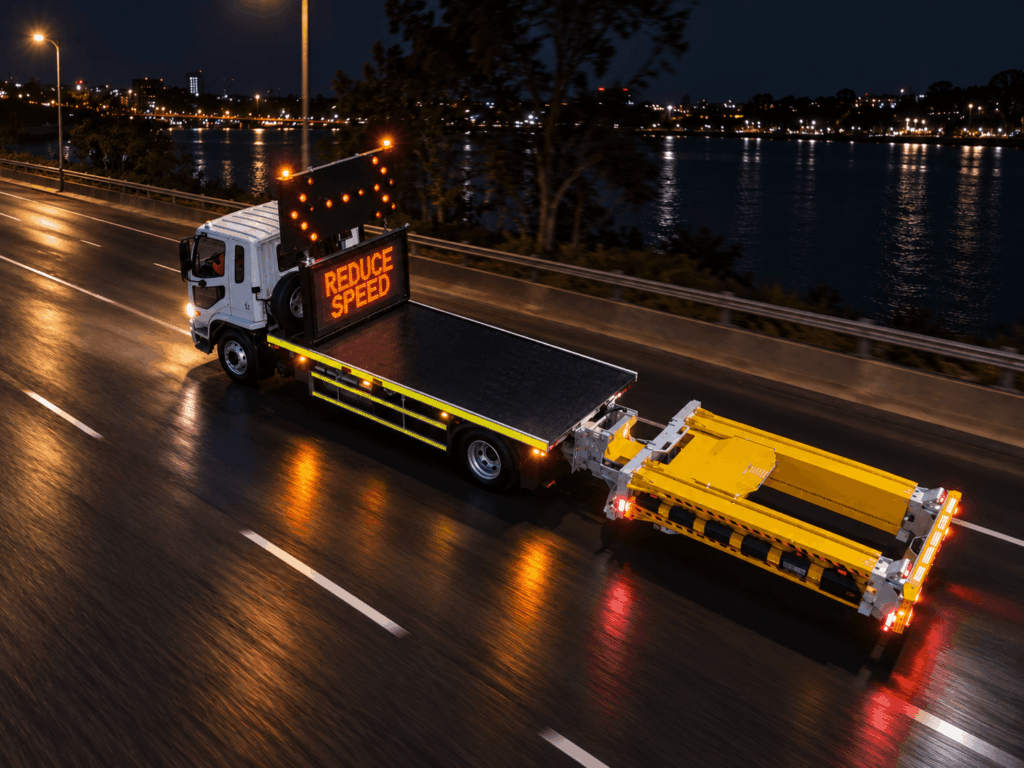
Whether you use a van or a truck for roadwork protection depends on the scale and duration of your work zone. Vans work well for short-term, lower-speed operations, while trucks are the right choice for high-speed roads, longer deployments, and heavier impact loads. The vehicle you choose determines which safety equipment you can mount, which standards you can meet, and ultimately how well you protect your workers and road users. Below, we answer the key questions that help you make the right call.
What makes a vehicle suitable for roadwork protection?
A vehicle is suitable for roadwork protection when it can safely carry the required safety equipment, meet the applicable crash test standards, and operate reliably in the conditions of your specific work zone. The three core factors are vehicle weight, structural compatibility with safety systems, and compliance with current standards such as MASH 2016.
Beyond weight and structure, the vehicle needs to be stable enough to absorb or redirect impact energy without endangering the driver or crew behind it. This is why crash test certification matters so much. A vehicle that carries a certified truck-mounted attenuator or van-mounted crash cushion has been validated to perform under real impact conditions, not just theoretical ones.
Practical usability also plays a role. A protection vehicle that blocks access to its own flatbed or rear doors creates operational problems on site. The best setups preserve full vehicle functionality while still deploying safety equipment quickly, ideally in under 20 to 30 seconds.
What is the difference between a van and a truck in work zone safety?
The key difference between a van and a truck in work zone safety is impact capacity and load rating. Trucks are heavier, which allows them to mount larger, higher-rated attenuators capable of absorbing impacts at motorway speeds. Vans are lighter and more maneuverable, making them better suited to urban or lower-speed environments where a smaller footprint is an advantage.
From a structural standpoint, trucks typically have flatbeds or chassis configurations that allow rear-mounted crash cushions to deploy horizontally behind the vehicle. Vans, by contrast, have closed bodies, which means any mounted attenuator must work around the rear doors and the vehicle’s lower gross vehicle weight rating.
There is also a difference in how each vehicle integrates with your broader operation. Trucks often serve as the primary shadow vehicle in a work zone convoy, while vans are more commonly used as mobile protection for individual crews doing maintenance tasks. Both can carry arrow boards and signage, but the scale and sophistication of that equipment differs significantly.
When is a van sufficient for roadwork protection?
A van is sufficient for roadwork protection when your work zone operates at speeds up to 80 km/h (50 mph), the deployment is short-term or mobile, and you need a compact vehicle that can navigate urban streets or tight road sections. Van-mounted attenuators are a practical and certified solution for these conditions.
Typical scenarios where a van works well include:
- Lane maintenance on secondary roads or urban arterials
- Short-duration tasks such as pothole repair, line marking, or utility inspection
- Work zones where access is restricted and a large truck would be impractical
- Operations that require frequent repositioning throughout the day
The important qualifier is speed. If traffic regularly exceeds 80 km/h in your work zone, a van-mounted system may not provide sufficient protection. In those cases, you need to assess whether the system you are using is certified for the actual impact speed, not just the posted limit.
When does roadwork protection require a truck?
Roadwork protection requires a truck when your work zone is on a high-speed road (above 80 km/h), the operation is long-duration or stationary, or the risk profile demands a higher-rated attenuator. Trucks provide the vehicle mass and structural capacity needed to meet MASH 2016 TL-3 requirements at 100 km/h (62 mph).
Situations that typically call for a truck include:
- Motorway and highway maintenance where traffic speeds are 100 km/h or higher
- Stationary work zones lasting several hours or multiple days
- Operations involving heavy machinery behind the protection vehicle
- Projects where regulatory requirements specify a minimum vehicle weight class
The minimum vehicle weight is not a suggestion. For example, a properly rated truck attenuator system requires a support truck within a specific weight range to perform as tested. Fitting a high-rated crash cushion to an undersized vehicle does not give you the same protection, and it may void the system’s certification entirely.
What safety equipment can each vehicle type carry?
The safety equipment a vehicle can carry is directly tied to its weight class, structural configuration, and electrical system. Trucks can carry larger, heavier attenuators along with full-size arrow boards, Variable Message Signs, and hydraulic systems. Vans support lighter, compact systems that are specifically engineered to work within their weight and dimensional limits.
Equipment suited to vans
Van-mounted systems are designed to integrate with the vehicle’s closed body. A rear-mounted crash cushion unfolds from a transport position into an operational position behind the van. Top-mounted and swing-mounted variants allow the rear doors to remain fully accessible during deployment, which is important when the van also carries tools or materials. Arrow boards and VMS signs can be fitted to these systems in 12V or 24V configurations to match the van’s electrical system.
Equipment suited to trucks
Trucks can support heavier crash cushions with greater energy absorption capacity, hydraulic rams for raising and lowering the attenuator, integrated underride protection, and full-size arrow boards with high-visibility LED displays. The flatbed remains accessible when the attenuator is in transport position, which allows the truck to serve a dual purpose: protection vehicle and equipment carrier. Optional accessories such as multi-truck brackets, jockey wheels, and quick-connect systems for swapping attenuators and arrow boards by forklift are also available for truck-mounted setups.
Both vehicle types can be fitted with GPS tracking and real-time monitoring through platforms like Mobitrack, which integrates with safety alert systems including Waze, Google, and national traffic control networks.
How do regulations affect your van or truck choice?
Regulations directly determine which vehicle type you can legally use for roadwork protection on a given road. The applicable crash test standard, the road’s speed limit, and the jurisdiction’s equipment approval requirements all influence whether a van or truck is permitted. In most markets, MASH 2016 is the current standard, and equipment must carry valid certification under the relevant test level.
Test Level 3 (TL-3) under MASH 2016 covers impacts at 100 km/h and is the standard required for most motorway and highway work zones. This test level requires a support vehicle within a specific weight range, which in practice means a truck. Lighter van-based systems are typically tested at lower impact speeds and are approved for correspondingly lower-speed environments.
In the UK, the optional 110K test (TD49/07) adds an additional requirement for some deployments. In the United States and other markets that reference FHWA acceptance letters, only systems with current MASH 2016 acceptance are recognized for federally funded projects. Always verify that the system you are deploying holds valid certification for the specific road type and jurisdiction where you are working. Using an uncertified or mismatched system creates both a legal liability and a genuine safety risk.
How Verdegro Helps You Choose the Right Protection Vehicle
We design and manufacture certified attenuator systems for both vans and trucks, so you are not forced into a one-size-fits-all solution. Our product range covers the full spectrum of work zone protection needs:
- VanGuard TMA – the world’s first TMA for closed vans, available in rear-mounted, top-mounted, and swing-mounted variants. It handles impacts up to 80 km/h and fits a wide range of van brands including Renault, Mercedes, Iveco, and Opel. It carries two patents and is available in 12V and 24V configurations.
- Armadillo TMA – our newest truck attenuator, introduced in 2026, fully tested and approved under MASH 2016 TL-3 at 100 km/h. It deploys in a single stage in under 20 seconds, operates without sensors or electronic components, and preserves full flatbed access in transport position.
- Mobitrack integration – available on both systems, providing real-time GPS tracking, location history, and automatic integration with safety alert platforms so drivers approaching your work zone receive advance warnings.
All our systems are delivered with official crash test certifications and CE marking. You can explore our full range of crash and attenuator systems to compare specifications, or contact us directly to discuss which system fits your vehicle type, road conditions, and regulatory requirements.