
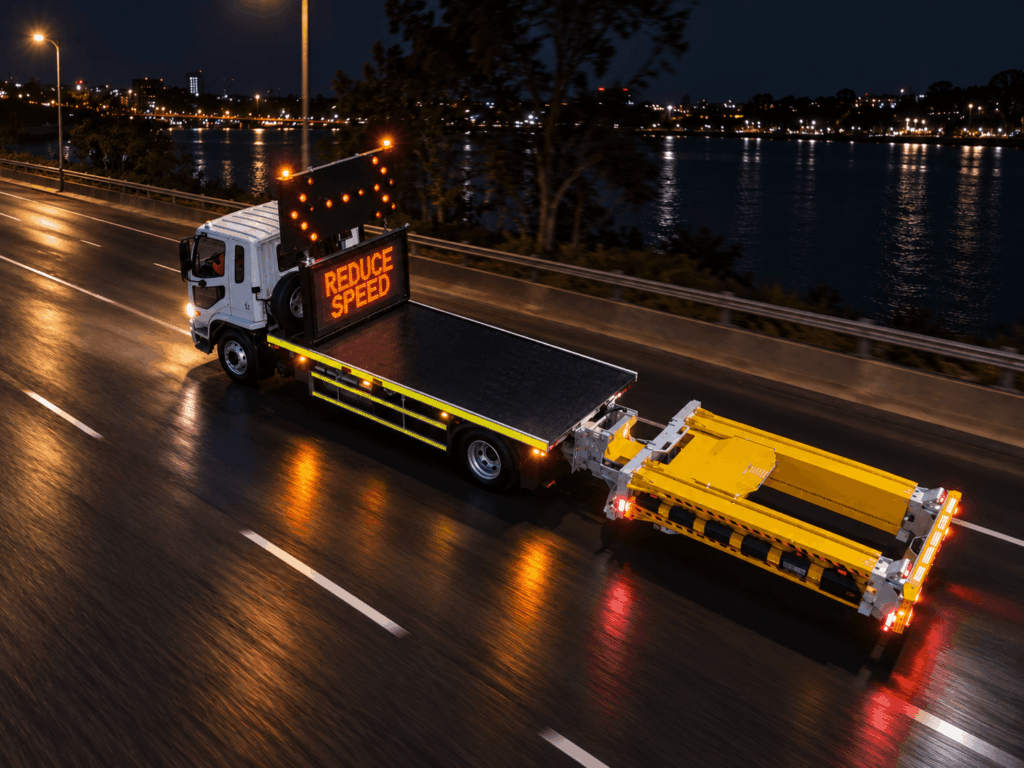
Contractors can make roadwork safety vehicles more versatile by combining the right attachments, signaling systems, and remote monitoring tools on a single platform. A well-configured safety vehicle can handle crash protection, traffic guidance, and real-time communication without requiring multiple separate units on site. The sections below walk through the specific questions contractors ask most when building out a more capable fleet.
What attachments and add-ons expand a safety vehicle’s capabilities?
Attachments such as arrow boards, Variable Message Signs, hydraulic lifts, and crash cushion accessories are what turn a standard safety vehicle into a multi-purpose work zone tool. Each add-on addresses a specific operational need, and the right combination depends on the type of roadwork, lane configuration, and traffic volume you are managing.
Arrow boards direct traffic flow and are available in different sizes and mounting configurations to suit both van-based and truck-based platforms. Variable Message Signs (VMS) go further by displaying dynamic text or symbols, letting you communicate lane closures, speed limits, or hazard warnings in real time. Hydraulic lifts extend the reach of lighting systems, improving visibility across a broader section of the work zone without additional vehicles.
Reflective foil chevrons, quick-connect brackets, and multi-truck brackets add further flexibility. Quick-connect systems, for example, allow operators to swap between an attenuator and an arrow board using a forklift, reducing the time and effort needed to reconfigure a vehicle between assignments. Jockey wheels make repositioning easier on site, while custom RAL color finishes and country-specific markings keep vehicles compliant with local regulations.
The key principle is modularity. When attachments are designed to work together on a shared mounting system, one vehicle can transition from crash protection duty to active traffic signaling without returning to a depot.
What is a truck-mounted attenuator and what tasks can it handle?
A truck-mounted attenuator (TMA) is a crash cushion system fitted to the rear of a slow-moving or stationary work zone vehicle. Its primary task is to absorb the energy of an errant vehicle that strikes the rear of the host truck, protecting both the truck crew and the workers ahead. A truck attenuator is tested and certified to specific impact standards before it can be used in live traffic environments.
Beyond basic crash protection, a truck-mounted attenuator can carry additional equipment that expands what the vehicle does on site. Arrow boards mounted above or alongside the attenuator guide drivers around the work zone. VMS signs communicate real-time instructions. When the attenuator system uses an upright transport design, the truck’s flatbed remains fully accessible, meaning the same vehicle can carry tools, materials, or additional safety equipment alongside the crash protection system.
Modern truck attenuators are also built for speed of deployment. A single-stage system that reaches operational position in under 20 seconds while the vehicle is moving at highway speed means the host truck does not need to stop traffic or wait for a setup window. This makes the vehicle useful in dynamic environments where the work zone shifts location throughout the day, such as pothole repair or line marking operations.
Truck-mounted attenuators are certified against crash test standards such as MASH 2016 TL-3, which covers impacts at 100 km/h. Some systems also carry the UK optional 110K test approval, extending their usability across different regulatory markets.
How can one vehicle serve both lighting and signaling needs?
A single safety vehicle can serve both lighting and signaling needs by combining a hydraulic lift-mounted light tower with an arrow board or VMS sign on the same platform. This approach reduces the number of vehicles needed on site and lowers both fuel costs and the logistical complexity of coordinating multiple units.
Hydraulic lifts raise lighting systems to the height needed to illuminate a wide section of the work zone without creating glare for oncoming drivers. When mounted on a vehicle that also carries an arrow board, operators control both systems from the cab, keeping the crew together and minimizing exposure to live traffic. Solar hybrid light towers add another layer of efficiency by reducing generator dependency during extended overnight operations.
Signaling and lighting needs often peak at the same time, particularly during night work or low-visibility conditions. A combined platform addresses both simultaneously. Arrow boards remain visible even when a crash cushion is folded or stowed, which means the signaling function continues uninterrupted during repositioning. LED technology keeps power consumption low enough that a vehicle’s standard 12 V or 24 V electrical system can supply the full load without a separate generator.
How does remote monitoring make safety vehicles more adaptable?
Remote monitoring makes safety vehicles more adaptable by giving fleet managers and site supervisors real-time visibility into where every vehicle is, what status each system is in, and whether any action is needed, all without requiring someone to physically check each unit. This capability allows a single operator to oversee multiple vehicles across different locations simultaneously.
GPS tracking tells you where each vehicle is at any given moment and keeps a location history you can review after the fact. This is useful for compliance reporting, incident investigation, and optimizing route planning between assignments. Real-time status updates show whether an arrow board is pointing left or right, whether a crash cushion is raised or lowered, and whether lights are on or off, so you can confirm that every vehicle is configured correctly for its current task.
Remote monitoring systems can also integrate with public safety alert platforms. When a vehicle’s location is shared with navigation apps and traffic management systems, drivers approaching the work zone receive advance warnings through tools they already use. This reduces the likelihood of late reactions and improves safety for both road users and workers on site.
Geofencing adds another dimension. When a vehicle moves outside a defined area, the system flags it automatically. This helps prevent unauthorized use and ensures vehicles stay within the zones where they have been deployed.
Which safety vehicle configurations work best for long-term road maintenance?
For long-term road maintenance, the configurations that work best are those that balance crash protection, operational flexibility, and low maintenance requirements over sustained deployment. A truck-based platform with a modular attenuator, integrated signaling, and remote monitoring is the most practical choice for projects that run over weeks or months rather than days.
Mechanical simplicity is important for long-term work. Systems that rely on fewer electronic components and sensors have fewer points of failure. A hydraulic-only attenuator that operates without sensor feedback is easier to service in the field and less likely to go offline during a shift. When a component does need attention, simpler systems allow maintenance crews to diagnose and fix the issue quickly without specialist equipment.
Van-based attenuator platforms offer a complementary option for maintenance crews that need to access rear cargo doors regularly. Swing-mounted or top-mounted configurations keep the crash cushion in place while leaving the rear of the vehicle fully accessible, which matters on jobs where tools and materials need to be loaded and unloaded throughout the day.
For projects that span multiple road types and regulatory environments, choosing a platform with certifications across multiple standards, such as MASH 2016 TL-3 and the UK 110K test, avoids the need to swap vehicles when work crosses jurisdictional boundaries. Customizable color finishes and country-specific markings further reduce the administrative burden of deploying the same vehicle across different regions.
How We Help You Build a More Versatile Safety Vehicle
We design and manufacture traffic safety systems that are built to work together as a complete platform rather than as isolated products. Here is what we offer for contractors and road maintenance teams looking to get more from each vehicle:
- Armadillo TMA: Our newest truck-mounted attenuator, fully approved under MASH 2016 TL-3 at 100 km/h. It deploys in under 20 seconds, uses no sensors, and keeps the flatbed fully accessible in transport position.
- VanGuard TMA: The world’s first TMA for closed vans, available in rear-mounted, top-mounted, and swing-mounted versions, all with rear door access preserved on the top and swing variants.
- Arrow boards and VMS signs: Available in multiple configurations and compatible with quick-connect brackets for fast swaps between assignments.
- Mobitrack: Our GPS and remote monitoring module, integrable with new and existing products. It connects with Google, Waze, Flitsmeister, Monotch, and national traffic control systems, making us the only manufacturer with this breadth of safety alert integration.
- Mobilityplanner: Our online platform gives you real-time status updates, location history, statistics, and remote control capabilities across your entire fleet from a single interface.
Every system we produce is tested and certified before it reaches your fleet. If you want to discuss which configuration fits your maintenance program, contact our team and we will help you find the right setup.
Related Articles
- How do you select safety vehicles for different road maintenance tasks?
- What is the story behind the Armadillo truck mounted attenuator?
- What happens to a truck mounted attenuator after it's been hit?
- How often are truck mounted attenuators hit by vehicles?
- What is another name for a truck mounted attenuator?