
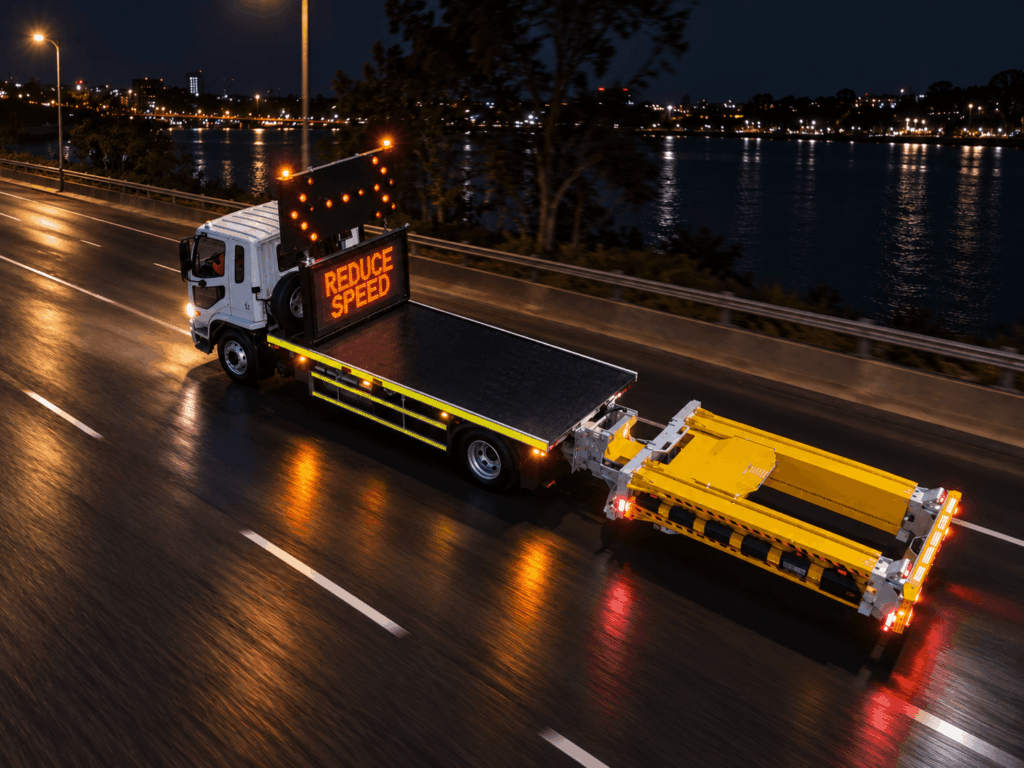
Roadwork impact protection is expanding beyond traditional heavy trucks to include lighter vehicles such as closed vans and medium-duty trucks. Modern crash standards, particularly MASH 2016, now provide a certified testing framework that covers a broader range of host vehicle weights, making it possible for contractors to mount attenuator systems on vehicles they already operate. The sections below answer the most common questions procurement teams and road safety managers ask when evaluating truck mounted attenuators for lighter fleets.
What vehicles now qualify for impact protection roles in road work zones?
A growing range of vehicles now qualify as host vehicles for truck mounted attenuators in road work zones. Under MASH 2016, the accepted host vehicle weight range has been defined with both minimum and maximum thresholds, allowing medium-duty trucks, heavy vans, and traditional heavy trucks to carry certified attenuator systems, provided the attenuator is tested and approved for that specific vehicle class.
Historically, impact protection in work zones relied almost exclusively on heavy trucks. The assumption was simple: more mass behind the attenuator meant better absorption of crash energy. While that logic holds in principle, it created operational constraints for contractors who needed flexible, mobile protection across a variety of sites and vehicle fleets.
Today, the qualifying vehicle range is wider. Closed vans in the L3H2 class, medium-duty trucks in the 7,000 to 12,000 kg range, and larger support trucks all appear in certified TMA configurations. The specific qualifying weight depends on the attenuator product and its crash test certification, each approval document specifies the minimum and maximum host vehicle weight the system was tested with.
How does MASH 16 differ from older crash test standards for attenuators?
MASH 2016 (Manual for Assessing Safety Hardware) differs from its predecessor, NCHRP Report 350, primarily in the size and weight of the test vehicles used during crash evaluation. MASH uses heavier and more realistic impactor vehicles that better represent the modern vehicle fleet, which means attenuators certified under MASH 2016 have been validated against more demanding real-world collision scenarios than those tested under older standards.
Under NCHRP 350, the small car test vehicle weighed approximately 820 kg. MASH 2016 increased that to around 1,100 kg, reflecting the growth in average passenger vehicle weight over recent decades. This change has a direct effect on attenuator design: systems must absorb more energy from the same impact speed to meet the newer standard.
For procurement teams, the practical implication is straightforward. MASH 2016 certification is now the benchmark required for federal highway projects in the United States, and it is increasingly referenced in European and international tender specifications. An attenuator carrying only NCHRP 350 approval may not satisfy current contract requirements. When evaluating crash protection systems, always confirm which standard the product was tested and approved under, and verify that the approval covers the test levels relevant to your operating speeds.
Why are contractors moving toward lighter host vehicles for TMA operations?
Contractors are moving toward lighter host vehicles for truck mounted attenuator operations primarily because lighter vehicles are more versatile, less expensive to operate, and easier to deploy across a wider range of work zone types. A van or medium-duty truck can access urban streets, narrow maintenance sites, and locations where a full-size heavy truck would be impractical or prohibited.
Operational cost is a significant driver. Lighter vehicles consume less fuel, require lower licensing categories in many countries, and carry lower acquisition and maintenance costs than heavy trucks. For contractors running large fleets across multiple simultaneous sites, those savings compound quickly.
Staffing flexibility is another factor. Drivers qualified to operate lighter vehicles are more widely available than those licensed for heavy goods vehicles. This reduces scheduling constraints and makes it easier to scale operations during peak road maintenance seasons.
There is also a practical argument around site access. Many urban maintenance tasks, utility works, and short-duration road closures take place on roads with weight restrictions or tight turning circles. A lighter host vehicle with a compact attenuator can operate in those environments without requiring special permits or route planning that a heavier vehicle would demand.
What safety trade-offs come with lighter attenuator host vehicles?
The main safety trade-off with lighter host vehicles is reduced resistance to roll-ahead movement after a crash impact. A heavier truck absorbs more kinetic energy through its own mass, limiting how far the host vehicle travels forward into the work zone after a collision. A lighter vehicle, by definition, offers less of this passive resistance, which means attenuator design and crash test performance become even more important.
MASH 2016 addresses this directly. The standard specifies maximum allowable roll-ahead distances, and any certified attenuator must demonstrate compliance within those limits regardless of the host vehicle weight class it is approved for. This means a well-engineered attenuator on a lighter vehicle can still meet the same roll-ahead requirements as one mounted on a heavier truck, but only if it has been specifically tested and approved for that vehicle weight range.
A second consideration is stability. Lighter vehicles have a lower threshold for lateral movement during an angled impact. Attenuator systems designed for lighter hosts must account for this in their structural engineering, ensuring the crash cushion redirects impact energy in a controlled way without destabilizing the host vehicle sideways.
The important takeaway is that lighter does not automatically mean less safe, provided the attenuator is correctly matched to the host vehicle and carries the appropriate certification. Mismatching an attenuator designed for a heavy truck onto a lighter vehicle without proper approval is where genuine safety risk arises.
Which TMA configurations are certified for use on lighter vehicles?
Several TMA configurations are now certified for use on lighter vehicles, including van-mounted systems and medium-duty truck attenuators that meet MASH 2016 or equivalent national standards. The specific configurations available depend on the manufacturer, but the market has expanded meaningfully in recent years to include systems purpose-built for lighter host vehicle classes.
Van-mounted attenuator systems
The most notable development in this category is the emergence of TMA systems designed specifically for closed vans. These systems mount directly to the van structure and deploy a crash cushion from the rear. They are particularly suited to urban maintenance operations, utility works, and short-duration closures where a full-size truck would be disproportionate to the task.
These van-mounted configurations are tested to withstand impacts at speeds up to 80 km/h (50 mph), making them appropriate for national road and motorway maintenance in many jurisdictions, subject to local regulatory approval.
Medium-duty truck attenuator systems
For operations that require more structural capacity than a van but do not justify a full heavy truck, medium-duty attenuators offer a practical middle ground. These systems are approved for host vehicles within defined weight ranges, typically with a minimum truck weight around 7,000 kg and a maximum around 12,500 kg, and they carry full MASH 2016 certification at TL-3, meaning they are tested at 100 km/h (62 mph).
These configurations combine a compact physical footprint with full-standard crash performance, making them well suited to both highway maintenance and urban road work where space and maneuverability matter.
How should procurement teams evaluate impact protection for lighter fleets?
Procurement teams evaluating impact protection for lighter fleets should start by confirming that any attenuator under consideration carries a current, applicable crash test certification that specifically covers the host vehicle weight class in their fleet. Certification documents must state the minimum and maximum host vehicle weight tested, not just the test level or speed.
Beyond certification, the following factors deserve attention during evaluation:
- Approved host vehicle weight range: Verify that your vehicles fall within the tested weight window. Operating outside this range voids the certification.
- Deployment speed and time: For active traffic environments, how quickly the system reaches operational position matters. Systems that deploy in under 20 seconds while driving at road speed reduce exposure time for operators.
- Mechanical complexity: Simpler systems with fewer electronic components and no sensor dependencies are generally easier to maintain and less prone to failure in field conditions.
- Flatbed and door access: For lighter vehicles especially, whether the attenuator blocks access to the truck bed or van doors in transport position affects day-to-day usability.
- Roll-ahead distance compliance: Confirm the certified maximum roll-ahead distance and assess whether it is appropriate for the work zones you operate in.
- Compatibility with tracking and alert systems: Integration with GPS tracking and driver alert platforms adds an operational safety layer that complements the physical protection the attenuator provides.
A comparison table can help structure the evaluation across multiple products:
Key evaluation criteria for TMA procurement on lighter vehicles:
- Crash standard: MASH 2016 TL-3 is the current benchmark for highway-speed work zones
- Host vehicle weight range: Must match your fleet’s actual vehicle weights
- Deployment time: Under 20 seconds at operating speed is a practical target
- System weight: Lighter attenuators reduce payload burden on smaller host vehicles
- Maintenance requirements: Hydraulic-only systems without sensors reduce service complexity
- Certifications included: Look for CE marking, crash test certificates, and country-specific approvals
How We Can Help with Impact Protection for Lighter Vehicles
We design and manufacture truck mounted attenuators specifically engineered to match the operational realities of lighter vehicle fleets without compromising on certified crash performance.
Our Armadillo TMA, introduced in 2026, is our latest development for medium-duty host vehicles. It is fully tested and approved under MASH 2016 TL-3 at 100 km/h, and it is approved for host vehicles between 7,228 kg and 12,475 kg. Key features that make it practical for lighter fleet operations include:
- Single-stage deployment in under 20 seconds while driving at 80 km/h, reducing operator exposure during setup
- No sensors or electronic components, only a hydraulic power pack, which means fewer failure points and simpler field maintenance
- Compact width of 2,300 mm, allowing operation in narrow lanes and constrained work zones
- Upright transport position that preserves full access to the truck flatbed
- Approximate weight of 950 kg, keeping the load on the host vehicle manageable
- Patented design protected in Europe, the United States, China, and Hong Kong
For contractors operating closed vans, our VanGuard TMA is the world’s first certified attenuator system designed specifically for closed vans. It is available in three configurations, rear mounted, top mounted, and swing mounted, giving you flexibility based on how you use the vehicle day to day. The swing-mounted version allows rear door access even in operational position, which is a practical advantage for multi-purpose maintenance vehicles.
Both systems can be equipped with our Mobitrack GPS and alert integration, giving your team real-time location data and automatic integration with safety alert platforms including Waze, Google, and Flitsmeister.
If you are evaluating impact protection options for your fleet, contact us to discuss which configuration fits your vehicle weights, operating speeds, and site conditions. We will help you identify the right certified solution.