
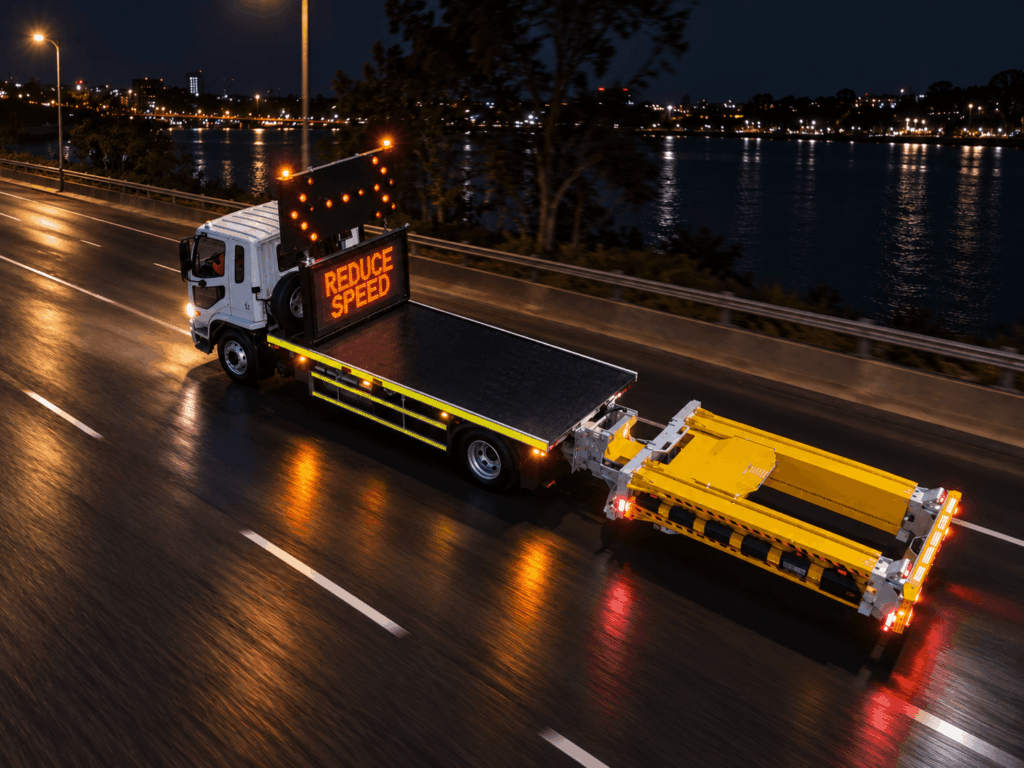
No, the same crash protection solution cannot be used on every roadwork vehicle. The right system depends on the vehicle’s weight class, structural configuration, and the type of work being performed. A Truck Mounted Attenuator designed for a heavy support truck will not fit, or perform safely, on a closed van, and vice versa. The sections below break down the key questions fleet managers and road safety professionals ask when selecting the right crash protection for their vehicles.
What factors determine which crash protection system fits a vehicle?
The most important factors are vehicle weight, structural compatibility, deployment requirements, and the regulatory standard that applies in your country or region. A crash protection system must be matched to the host vehicle’s gross vehicle weight, mounting points, and power supply, otherwise it cannot perform as tested and certified.
Weight is the starting point. Most truck mounted attenuators specify a minimum and maximum host vehicle weight. If the vehicle is too light, it cannot absorb the impact energy the system is designed to redirect. If it is too heavy, the dynamics of a crash event may fall outside the parameters of the crash test. Beyond weight, you need to consider:
- Vehicle type: flatbed truck, closed van, or specialized roadwork vehicle
- Mounting compatibility: whether the vehicle has a suitable rear frame or tow hitch
- Power supply: whether the vehicle provides 12 Vdc or 24 Vdc electrical output
- Operational context: highway speeds, urban roads, or narrow work zones
- Deployment speed: how quickly the system must reach operational position
Each of these factors can eliminate or confirm a particular system. Selecting a crash protection solution without checking all of them against the manufacturer’s specifications creates both a safety risk and a compliance problem.
What is the difference between a TMA and a crash cushion?
A Truck Mounted Attenuator (TMA) is a crash protection device permanently or semi-permanently mounted to a host vehicle. A crash cushion, in contrast, is typically a standalone, stationary barrier placed at a fixed point in a work zone. The key distinction is mobility: a TMA moves with the vehicle, while a crash cushion stays in place.
In practice, the terms overlap because many TMAs incorporate a cushion element as the energy-absorbing component. The cushion is the part that deforms on impact, redirecting crash energy away from workers and the host vehicle. What makes a TMA distinct is the mounting system, the deployment mechanism, and the fact that it must perform safely while the host vehicle is in motion.
For road crews, this difference matters practically. A TMA protects a moving shadow vehicle that follows a work convoy or slow-moving maintenance operation. A stationary crash cushion protects a fixed point, such as the end of a barrier or the entrance to a work zone. Both serve important roles, but they are not interchangeable.
Can a TMA be mounted on any truck or host vehicle?
No, a TMA cannot be mounted on any truck or host vehicle. Every certified TMA is tested and approved for a specific vehicle weight range. Mounting a system outside that range, even if it physically fits, means operating outside the conditions under which it was crash tested, which invalidates its safety certification.
Weight limits are the most common constraint. For example, a TMA rated for trucks between 7,228 kg and 11,247 kg will not perform as certified on a vehicle that falls below or above that range. Beyond weight, the truck’s frame must support the structural loads generated during a crash event. A vehicle with an incompatible rear frame or insufficient tow hitch rating is not a suitable host, regardless of its weight.
Flatbed trucks and closed vans also require different system designs. A TMA built for a flatbed uses the open rear structure for mounting and deploys horizontally behind the vehicle. A system designed for a closed van must work around the rear doors and the vehicle’s different structural geometry. These are fundamentally different engineering challenges, which is why purpose-built solutions exist for each vehicle category.
Which roadwork vehicles typically need dedicated crash protection?
Roadwork vehicles that operate on or near live traffic lanes typically need dedicated crash protection. This includes shadow vehicles following slow-moving maintenance crews, lane closure trucks, road marking vehicles, and any vehicle that positions workers between itself and approaching traffic.
The most common vehicle types that require a TMA or equivalent protection include:
- Shadow vehicles and attenuator trucks: positioned at the rear of a work convoy to absorb rear-end impacts
- Road marking and line painting vehicles: which move slowly along carriageways with workers alongside
- Lane closure and traffic management vans: including closed vans used by smaller crews on urban roads
- Incident management trucks: deployed at collision sites where rear-end risk is high
- Inspection and survey vehicles: that stop or travel slowly on high-speed roads
The vehicle category directly affects which type of system is appropriate. A heavy shadow truck on a motorway requires a full-scale TMA tested at highway speeds. A closed van used for urban lane management may be better suited to a van-specific solution with a lighter, more compact crash cushion design.
How do regulatory standards affect crash protection compatibility?
Regulatory standards define the minimum performance a crash protection system must achieve to be legally deployed in a given country or region. If a system is not certified to the applicable standard, it cannot be used, regardless of how well it may perform in practice. This makes standard compliance a hard requirement, not a preference.
The two most widely referenced standards in international markets are MASH 2016 (the current U.S. standard, replacing the earlier NCHRP 350) and the UK’s TD49/07, which includes an optional 110K test for higher-speed impact scenarios. Some markets also reference earlier standards, though procurement requirements increasingly demand MASH 2016 compliance as the baseline.
Standards specify test conditions, including impact speed, vehicle mass, and angle of impact, which means a system certified at one test level may not be approved for use in conditions that require a higher level. Test Level 3 (TL-3), for instance, covers impacts at 100 km/h, which is the relevant benchmark for most motorway work zones. A system certified only at TL-2 would not satisfy requirements where TL-3 is mandated.
When selecting a crash protection system for a specific vehicle or fleet, always verify that the system holds the correct certification for your operating environment. Certifications should come with official documentation, including crash test reports and, where applicable, CE marking.
What should fleet managers evaluate before selecting a crash protection system?
Fleet managers should evaluate vehicle compatibility, certification status, operational requirements, and total cost of ownership before selecting a crash protection system. A system that fits one vehicle in a fleet may be entirely unsuitable for another, so evaluation must happen vehicle by vehicle rather than fleet-wide.
A structured evaluation covers the following areas:
- Vehicle weight and type: Confirm the host vehicle falls within the system’s tested weight range. Distinguish between flatbed trucks and closed vans, as each requires a different system design.
- Certification and compliance: Verify the system is certified to the standard required in your operating region. Request official crash test documentation and check whether CE marking applies.
- Deployment speed and ease of use: Consider how quickly operators need to deploy the system and whether the mechanism suits the working environment. Systems with fewer mechanical components tend to be faster and more reliable in the field.
- Maintenance requirements: Simpler systems with fewer electronic components require less maintenance and are less likely to fail in demanding conditions.
- Customization needs: Determine whether the system needs to accommodate arrow boards, Variable Message Signs, or specific RAL color finishes to meet national visibility requirements.
- Tracking and fleet management integration: Consider whether GPS tracking or integration with safety alert platforms adds operational value for your fleet.
A comparison table can help structure this evaluation across multiple vehicles or candidate systems before making a procurement decision.
How We Help You Choose the Right Crash Protection Solution
We design and manufacture crash protection systems for a range of roadwork vehicles, from heavy support trucks to closed vans, so we understand that compatibility is not a one-size-fits-all question. Here is how we approach it with our customers:
- The Armadillo TMA is our latest truck mounted attenuator, introduced in 2026 and fully tested and approved to MASH 2016 TL-3 at 100 km/h. It is designed for support trucks between 7,228 kg and 11,247 kg, deploys in under 20 seconds while driving at 80 km/h, and operates using only a hydraulic power pack, no sensors, no electronic feedback systems. This keeps maintenance simple and reliability high.
- The VanGuard TMA is the world’s first TMA purpose-built for closed vans, available in three mounting configurations: rear mounted, top mounted, and swing mounted. Each variant keeps the rear doors accessible and the tow hitch usable, making it a practical solution for smaller crews operating on urban and regional roads.
- Mobitrack integration is available across our product range, giving you real-time GPS tracking, location history, and integration with safety alert platforms including Waze, Flitsmeister, and Google, so your fleet stays visible and your operators stay safer.
- All our systems are delivered with official crash test certifications and full documentation, so you can confirm compliance before deployment.
If you are not sure which system fits your vehicle or fleet, we are ready to help you work through the specifics. Contact us to discuss your requirements, or explore our crash protection range to compare systems and specifications.