
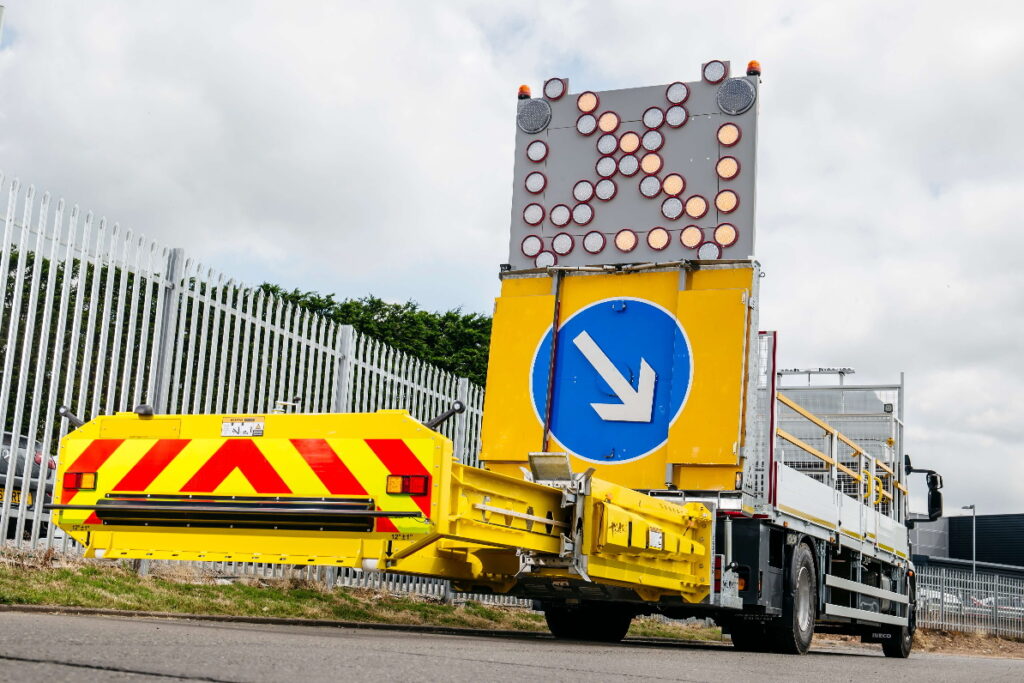
In most cases, yes, you do need a special license to tow a trailer truck mounted attenuator. Whether a standard category B driving license is enough depends on the combined weight of the towing vehicle and the trailer. If that combined weight exceeds 3,500 kg, which is common with trailer TMAs, you will need at minimum a BE license. Below, we answer the most common questions about licensing, weight limits, and road requirements for trailer TMAs.
What type of vehicle is typically used to tow a trailer TMA?
A trailer truck mounted attenuator is most commonly towed by a pickup truck, light commercial vehicle, or a dedicated work zone truck. The towing vehicle must have a tow hitch rated for the trailer’s weight and be powerful enough to handle the combined load safely in active traffic environments. In road construction and maintenance settings, contractors often use vehicles already present on site.
The choice of towing vehicle matters for more than just power. It also determines which driving license category applies to the driver. A heavier towing vehicle combined with a heavier trailer quickly pushes the combination above the 3,500 kg threshold that separates category B from category BE. If you are planning to deploy a trailer TMA, the vehicle you choose to tow it with directly affects your licensing requirements.
What license do you need to tow a trailer in the Netherlands?
In the Netherlands, the license you need to tow a trailer depends on the combined maximum authorized mass (MAM) of the towing vehicle and the trailer. A standard category B license allows you to tow a trailer up to 750 kg MAM without restriction. If the trailer exceeds 750 kg MAM, the combined total of both vehicle and trailer must not exceed 3,500 kg to stay within category B. Above 3,500 kg combined, you need a category BE license.
These rules follow EU driving license regulations, which the Netherlands applies directly. The BE license is an extension of the standard B license and requires a separate practical test. It does not require a full truck license (C or CE), which makes it a realistic qualification for most road workers and contractors who regularly tow equipment trailers.
How heavy is a trailer truck mounted attenuator?
A trailer TMA typically has a maximum authorized mass (MAM) between 1,500 kg and 3,500 kg, depending on its design, materials, and any additional equipment fitted to it. Units equipped with LED arrow boards, variable message signs, or hydraulic lift masts will weigh more than a bare-frame attenuator. The exact weight varies by model and configuration.
When you add the weight of the towing vehicle, which for a typical pickup or light commercial vehicle sits between 2,000 kg and 3,500 kg MAM, the combined total almost always exceeds 3,500 kg. This means that for the vast majority of trailer TMA deployments, a category B license alone is not sufficient.
Does a trailer TMA require a BE license or is category B enough?
For most trailer TMA configurations, a BE license is required. Because trailer TMAs regularly exceed 750 kg MAM and the combined weight of the towing vehicle and trailer typically exceeds 3,500 kg, the conditions for a category B license are not met. A BE license is the minimum requirement in these situations.
There is one narrow exception: if you are using an unusually light towing vehicle and a very basic trailer TMA configuration where the combined MAM stays below 3,500 kg, a category B license may technically suffice. However, this is the exception rather than the rule in professional work zone deployments. If you are unsure about your specific combination, always verify the MAM values on both the vehicle registration document and the trailer’s technical documentation before putting a driver behind the wheel.
Are there additional certifications needed to operate a TMA on public roads?
Beyond the driving license, operating a truck mounted attenuator on public roads in the Netherlands typically requires compliance with work zone regulations set by the road authority responsible for that road. This includes following guidelines from CROW (the Dutch knowledge platform for infrastructure), which sets out how safety equipment must be deployed in traffic management scenarios.
Depending on the type of road and the nature of the work, the operator or contractor may also need:
- A valid traffic management plan approved by the relevant road authority
- Proof that the TMA meets applicable crash test standards such as NCHRP-350 TL-3 or MASH 2016
- Trained personnel who understand the correct deployment and positioning of the attenuator
- In some cases, a permit or notification submitted to the road authority before work begins
The TMA itself must be certified to the appropriate crash test standard for the road type and speed environment where it will be used. Using an uncertified or incorrectly rated attenuator not only creates legal liability but also puts road workers and drivers at serious risk. Always verify that your equipment carries the correct approval documentation before deployment.
How Verdegro Helps with Trailer TMA Compliance
We manufacture a range of truck mounted attenuators that are tested and approved to both NCHRP-350 TL-3 and MASH 2016 standards, including trailer-mounted configurations. Our systems are designed to meet the technical requirements that road authorities and contractors need when deploying crash protection in active work zones.
When you work with us, you get more than just the hardware. Here is what we provide to support compliant deployment:
- Certified crash test documentation for each TMA model, so you can demonstrate compliance to road authorities and clients
- Technical specifications including exact MAM values, helping you determine the correct license category for your towing combination
- Optional accessories such as LED arrow boards, full-color VMS displays, and hydraulic LED lift masts, all integrated into the TMA system
- Support for international deployments, with products designed to meet compliance requirements across multiple markets
If you are unsure which TMA configuration is right for your vehicle, your license category, or your specific road authority requirements, contact us directly and we will help you find the right solution.
Related Articles
- How is a truck mounted attenuator tested before it's approved?
- Is a trailer truck mounted attenuator safer than a truck mounted attenuator?
- What is the difference between a 70K and 100K truck mounted attenuator?
- What are the advantages of a trailer-mounted attenuator?
- Should you choose a truck-mounted or trailer-mounted attenuator?