
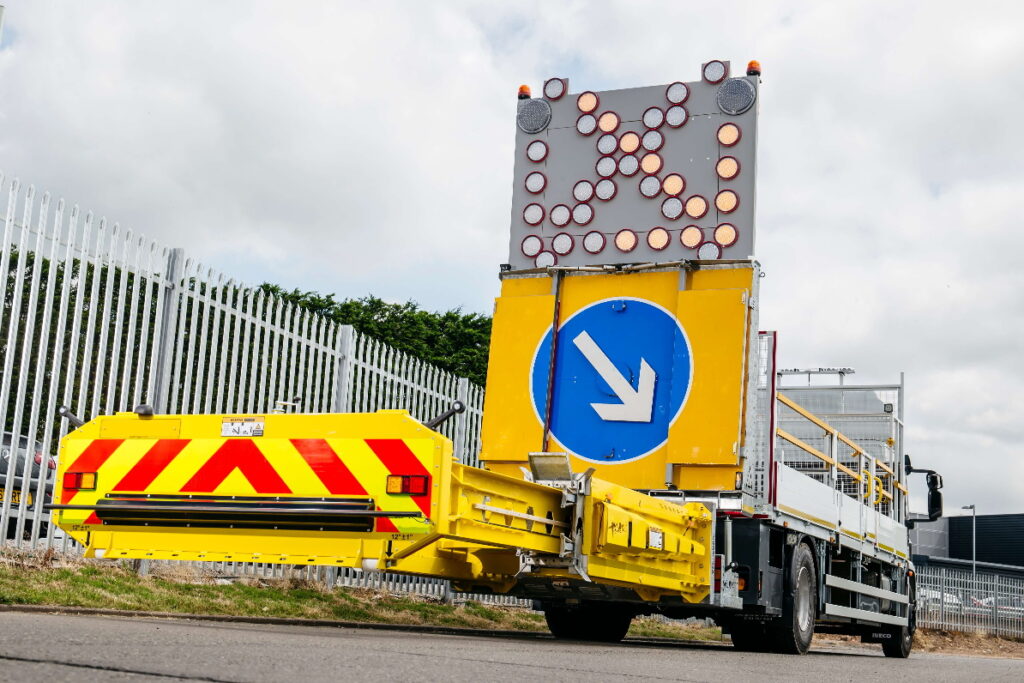
Truck mounted attenuator models differ in crash performance based on their test level rating, design type (redirective vs. non-redirective), and mounting configuration. A TMA rated to MASH Test Level 3 absorbs significantly more impact energy than one rated to TL-2, and a redirective design keeps an errant vehicle on a controlled path while a non-redirective design does not. The sections below unpack each of these differences in practical terms so you can match the right TMA to your specific work zone conditions.
What crash test standards do truck mounted attenuators have to meet?
Truck mounted attenuators must meet standardized crash test protocols that define how they perform under controlled impact conditions. In the United States, the two main standards are NCHRP Report 350 and the newer MASH 2016 (Manual for Assessing Safety Hardware). MASH 2016 is the current benchmark, and the Federal Highway Administration (FHWA) now requires new TMA installations on federally funded projects to have MASH acceptance.
MASH testing evaluates how a TMA responds to vehicle impacts at defined speeds and angles. It measures occupant risk values, post-impact vehicle behavior, and the structural integrity of the attenuator system. A TMA that passes MASH testing receives an FHWA acceptance letter, which serves as documented proof of compliance.
Outside the United States, equivalent standards apply in European and other international markets, though specific requirements vary by country. If you operate across multiple markets, verifying which standard applies in each jurisdiction before procuring equipment is important. Working with a manufacturer that holds acceptance letters under the most current standards removes a significant compliance burden from your procurement process.
How does test level rating affect TMA crash performance?
Test level (TL) rating directly determines the maximum impact speed and vehicle mass a TMA is certified to withstand. Under MASH, TL-2 covers impact speeds up to 70 km/h (44 mph), while TL-3 covers impacts up to 100 km/h (62 mph). A TMA rated at TL-3 is engineered and tested to absorb significantly greater kinetic energy than a TL-2 unit.
The practical consequence is straightforward: deploying a TL-2 attenuator in a high-speed highway environment exposes your crew and the traveling public to a level of risk the equipment was never certified to handle. Test level also affects the structural mass and energy absorption mechanisms built into the system, which is why higher-rated TMAs are generally heavier and require a host vehicle with a higher gross vehicle weight rating (GVWR).
Choosing the correct test level is not simply a regulatory formality. It is a direct engineering decision that determines whether the attenuator can actually do its job when an impact occurs at the speeds present in your work zone.
What’s the difference between redirective and non-redirective TMA designs?
A redirective TMA guides an impacting vehicle along a controlled trajectory away from the work zone after absorbing the collision energy, while a non-redirective TMA absorbs impact without controlling the vehicle’s post-impact path. This distinction has significant safety implications for workers positioned alongside or ahead of the truck.
In a redirective design, the attenuator’s geometry and structural response work together to steer the errant vehicle to one side. This reduces the chance of the impacting vehicle penetrating the work zone or striking personnel. Non-redirective designs focus primarily on energy absorption and deceleration, which is effective at reducing occupant injury risk but does not control where the vehicle ends up after impact.
For high-traffic or high-speed environments where lateral containment matters, a redirective system provides an additional layer of protection. For lower-speed applications where the primary concern is decelerating the impacting vehicle, a non-redirective design may be sufficient and more cost-effective. Understanding this distinction helps you evaluate TMA specifications beyond the test level rating alone.
Which TMA model is right for high-speed highway work zones?
For high-speed highway work zones, you need a TMA rated to MASH TL-3 that is tested and accepted under the current MASH 2016 standard. This ensures the system is certified to handle impacts at highway speeds of up to 100 km/h. A redirective design is strongly preferable in these environments because it adds post-impact vehicle control in addition to energy absorption.
Beyond the test level, consider the weight class of the TMA. Heavier attenuator systems generally offer more robust energy absorption, but they also require a host vehicle with sufficient GVWR to remain stable during an impact. Matching the TMA’s rated weight class to your truck’s capacity is a non-negotiable part of the selection process.
You should also factor in operational requirements specific to highway work: arrow board integration, visibility, and the ability to deploy quickly in live traffic conditions. A TMA that combines certified crash performance with integrated LED arrow boards and hydraulic lift masts gives your crew both protection and the signaling capability needed to manage traffic flow safely.
How do mounting configuration and host vehicle affect crash performance?
Mounting configuration and host vehicle weight directly influence how effectively a TMA performs in a crash. The attenuator transfers impact forces through its mounting interface into the host vehicle, which acts as an anchor mass. If the host vehicle is too light or the mounting is not rated for the attenuator’s impact class, the system cannot perform as tested.
Most TMA manufacturers specify a minimum host vehicle weight, often expressed as a minimum GVWR. For example, a TMA tested with a 100,000 lb (approximately 45,000 kg) host vehicle configuration will not replicate that crash performance when mounted on a significantly lighter truck. Deviating from the tested configuration can invalidate the acceptance and compromise real-world performance.
Mounting geometry also matters. The height, angle, and rigidity of the mounting frame affect how impact energy is transmitted and absorbed. A properly engineered mounting system keeps the attenuator aligned during impact and prevents the host vehicle from becoming a secondary hazard. Always verify that the mounting hardware and host vehicle combination match the tested configuration documented in the manufacturer’s FHWA acceptance letter.
How Verdegro Helps with Truck Mounted Attenuator Selection
We manufacture a range of truck mounted attenuator systems built and tested to meet current international crash safety standards, including NCHRP-350 TL-3 and MASH 2016. Our product line includes the TMA-US 100K, TTMA-US 100K, LTMA-US 70K, and BLADE TMA, each designed for specific host vehicle configurations and work zone requirements. Here is how our range addresses the key selection factors covered in this article:
- Standards compliance: All our TMA models hold FHWA acceptance letters under MASH 2016, the most current standard, so you can deploy with confidence on federally funded projects.
- Test level options: Our range covers both TL-3 highway-rated systems and lighter-duty configurations, giving you the right crash performance for the speed environment you are working in.
- Host vehicle compatibility: Each model is matched to a defined host vehicle weight class, from the 70K to the 100K range, so you can align attenuator selection with your existing fleet.
- Integrated accessories: Our TMAs are available with LED arrow boards, full-color VMS displays, and hydraulic LED lift masts, combining certified crash protection with the traffic management tools your crew needs on site.
- Global deployment: We supply road construction contractors and traffic management operators worldwide, and our systems are designed to meet compliance requirements across multiple markets.
If you are evaluating which TMA model fits your work zone conditions, host vehicle, and compliance requirements, contact us and we will help you identify the right solution.
Related Articles
- What is the role of an impact protection vehicle in temporary traffic management?
- What factors affect the price of a truck mounted attenuator?
- What happens if a vehicle crashes into a truck mounted attenuator?
- How do you choose the right truck mounted attenuator for your fleet?
- What are the advantages of a trailer-mounted attenuator?