
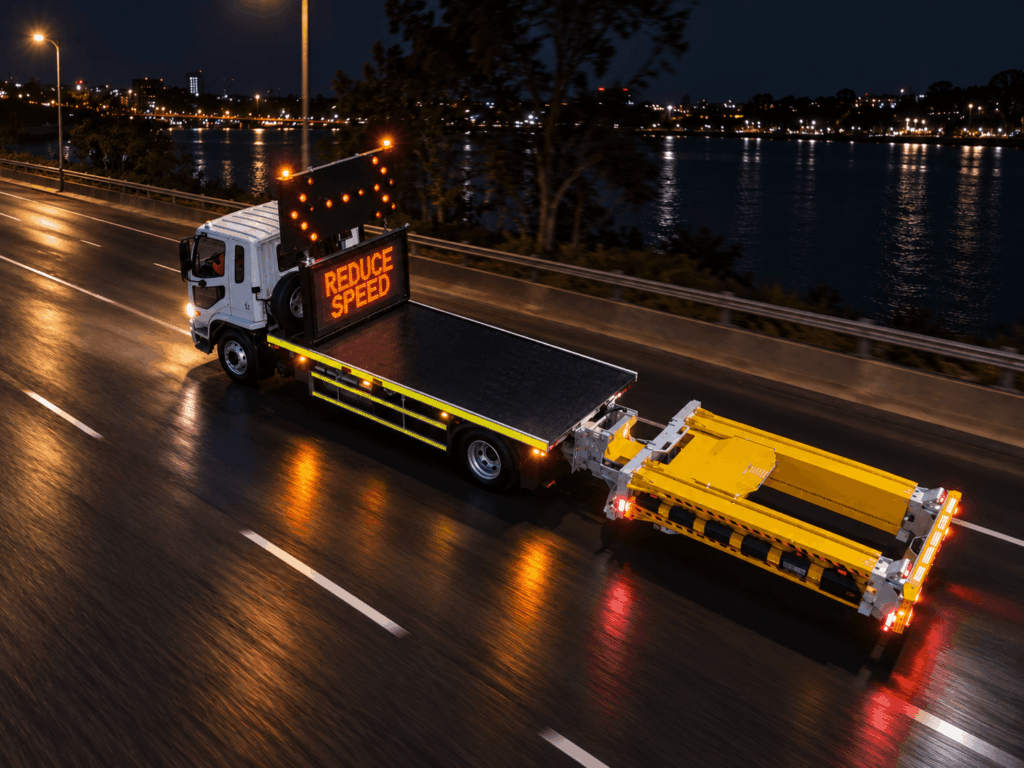
You select safety vehicles for road maintenance tasks by matching the vehicle’s protection level, size, and deployment speed to the specific hazard environment, primarily the posted speed limit, traffic volume, lane configuration, and the nature of the maintenance work being performed. A short-duration pothole repair on a low-speed urban road calls for different equipment than a multi-day highway resurfacing project. The sections below answer the most common questions road maintenance professionals ask when building out their work zone vehicle plans.
What types of safety vehicles are used in road maintenance work zones?
Road maintenance work zones typically use four main categories of safety vehicles: truck mounted attenuators (TMAs), shadow vehicles, pilot vehicles, and mobile warning units such as arrow board trucks or variable message sign (VMS) carriers. Each plays a specific role in managing traffic flow and absorbing or deflecting impact energy away from workers.
A truck mounted attenuator is a crash cushion bolted to the rear of a host truck. It absorbs the energy of an errant vehicle before it reaches workers or stationary equipment. Arrow board trucks carry directional signage and are often positioned upstream to guide traffic around the work zone. VMS trucks display real-time messages warning drivers of lane closures, reduced speed limits, or changing conditions ahead. Pilot vehicles lead traffic through narrow or complex work zones where drivers need active guidance rather than passive signage.
In many jurisdictions, a combination of these vehicles is required simultaneously. A typical highway maintenance convoy might include a TMA-equipped shadow vehicle at the rear, an arrow board truck upstream, and one or more VMS units placed at advisory distances well ahead of the taper.
How does the type of road maintenance task affect vehicle selection?
The type of maintenance task directly determines which safety vehicles you need because different tasks create different exposure durations, work zone geometries, and hazard levels. Short-duration mobile operations need vehicles that can move continuously, while stationary long-duration tasks require fixed protective setups with higher-rated equipment.
Consider the contrast between two common tasks. A mobile striping operation moves steadily along the road, so the TMA and arrow board must travel at or near traffic speed, deploying and retracting quickly as the crew advances. A stationary bridge deck repair, by contrast, may occupy a lane for several days, requiring a fully deployed TMA positioned at a fixed point and supplemented by upstream advance warning signs and possibly a VMS unit.
Utility work near live traffic lanes, milling operations, and guardrail replacement each present unique combinations of lane width, worker proximity to traffic, and task duration. Selecting vehicles without accounting for these variables creates gaps in protection that put both workers and road users at risk.
What’s the difference between a TMA and a shadow vehicle?
A truck mounted attenuator is the crash cushion system itself, the energy-absorbing device mounted to the rear of a truck. A shadow vehicle is the host truck that carries the TMA. The two terms are often used interchangeably in the field, but technically the shadow vehicle is the platform and the TMA is the safety system it supports.
The shadow vehicle earns its name from its role: it follows, or “shadows,” the work crew or a piece of slow-moving equipment, keeping the TMA positioned between live traffic and the workers at all times. Without the TMA, the shadow vehicle is just a truck. Without the shadow vehicle, the TMA has no mobility or positioning capability.
This distinction matters when specifying equipment. You need to evaluate both the TMA’s crash test rating and the host vehicle’s weight class to ensure compatibility. Most TMA manufacturers specify a minimum and maximum support truck weight. For example, the Armadillo TMA requires a minimum vehicle weight of 7,228 kg (15,935 lbs) and a maximum of 12,475 kg (27,502 lbs). Pairing a TMA with an incompatible truck undermines the system’s certified performance.
Which safety vehicles are required for high-speed highway maintenance?
High-speed highway maintenance, generally defined as work zones on roads with posted speeds above 70 km/h (45 mph), requires at minimum a MASH-certified truck mounted attenuator rated to Test Level 3 (TL-3), which covers impacts at 100 km/h (62 mph). Most regulatory frameworks also require upstream advance warning signage, a taper with appropriate channelizing devices, and in many cases a VMS unit.
At highway speeds, the consequences of an errant vehicle entering a work zone are severe. A TL-3 rated TMA is designed to absorb that impact and redirect the striking vehicle away from workers. Arrow boards mounted on the TMA or on a separate upstream vehicle provide directional guidance well before drivers reach the taper. For longer-duration highway projects, portable rumble strips and additional VMS units placed at extended advisory distances further reduce the risk of rear-end collisions.
Some national and regional standards also require that the TMA has passed specific optional crash tests. In the UK, for instance, the optional 110K test under TD49/07 is relevant for higher-speed environments. Always verify which specific certifications apply in your jurisdiction before deploying equipment on a high-speed corridor.
How do speed limits and traffic volume influence work zone vehicle requirements?
Speed limits determine the crash energy your safety vehicles must absorb, while traffic volume determines the frequency of exposure and the complexity of traffic management needed. Together, they set the baseline for how much equipment you need and how capable that equipment must be.
Higher posted speeds require TMAs certified to higher test levels. A TL-2 attenuator rated for 70 km/h (45 mph) is not adequate on a 110 km/h motorway. Traffic volume adds another layer: a high-volume road increases the statistical likelihood of a distracted or impaired driver entering the work zone, which strengthens the case for redundant upstream warning systems such as multiple VMS units or active speed enforcement.
- Low-speed, low-volume roads: Shadow vehicle with a van-mounted or lighter TMA, basic arrow board, and advance signage
- Medium-speed arterials: TL-2 or TL-3 certified TMA, arrow board truck, and at least one VMS unit upstream
- High-speed highways: MASH TL-3 certified TMA, full advance warning array, VMS units at advisory distances, and in some cases a second attenuator-equipped vehicle for complex lane configurations
Traffic volume also affects how quickly you need to deploy and retract your setup. On a busy road, delays in deployment create unnecessary exposure time. This is why single-stage deployment systems that reach operational status in under 20 seconds while the vehicle is moving are particularly valuable on high-volume corridors.
What should road maintenance crews evaluate before deploying safety vehicles?
Before deploying safety vehicles, road maintenance crews should evaluate six key factors: posted speed limit, traffic volume, task duration, work zone geometry, applicable certification standards, and host vehicle compatibility. Running through these systematically ensures your setup matches the actual risk environment rather than defaulting to a one-size-fits-all approach.
Start with the posted speed limit and any temporary reduced speed in effect, this determines your minimum TMA rating. Then assess traffic volume and peak hours to understand exposure frequency. A short-duration task during off-peak hours on a medium-speed road carries a different risk profile than the same task during morning rush hour.
Work zone geometry matters because narrow lanes, curved alignments, and limited sight distances all affect where you position upstream warning equipment and how much advance warning distance you need. Check the host vehicle’s weight against the TMA manufacturer’s specifications before every deployment, not just at initial setup. Personnel changes, vehicle swaps, or equipment modifications can inadvertently create incompatible pairings.
Finally, confirm that your TMA holds the correct certifications for the country or jurisdiction where you are working. MASH 2016 is the current standard in the United States, while European and UK markets may have additional or different requirements. Deploying uncertified equipment in a jurisdiction that mandates specific standards creates both legal exposure and genuine safety gaps.
How We Help You Select and Deploy the Right Safety Vehicles
At Verdegro, we design and manufacture truck mounted attenuators and work zone safety systems built for real operating conditions, not just laboratory tests. Our product range gives you options that match different task types, speed environments, and host vehicle classes.
- Armadillo TMA (MASH 2016 TL-3): Our newest truck mounted attenuator, fully tested and approved at 100 km/h (62 mph). It deploys in a single stage in under 20 seconds while driving at 80 km/h, making it suited for both mobile operations and stationary highway work zones. Its compact 2,300 mm width allows it to operate in narrow lanes without unnecessary overhang.
- VanGuard TMA: The world’s first TMA designed for closed vans, available in rear-mounted, top-mounted, and swing-mounted variants. It is a practical choice for medium-speed environments where a full flatbed truck is not required or available.
- Mobitrack integration: Our Mobitrack system provides real-time GPS tracking and integrates with safety alert platforms including Waze, Google, and national traffic control systems, so drivers approaching your work zone receive active warnings, not just passive signage.
Choosing the right crash safety system starts with understanding your specific work zone conditions. If you want to discuss which TMA or safety vehicle configuration fits your maintenance operations, contact our team and we will help you work through the selection criteria for your specific project.
Related Articles
- How are road workers protected when closing a traffic lane?
- What is an arrow board add-on for a truck mounted attenuator?
- What makes one truck mounted attenuator model better suited to your project?
- What is the difference between the Blade and Armadillo truck mounted attenuator?
- Is NCHRP-350 still valid or has it been replaced by MASH for truck mounted attenuators?