
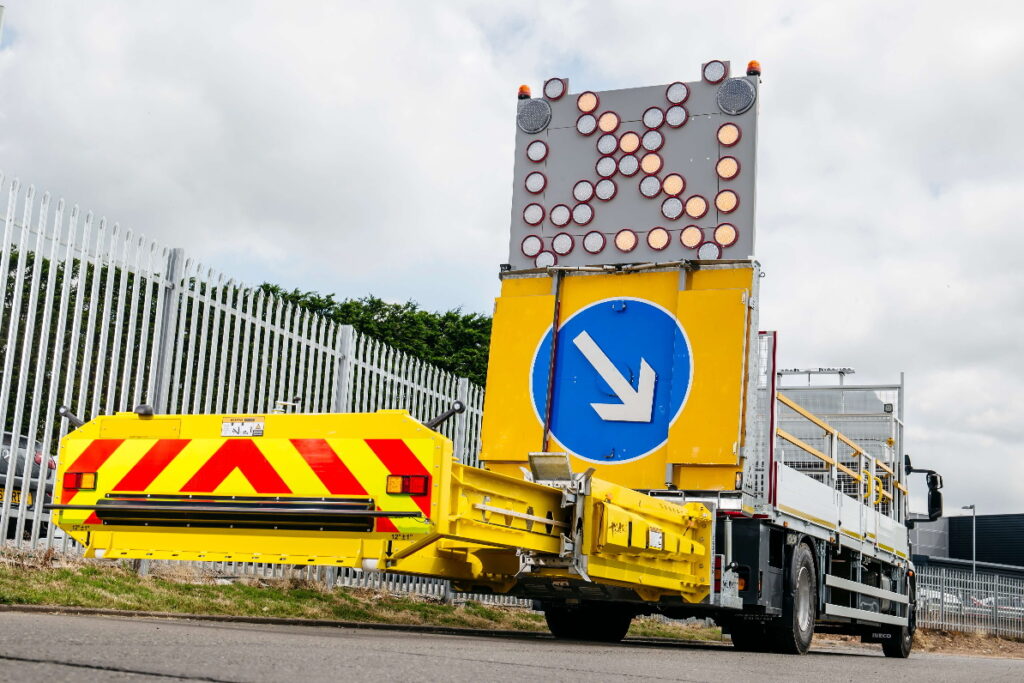
A truck mounted attenuator works by absorbing and redirecting the kinetic energy of an errant vehicle before it reaches workers or equipment in a work zone. The attenuator mounts to the rear of a host truck and acts as a sacrificial buffer, collapsing in a controlled way on impact to slow the striking vehicle and reduce the severity of the crash. The sections below answer the most common questions about how these systems function, what they are made of, and when you should use one.
What happens when a vehicle hits a truck mounted attenuator?
When a vehicle strikes a truck mounted attenuator, the system absorbs the impact energy through controlled deformation of its cartridge or cushion structure. This process slows the striking vehicle progressively, reducing the force transmitted to the host truck and preventing the errant vehicle from penetrating the work zone. The host truck is pushed forward, but the attenuator takes the primary force of the collision.
The physics behind this are straightforward. A vehicle traveling at highway speed carries significant kinetic energy. A TMA is engineered to dissipate that energy over a longer stopping distance than a rigid barrier would allow. Rather than a sudden, violent stop, the crash becomes a controlled deceleration. This dramatically reduces the risk of fatal injury to the vehicle occupants and eliminates the risk of the striking vehicle being redirected into workers or other traffic lanes.
The host truck itself is typically a heavy vehicle, which adds mass to the system and limits how far it moves forward during impact. Some TMA designs also include a decoupling mechanism that separates the attenuator from the truck after a severe hit, protecting the truck’s chassis and making the system easier to reset.
What are the main components of a truck mounted attenuator?
A truck mounted attenuator consists of three main components: the impact-absorbing cartridge or cushion, the mounting frame, and the attachment hardware that connects the system to the host truck’s hitch or rear frame. Together, these components form a crash protection system that can be fitted to standard work trucks used in road construction and maintenance.
The impact cartridge is the core of the system. It contains the energy-absorbing material, which may be aluminum honeycomb, foam, or a hydraulic mechanism depending on the design. The mounting frame holds the cartridge at the correct height and angle behind the truck, and it is engineered to transfer forces safely during a crash. Attachment hardware must be rated to handle the loads generated on impact without failing prematurely.
Many modern attenuators also integrate optional accessories directly into the system. Arrow boards, variable message signs, and hydraulic LED-lift masts can all be mounted to the TMA frame, turning the host truck into a fully equipped work zone warning vehicle without requiring separate trailer equipment.
What is the difference between a TMA and a crash cushion?
A truck mounted attenuator is a mobile crash protection device attached to a moving vehicle, while a crash cushion is a fixed or semi-permanent barrier installed at a specific hazard location such as a bridge pier or gore area. The key distinction is mobility: a TMA travels with the work crew and protects a moving work zone, whereas a crash cushion protects a stationary hazard.
Both systems absorb impact energy through controlled deformation, and both are tested to similar crash safety standards. However, a crash cushion is designed to be reset or replaced at a fixed location after a hit, while a TMA is designed to be quickly reset and returned to service in the field. This makes TMAs the preferred solution for mobile work zone protection where the hazard location changes throughout the day.
Another practical difference is the host vehicle. A TMA requires a truck to function, which means the protection moves wherever the truck moves. A crash cushion is self-contained and does not depend on a vehicle. For long-term fixed installations, crash cushions are typically more cost-effective. For active road construction and maintenance operations, a TMA offers flexibility that a fixed cushion cannot match.
What safety standards must a truck mounted attenuator meet?
In the United States, truck mounted attenuators must meet either NCHRP 350 or the more current MASH 2016 (Manual for Assessing Safety Hardware) standard. MASH 2016 is now the accepted benchmark for new product approvals, and the FHWA issues acceptance letters to manufacturers whose systems pass the required crash tests at specified test levels.
The most common test level for highway work zones is Test Level 3 (TL-3), which simulates a passenger car and a pickup truck striking the attenuator at 100 km/h (62 mph). Products must demonstrate that the striking vehicle is controlled within defined exit box boundaries and that occupant risk values remain within acceptable limits.
In other markets, equivalent national or regional standards apply. European road authorities, for example, may reference EN standards or require specific national approvals. Regardless of the market, the principle is the same: independent crash testing must verify that the system performs as designed before it can be used on public roads.
When should a work zone use a truck mounted attenuator?
A work zone should use a truck mounted attenuator whenever workers are exposed to live traffic and a fixed barrier is not practical. This includes mobile operations such as pavement marking, line striping, pothole repair, and lane closures where the work crew advances along the road throughout the shift. In these situations, a TMA-equipped shadow truck provides a moving buffer between traffic and workers.
The decision to deploy a TMA is typically guided by traffic management plans, national work zone safety regulations, and the speed and volume of passing traffic. At speeds above 50 km/h (31 mph), the risk to workers increases significantly, and a TMA becomes a standard requirement rather than an optional precaution in most jurisdictions.
Even in lower-speed environments, a TMA adds meaningful protection. Urban maintenance crews working on busy city streets benefit from the same energy-absorbing principle, even if the impact forces involved are lower than on a motorway. When you are planning a work zone, the question is not whether a TMA is necessary, but which system matches the speed, traffic volume, and duration of your operation.
How is a truck mounted attenuator reset after an impact?
After an impact, a truck mounted attenuator is reset by replacing the damaged energy-absorbing cartridge or cushion element. Most modern TMA designs are built for rapid field replacement, allowing a trained crew to swap out the impact cartridge and return the system to service without removing the entire mounting frame from the truck.
The reset process typically involves the following steps:
- Inspect the mounting frame and attachment hardware for structural damage before attempting any reset.
- Detach the damaged cartridge from the frame according to the manufacturer’s instructions.
- Install the replacement cartridge and verify that all connections are secure and torqued to specification.
- Check that any integrated accessories such as arrow boards or lights are still functioning correctly.
- Document the impact event and replacement for maintenance records and compliance purposes.
Some TMA systems use a decoupling mechanism that separates the attenuator body from the truck on impact. This protects the truck’s hitch and rear frame from damage and simplifies the reset process. Always follow the manufacturer’s specific reset procedure, as the steps vary between product models and any deviation can affect the system’s certified performance in a subsequent impact.
How Verdegro Supports Your Work Zone Protection
We manufacture a range of truck mounted attenuators designed for road construction contractors and traffic management operators who need certified, durable crash protection. Our TMA lineup includes:
- TMA-US 100K and TTMA-US 100K for standard and tandem configurations, both tested and approved to MASH 2016.
- LTMA-US 70K for lighter host vehicles requiring a lower gross vehicle weight rating.
- BLADE TMA, approved to NCHRP 350 TL-3, offering a compact and field-proven option for contractors operating under that standard.
All our systems are available with optional accessories including LED arrow boards, full-color VMS displays, and hydraulic LED-lift masts, so your shadow truck can serve as a complete work zone warning platform. We hold multiple FHWA acceptance letters under MASH 2016, which means you can deploy our systems with confidence on federally funded projects in the United States.
If you are selecting a TMA for an upcoming project or want to understand which system fits your host vehicle and traffic conditions, contact us directly and we will help you find the right solution.