
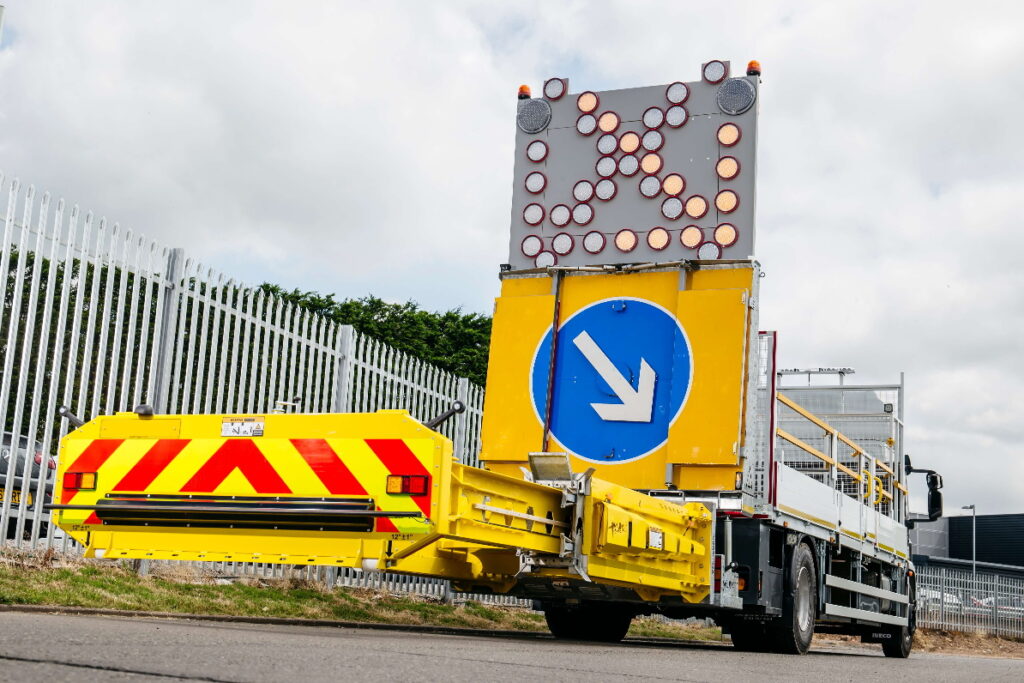
Truck mounted attenuators are hit by errant vehicles more often than most people outside the industry realize. Industry experience and incident data consistently show that work zones are among the most dangerous environments on public roads, and TMAs absorb impacts on a regular basis; in some high-traffic deployments, a single unit may be struck multiple times over its service life. The sections below unpack the conditions, causes, and consequences behind those collisions.
How dangerous are work zones for TMA-equipped vehicles?
Work zones are significantly more dangerous than standard road environments. Shadow vehicles equipped with truck mounted attenuators operate at the rear of moving or stationary work convoys, placing them directly in the path of distracted, speeding, or impaired drivers. Government road safety data from multiple countries consistently identify work zones as high-risk collision zones, with rear-end impacts being among the most common crash types.
The danger is compounded by the nature of work zone traffic. Drivers often encounter unexpected speed reductions, lane shifts, and narrow corridors with little warning. At highway speeds, the margin for error is extremely small. TMA-equipped vehicles exist precisely because these conditions make rear-end collisions not just possible, but statistically predictable over enough miles and hours of operation.
For road construction contractors and traffic management operators, this is not a theoretical risk. It is a routine operational reality that shapes equipment decisions, crew positioning, and deployment protocols on every project.
What happens to a truck mounted attenuator when it gets hit?
When a vehicle strikes a truck mounted attenuator, the TMA absorbs and redirects the kinetic energy of the impact through a controlled deformation process. The attenuator’s crash cushion collapses progressively, slowing the impacting vehicle and preventing it from penetrating the work zone or reaching workers ahead. The host truck may be pushed forward, but the TMA decouples or cushions the force transmitted to the cab and crew.
The specific outcome depends on the impact speed, angle, and the TMA’s test rating. A unit tested to MASH 2016 standards is designed to handle defined impact conditions, typically a passenger vehicle striking at highway speed at a specified angle. Within those parameters, the attenuator performs its protective function while keeping the impacting vehicle contained and the host vehicle crew protected.
After a significant impact, the TMA itself is typically damaged and must be inspected before any further deployment. The structural integrity of the crash cushion is compromised once it has absorbed a major collision, and redeploying a damaged unit defeats the purpose of having one.
How often do truck mounted attenuators need to be replaced after a crash?
Whether a TMA needs full replacement or only repair after a crash depends on the severity of the impact. Minor low-speed contacts may leave the unit structurally sound after inspection and part replacement. A high-speed impact that triggers full cushion collapse will typically require the crash cartridge or the entire attenuator assembly to be replaced before the unit returns to service.
Most TMA manufacturers design their systems with this reality in mind. Replaceable crash cartridges and modular components reduce downtime by allowing operators to swap out damaged sections rather than scrapping the entire unit. That said, any TMA that has absorbed a significant impact must be formally inspected by a qualified technician before being cleared for redeployment.
Operators who run large fleets in high-volume work zones should factor replacement cycles into their total cost of ownership calculations. A TMA deployed on a busy motorway project may absorb multiple impacts over several years, and having replacement parts or backup units available is a practical necessity rather than an optional precaution.
Which road environments see the highest TMA impact rates?
High-speed, high-volume roads see the greatest number of TMA strikes. Motorways and interstate highways are consistently the most hazardous environments for work zone vehicles, combining fast-moving traffic with the sudden speed changes that work zones create. Urban arterials with mixed traffic and frequent lane changes also produce elevated incident rates, particularly during peak hours.
Several environmental factors increase impact likelihood:
- High posted speed limits – less reaction time for approaching drivers
- Poor visibility conditions – night work, rain, fog, and glare increase crash risk significantly
- Long, straight approach sections – drivers underestimate closure speed on flat, open roads
- Heavy freight corridors – large vehicles traveling at speed have far greater stopping distances
- Complex lane configurations – multi-lane closures with abrupt tapers create confusion and late braking
Night operations deserve particular attention. Research and field experience consistently show that work zone crashes occur disproportionately after dark, when driver attention drops and visibility of warning equipment depends entirely on lighting and retroreflective materials.
What causes most vehicle strikes on truck mounted attenuators?
The majority of TMA impacts are caused by driver inattention, distraction, or failure to respond to advance warning signs in time. Distracted driving, including mobile phone use, is a leading factor in work zone rear-end collisions. Speeding through or into work zones is the second most significant contributor, particularly on roads where drivers are accustomed to higher speeds and resist reducing them.
Other common causes include:
- Driver impairment from alcohol or fatigue, especially on overnight routes
- Inadequate advance warning that does not give drivers enough distance to slow down
- Sudden traffic queuing behind a slow-moving work convoy with no prior warning
- Rubbernecking at adjacent incidents, pulling driver attention away from the work zone ahead
- Aggressive lane changes that bring vehicles into the path of the shadow truck unexpectedly
Understanding these causes matters because it informs how work zones are designed. Better advance warning, higher-visibility arrow boards, and variable message signs can reduce, though not eliminate, the frequency of strikes. The TMA remains the last line of defense when those measures fail.
Does a higher-rated TMA reduce the risk of worker fatalities?
Yes, a higher-rated truck mounted attenuator directly reduces the risk of fatalities, both for workers in the work zone and for occupants of the impacting vehicle. A TMA tested and approved to a more demanding standard, such as MASH 2016, has demonstrated its ability to manage greater impact energy under controlled conditions, providing a measurable safety margin over older or lower-rated systems.
The rating reflects the speed and vehicle mass the attenuator was tested against. A unit certified under MASH 2016 has been validated against current vehicle fleet characteristics, which differ from the vehicles used in older test protocols. Deploying a MASH 2016-compliant unit means your crash protection reflects the actual vehicles on today’s roads, not those from a decade ago.
Higher-rated systems also provide better occupant ride-down performance, meaning the impacting driver decelerates more gradually, reducing injury severity. For workers ahead of the shadow truck, the benefit is even more direct: a properly functioning TMA prevents the host vehicle from being driven into the work crew, which is the scenario these devices exist to prevent.
How Verdegro Helps with Truck Mounted Attenuator Protection
We design and manufacture a full range of truck mounted attenuators built to meet the demands of real-world work zone operations. Our TMA lineup includes the TMA-US 100K, TTMA-US 100K, LTMA-US 70K, and BLADE TMA, each tested and certified to NCHRP-350 TL-3 and MASH 2016 standards, so you deploy equipment that meets the most current safety requirements.
Here is what you get when you work with us:
- MASH 2016-compliant crash protection validated against current vehicle fleet conditions
- Modular designs that simplify post-impact inspection and component replacement
- Optional LED arrow boards and full-color VMS displays to maximize advance warning and reduce strike frequency
- Hydraulic LED-lift masts for improved visibility in low-light and night operations
- Support for government and contractor procurement across international markets
If you are specifying TMAs for a new project, upgrading an existing fleet, or need guidance on which system fits your deployment environment, contact our team and we will help you find the right solution.
Related Articles
- How do you select safety vehicles for different road maintenance tasks?
- What impact protection is suitable for short-duration road maintenance?
- What is the safe following distance behind a truck mounted attenuator?
- How do truck mounted attenuator models differ in crash performance?
- What is NCHRP-350 and how does it apply to truck mounted attenuators?