
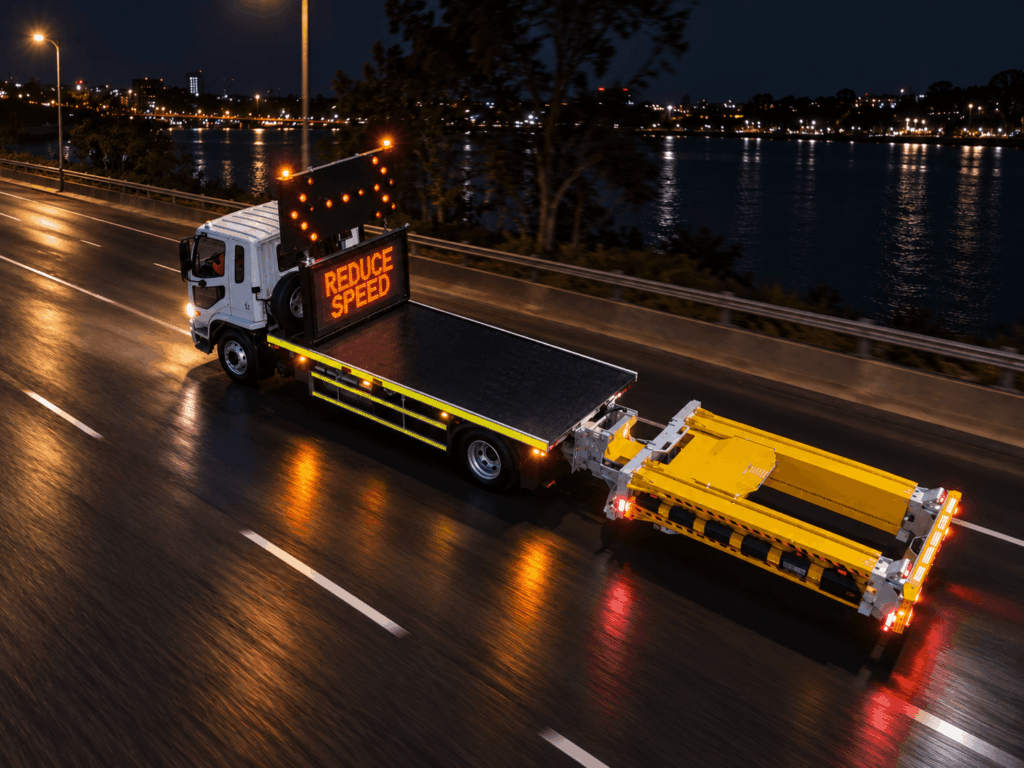
Mobile impact protection technology has advanced significantly in recent years, driven by stricter crash testing standards, lighter materials, and the integration of real-time tracking and alert systems. The shift from purely mechanical designs to smarter, connected systems means that today’s truck-mounted attenuators and crash cushions offer better protection with less complexity. This article unpacks the key developments shaping the field in 2026, from updated compliance standards to what you should look for when specifying equipment.
How has mobile impact protection technology changed in recent years?
Mobile impact protection has moved toward lighter, simpler, and more connected designs. Modern truck attenuators are built with fewer mechanical components, deploy faster, and integrate with digital tracking platforms, all while meeting more demanding crash test standards than previous generations of equipment.
A decade ago, most truck-mounted attenuators relied on multi-stage extension mechanisms, multiple motors, and sensor arrays to operate. While effective, these systems introduced more potential failure points and required more maintenance. The current generation of TMAs strips back that complexity. Engineers now achieve equivalent or superior protection using single-cushion designs, hydraulic power packs, and simplified deployment sequences that can reach operational status in under 20 seconds.
Material choices have also evolved. Galvanised steel frames, aluminium crash cushions, and sealed hydraulic housings are now standard features on high-quality systems. These choices improve durability in harsh road environments while reducing overall weight, a practical benefit when you need to stay within truck weight class limits.
Alongside mechanical improvements, connectivity has become a defining feature of modern mobile impact protection. GPS tracking, remote status monitoring, and integration with public navigation platforms have transformed how fleet operators manage their equipment in the field. Protection is no longer just a physical function, it now includes real-time data that helps you make better decisions about deployment and worker safety.
What is MASH 16 and why does it matter for crash attenuators?
MASH 16, the Manual for Assessing Safety Hardware, 2016 edition, is the current standard for crash testing road safety equipment in the United States. It defines the test conditions, vehicle types, and performance criteria that a crash attenuator must pass before it can be approved for use on public roads. For contractors and agencies, MASH 16 compliance is the benchmark that confirms a product actually performs as claimed.
MASH 16 replaced the earlier NCHRP 350 standard and introduced more realistic test conditions. The updated standard uses heavier test vehicles that better represent today’s car fleet, and it includes more stringent occupant risk criteria. A product tested under MASH 16 has been validated against conditions that more closely reflect real-world crashes.
For crash attenuators specifically, MASH 16 TL-3 is the most relevant test level for highway work zones. TL-3 testing covers impacts at 100 km/h (62 mph), which reflects the speeds commonly encountered on high-speed roads. When a truck-mounted attenuator carries a MASH 16 TL-3 approval, you know it has been subjected to full-scale crash testing at those speeds, not just modelled or estimated.
Regulatory bodies and procurement agencies increasingly require MASH 16 compliance as a condition of approval. If you are specifying equipment for government contracts or highway projects, selecting a non-compliant product carries both legal and safety risks. MASH 16 acceptance letters from the FHWA (Federal Highway Administration) are the formal documentation that confirms a product meets this standard.
What are the differences between truck-mounted attenuators and stationary crash cushions?
A truck-mounted attenuator (TMA) is a crash cushion fitted to the rear of a moving or stationary support truck, designed to protect workers in mobile or slow-moving work zones. A stationary crash cushion is a fixed installation placed in front of a hazard, such as a barrier end or a bridge pier, to redirect or absorb the energy of an errant vehicle. The core difference is mobility and deployment context.
The table below summarises the key distinctions:
| Feature | Truck-Mounted Attenuator | Stationary Crash Cushion |
|---|---|---|
| Mobility | Moves with the support truck | Fixed in position |
| Primary use case | Mobile and slow-moving work zones | Permanent or semi-permanent hazard shielding |
| Deployment speed | Operational in seconds to minutes | Requires installation time |
| Reusability after impact | Designed for field repair and reuse | Varies by system; some require full replacement |
| Typical attachment | Mounted to rear of truck via bracket | Anchored to road surface or barrier |
Truck-mounted attenuators are particularly valuable in situations where the work zone moves along the road, such as line painting, pothole repair, or pavement marking operations. The TMA travels behind the crew, absorbing any errant vehicle impact before it reaches workers. Stationary crash cushions serve a different purpose: they remain in place to protect drivers from fixed hazards that cannot be moved or relocated.
Some projects require both. A highway resurfacing project might use TMAs to protect a moving crew and stationary cushions to shield the ends of temporary concrete barriers at the work zone entry points. Understanding which type applies to your situation is the starting point for any work zone safety plan.
How do smart systems and telematics improve mobile impact protection?
Smart systems and telematics improve mobile impact protection by giving operators real-time visibility into where their equipment is, what status it is in, and whether it is functioning correctly, all without requiring a physical check. This reduces response times, supports better deployment decisions, and adds an active layer of safety for road workers.
GPS tracking is the foundation. When your truck-mounted attenuators and other safety equipment broadcast their location continuously, you can confirm that each unit is deployed where it should be. You can also review location history to understand how equipment has been used across a shift or project.
Beyond location, advanced telematics modules can report the operational status of individual components, whether an arrow board is active, whether the crash cushion is raised or lowered, and whether lights are functioning. This remote visibility reduces the need for manual checks and helps maintenance teams identify issues before they become failures in the field.
One of the most impactful developments is the integration of tracking data with public navigation and alert platforms. When a work zone vehicle is connected to systems like Waze, Google Maps, or national traffic control networks, approaching drivers receive advance warnings about nearby workers. This proactive alert function addresses one of the most persistent causes of work zone incidents: drivers who are not aware of the hazard ahead until it is too late.
What should contractors look for when selecting mobile impact protection equipment?
When selecting mobile impact protection equipment, contractors should prioritise MASH 16 compliance, mechanical simplicity, ease of deployment, and compatibility with their support vehicles. Beyond the technical specifications, consider how well the system integrates with your existing fleet and whether the manufacturer provides clear documentation and support.
Here are the key criteria to evaluate:
- Crash test certification: Confirm the product holds a current MASH 16 approval at the appropriate test level for your road environment. Ask for FHWA acceptance letters as supporting documentation.
- Vehicle compatibility: Check the minimum and maximum support truck weight requirements. A TMA that is too heavy or too light for your fleet creates both safety and compliance problems.
- Deployment time and simplicity: Systems that deploy quickly and without complex procedures reduce risk during setup. Single-stage deployment mechanisms are generally more reliable than multi-stage alternatives.
- Maintenance requirements: Fewer electronic components and sensors mean fewer failure points. A hydraulic-only system is typically easier to service in the field than one relying on multiple motors and feedback loops.
- Telematics integration: If you manage a fleet, GPS tracking and status monitoring capabilities are worth prioritising. Integration with safety alert platforms adds a measurable layer of protection for your workers.
- Accessories and customisation: Consider whether the system supports arrow boards, VMS signs, reflective chevrons, and other accessories relevant to your operations.
Weight and dimensions also matter for day-to-day practicality. A compact design that does not obstruct the truck’s flatbed in transport position gives your crew more operational flexibility, especially on projects where the support truck carries additional equipment.
How Verdegro Supports Your Mobile Impact Protection Needs
We design and manufacture truck-mounted attenuators and crash safety systems that address the practical demands of real work zones. Our product range reflects the developments covered in this article: MASH 16 compliance, mechanical simplicity, and smart connectivity built in from the start.
Our newest TMA, the Armadillo, launched in 2026, is fully tested and approved under MASH 2016 TL-3 at 100 km/h. It deploys in a single stage in under 20 seconds, operates without sensors or electronic feedback components, and weighs approximately 950 kg, making it lighter and more compact than previous-generation designs. Its patented single-cushion design eliminates extension mechanisms, reducing maintenance demands and improving reliability in demanding conditions.
For van-based operations, our VanGuard TMA is the world’s first truck-mounted attenuator designed specifically for closed vans. Available in rear-mounted, top-mounted, and swing-mounted variants, it supports speeds up to 80 km/h and keeps the van’s rear doors accessible in the top and swing configurations.
All our TMAs can be equipped with Mobitrack, our telematics module that provides:
- Real-time GPS tracking and location history
- Remote status monitoring of key system functions
- Integration with Google, Waze, Flitsmeister, Monotch, and national traffic control systems
- Automatic safety alerts to approaching drivers
We are the only manufacturer offering this breadth of integration across safety alert platforms. Combined with our Mobilityplanner web portal, you get a complete picture of your fleet’s status and location at any time.
If you are specifying equipment for an upcoming project or want to understand which system fits your support vehicles and road environment, contact us directly and we will help you find the right solution.
Related Articles
- How can a road maintenance fleet prepare for different work zones?
- What accessories improve truck mounted attenuator visibility at night?
- What should you consider before buying a truck mounted attenuator?
- What is the difference between the Blade and Armadillo truck mounted attenuator?
- What crash test levels apply to truck mounted attenuators?