
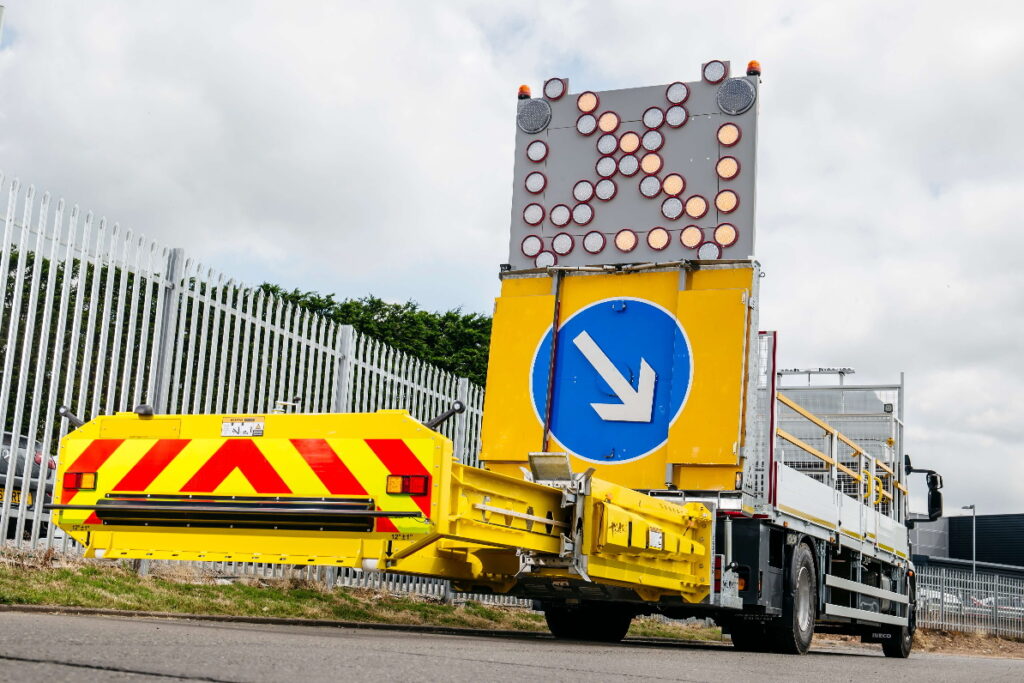
A truck-mounted attenuator (TMA) is a crash cushion device bolted to the rear of a work truck that absorbs the energy of an errant vehicle striking the back of the truck in an active work zone. It acts as a buffer between an out-of-control vehicle and the workers and equipment ahead. The sections below answer the most common questions professionals ask before specifying or deploying a TMA.
How does a truck-mounted attenuator protect workers?
A truck-mounted attenuator protects workers by absorbing and redirecting the kinetic energy of an impacting vehicle before that energy reaches the people and equipment further up the work zone. When a driver fails to slow down in time, the TMA crushes in a controlled manner, decelerating the striking vehicle gradually rather than abruptly, which dramatically reduces the forces transmitted to the host truck and the workers ahead.
The host truck, often called a shadow vehicle or attenuator truck, is positioned at the rear of the work zone specifically to take the impact. The TMA system is engineered so that the crash cushion deforms in a predictable pattern, keeping the striking vehicle from riding under the truck or deflecting dangerously into adjacent lanes. This controlled deformation is what separates a certified TMA from a simple physical barrier.
What are the main types of truck-mounted attenuators?
Truck-mounted attenuators are broadly divided into two categories: redirective and non-redirective systems. Redirective TMAs guide an impacting vehicle back toward its original travel path, which is particularly useful on narrow roads where lateral deflection could endanger other road users. Non-redirective systems absorb impact energy without actively steering the vehicle, making them suited to wider work zones with more lateral clearance.
Within those two categories, TMAs are further differentiated by the weight class of the host truck they are designed for. Lighter trailer-mounted attenuators attach to smaller vehicles, while heavy-duty systems are rated for larger trucks. The right choice depends on the host vehicle’s weight, the posted speed limit of the road, and the applicable crash test standard required in your jurisdiction.
What does MASH 16 compliance mean for a TMA?
MASH 16 refers to the Manual for Assessing Safety Hardware, 2016 edition, the most current crash-testing standard used in the United States and increasingly referenced internationally. A TMA that carries MASH 16 compliance has been physically crash-tested and accepted by the Federal Highway Administration (FHWA) under these updated protocols, which use more realistic vehicle weights and impact conditions than the older NCHRP-350 standard.
For contractors and agencies specifying work zone equipment, MASH 16 compliance is a meaningful benchmark. It tells you the system has passed standardized tests at defined impact speeds and angles, and that an independent authority has reviewed the results. Many state DOTs and highway authorities in 2026 now require MASH 16 acceptance as a condition of approval, meaning older NCHRP-350-only products may no longer qualify for certain contracts. Always verify the FHWA acceptance letter for the specific model you intend to deploy.
Where are truck-mounted attenuators required by law?
Truck-mounted attenuators are required on any shadow or protection vehicle operating in a moving or stationary work zone on high-speed roadways in jurisdictions that have adopted the Manual on Uniform Traffic Control Devices (MUTCD) or equivalent national standards. In the United States, the MUTCD mandates TMAs on protection vehicles in work zones on roads with speed limits above a defined threshold, typically 45 mph or higher, though individual state DOTs may set stricter requirements.
Outside the United States, requirements vary by country. European member states apply their own national road safety regulations, and many reference EN or ISO standards for crash cushion performance. In practice, most major highway authorities across North America, Europe, and Australia specify TMAs for any work zone where workers are exposed to live traffic at speed. Before deploying equipment, always check the specific regulations of the country, state, or province where the work is taking place.
What’s the difference between a TMA and a crash cushion?
The key distinction is mobility. A crash cushion is a fixed or semi-permanent device installed at a specific hazard point, such as the end of a barrier or a bridge pier, and stays in place for extended periods. A truck-mounted attenuator is a mobile crash cushion attached to a vehicle, allowing it to move with the work zone as it progresses along the road.
Both devices absorb impact energy through controlled deformation, and both must meet crash-test standards. However, a TMA is designed to be redeployable after a crash, either by repair or replacement of the cushion unit, and it travels with the work crew. A fixed crash cushion, once impacted, typically requires more involved repair or full replacement at a fixed location. For moving operations like highway striping, mowing, or patching crews, a TMA is the practical choice because it provides protection wherever the truck is, not just at one static point.
You can learn more about the full range of crash protection systems available for different work zone scenarios.
How is a truck-mounted attenuator installed and operated?
A truck-mounted attenuator is installed by mounting the crash cushion frame to a dedicated hitch receiver or mounting bracket at the rear of the host truck. The installation process typically involves securing the frame to the truck’s receiver, connecting any hydraulic or electrical systems for optional accessories, and verifying that the unit is level and locked before entering traffic. Most modern TMAs are designed for straightforward field installation without specialized tools.
During operation, the shadow vehicle drives at the rear of the work zone, maintaining a set following distance from the workers or equipment ahead. The driver monitors traffic approaching from behind and, on some equipped trucks, controls integrated arrow boards or variable message signs to direct road users. After an impact, the TMA must be inspected before the truck re-enters service. Depending on the severity of the strike, the cushion element may need repair or replacement before the system is certified safe to use again.
How Verdegro Helps with Truck-Mounted Attenuators
We manufacture a certified range of truck-mounted attenuators built to meet the demands of road construction contractors and traffic management operators worldwide. Our TMA lineup includes models tested and accepted under both NCHRP-350 TL-3 and MASH 2016, and we hold multiple FHWA acceptance letters under the current standard. Whether you need a system for a light support vehicle or a heavy shadow truck, we have a model rated for the right host vehicle weight.
Here is a quick overview of the systems we offer:
- TMA-US 100K – Full-size redirective attenuator for heavy host trucks, MASH 2016 accepted
- TTMA-US 100K – Trailer-mounted variant for flexible deployment configurations
- LTMA-US 70K – Lighter-duty option for mid-weight host vehicles
- BLADE TMA – Compact, low-profile design for operations requiring a smaller footprint
All systems are available with optional accessories that improve work zone visibility and communication:
- LED arrow boards for lane guidance
- Full-color variable message sign (VMS) displays
- Hydraulic LED-lift masts for elevated signaling
Every TMA we produce is backed by our Mobilityplanner platform, which gives you real-time GPS tracking, status updates, and remote control capabilities for your deployed equipment. If you want to discuss which system fits your project requirements, contact our team directly and we will help you identify the right solution.
Related Articles
- When is a light truck mounted attenuator sufficient instead of a full truck mounted attenuator?
- Can a trailer truck mounted attenuator be towed by any vehicle?
- Can you survive a crash into a truck mounted attenuator?
- What is the MASH standard for truck mounted attenuators?
- What is TL-3 in truck mounted attenuator crash testing?