
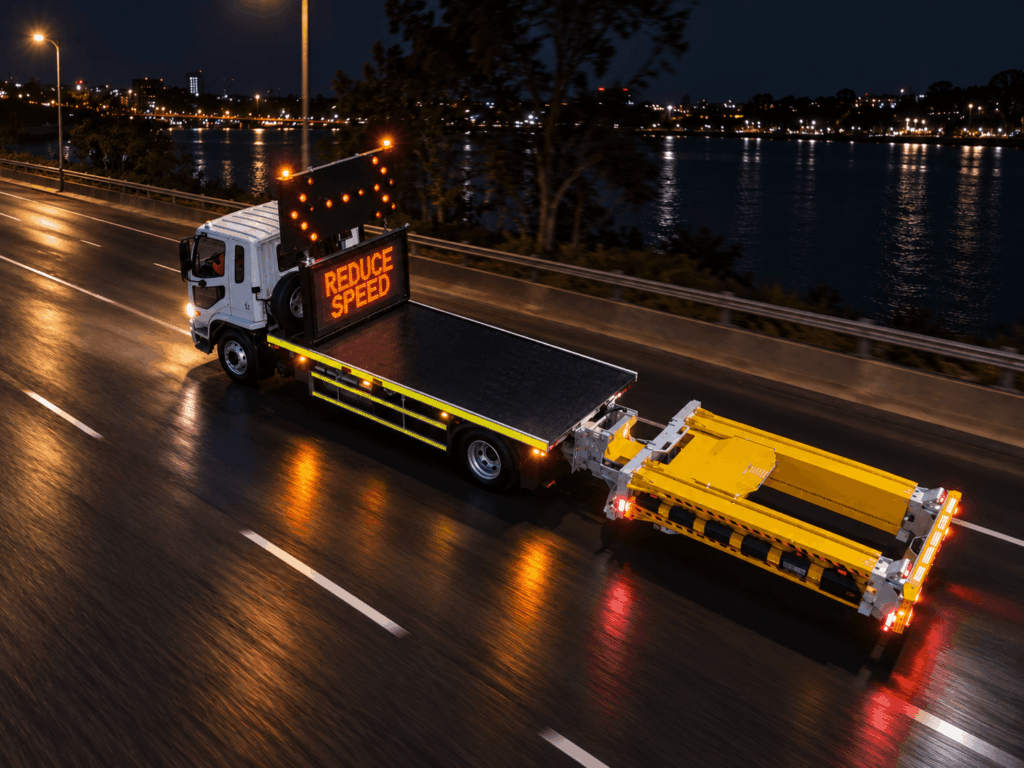
Roadwork vehicles need impact protection in the form of Truck Mounted Attenuators (TMAs), energy-absorbing crash cushions mounted to the rear of a host vehicle that absorb the force of an errant vehicle striking the work zone. The right option depends on the size and type of your vehicle, the speed environment of the work zone, and the applicable safety standards in your region. This article walks through the key questions road safety professionals ask when selecting impact protection for their fleet.
Which types of roadwork vehicles need impact protection?
Any vehicle operating in or near live traffic lanes during road maintenance, construction, or incident response needs some form of rear-end impact protection. This includes shadow vehicles, lane closure trucks, maintenance vans, and attenuator trucks that position themselves between traffic and workers. The vehicle type determines which protection system is appropriate.
In practice, roadwork vehicles fall into two broad categories when it comes to impact protection:
- Heavy trucks (7,000 kg and above): These vehicles support full-size TMAs mounted to their rear. They are typically used on motorways and high-speed dual carriageways where crash energy at impact is highest.
- Closed vans and light commercial vehicles: Vans operating in urban or lower-speed environments also require protection, but they need a system engineered specifically for their lighter structure and smaller dimensions.
Shadow vehicles, those that trail behind a mobile work convoy to shield workers from rear-end collisions, are among the highest-risk vehicles on any road project. Equipping them with a certified attenuator is not just a best practice; in many jurisdictions it is a legal requirement for work zones on public roads.
What is a Truck Mounted Attenuator and how does it work?
A Truck Mounted Attenuator (TMA) is a crash cushion bolted to the rear of a host vehicle that absorbs and redirects the kinetic energy of an impacting vehicle. When a car or light truck strikes the attenuator at speed, the cushion deforms in a controlled way, decelerating the impacting vehicle gradually and reducing the severity of injury to its occupants. The host truck acts as a stable anchor, and the attenuator absorbs the crash energy rather than transferring it directly to the workers ahead.
Modern TMAs use a hydraulic deployment system that allows the operator to raise and lower the cushion from inside the cab. Deployment happens quickly: advanced systems like the Armadillo TMA deploy in a single continuous motion in under 20 seconds while the vehicle is moving at up to 80 km/h. This speed of deployment is important during mobile operations where the work zone is constantly advancing.
The cushion itself is typically made from aluminium and is designed to crumple and absorb energy on impact. After a crash, the deformed cushion element is replaced, and the structural frame of the attenuator remains intact for continued use. This replaceability keeps long-term operating costs manageable compared to replacing an entire system after each incident.
How does a TMA differ from a fixed crash cushion?
A TMA is a mobile impact protection system mounted to a vehicle and repositioned as the work zone moves, whereas a fixed crash cushion is a permanent or semi-permanent installation anchored to infrastructure, typically placed in front of hazards like gore points, bridge piers, or median barriers. The core difference is mobility: a TMA travels with the work crew, while a fixed cushion stays in one location.
This distinction has practical consequences for how each system is tested and certified. Fixed cushions are evaluated against static installation criteria, while TMAs must pass dynamic crash tests that account for the movement of the host vehicle during and after impact. The roll-ahead distance, how far the host truck travels forward after absorbing a crash, is a key performance metric for TMAs and is not relevant to fixed installations.
The table below summarises the main differences:
- Mobility: TMA moves with the vehicle; fixed cushion stays in place
- Use case: TMA protects mobile work zones; fixed cushion protects static hazards
- Deployment: TMA deploys and retracts hydraulically in seconds; fixed cushion is installed once
- Testing standard: TMA tested under MASH TL-3 dynamic criteria; fixed cushion tested under separate static criteria
- Replacement after impact: TMA cushion element is replaced; fixed cushion may require full reinstallation
For road crews that move along a route, resurfacing teams, line-marking crews, or inspection vehicles, a TMA is the appropriate choice because it provides continuous protection without requiring setup and teardown at each new position.
What safety standards govern impact protection for work zone vehicles?
The primary standard governing TMA performance in North America is MASH 2016 (Manual for Assessing Safety Hardware), which replaced the earlier NCHRP 350 standard. MASH defines test levels based on impact speed and vehicle weight, with Test Level 3 (TL-3) being the benchmark for high-speed motorway applications, covering impacts at 100 km/h (62 mph). In the United Kingdom, the equivalent benchmark is the optional 110K test under TD49/07, which tests performance at 110 km/h.
MASH 2016 specifies a series of individual crash tests that a TMA must pass to achieve TL-3 certification:
- Test 3-50: Pickup truck impact at 100 km/h, centred on the attenuator
- Test 3-51: Pickup truck impact at 100 km/h, offset to one side
- Test 3-52: Small car impact at 100 km/h
- Test 3-53: Additional impact scenario verifying structural integrity
- Test 3-54: Optional test covering additional impact configurations
In Europe, CE marking and EMC compliance are also required, and many national road authorities specify additional requirements on top of the base MASH standard. When evaluating any attenuator, always confirm that it carries official crash test certifications, not just manufacturer claims, and that those certifications cover the specific test level required for your operating environment.
FHWA acceptance letters are another marker of compliance in the US market. These letters confirm that the Federal Highway Administration has reviewed the crash test results and accepted the product for use on federally funded projects. Holding multiple FHWA acceptance letters under MASH 2016 TL-3 is a meaningful indicator that a product has been rigorously evaluated.
Which impact protection option is right for your roadwork operation?
The right impact protection option depends on three factors: your vehicle type, your operating speed environment, and the regulatory requirements in your region. A heavy truck operating on a motorway requires a full-size MASH TL-3-certified TMA. A van working in urban environments needs a system specifically designed and tested for lighter vehicles. Matching the attenuator to the host vehicle is not optional: an undersized or oversized system will not perform as tested.
Use the following as a guide:
- High-speed motorway operations (100 km/h+): Choose a full-size TMA certified to MASH 2016 TL-3, mounted on a heavy truck within the specified weight range. Confirm the system has passed all mandatory test scenarios (3-50 through 3-53) and carries official certifications.
- Mixed-speed or urban operations with a van: Choose a TMA specifically designed for closed vans, with the appropriate mounting configuration for your vehicle. Check that the system is certified for the impact speeds relevant to your work zone.
- Mobile convoy operations: Prioritise fast deployment times and mechanical simplicity, since the attenuator will be raised and lowered repeatedly throughout the working day.
- Operations requiring rear door access: Look for mounting variants, such as top-mounted or swing-mounted configurations, that keep the vehicle’s rear doors usable while the attenuator is in its transport position.
Beyond the hardware itself, consider whether GPS tracking and integration with driver alert systems add value for your operation. Knowing where your attenuator trucks are in real time, and automatically alerting approaching drivers through navigation platforms, adds a layer of active protection on top of the physical crash cushion.
How We Help You Choose the Right Impact Protection
We design and manufacture crash and impact protection systems for a wide range of roadwork vehicles, from heavy trucks to closed vans. Our product range includes two distinct TMA families to match different operational needs:
- Armadillo TMA: Our newest truck-mounted attenuator, introduced in 2026. Fully tested and approved to MASH 2016 TL-3 across all mandatory test scenarios (3-50, 3-51, 3-52, 3-53, and optional 3-54). Designed for heavy trucks between 7,228 kg and 12,475 kg. Single-stage deployment in under 20 seconds at 80 km/h, no sensors or electronic components, only a hydraulic power pack. Lighter, more compact, and mechanically simpler than previous generations.
- VanGuard TMA: The world’s first TMA purpose-built for closed vans, available in three configurations, rear mounted, top mounted, and swing mounted, so you can match the system to your van’s layout and keep rear doors accessible where needed. Tested to withstand impacts at up to 80 km/h.
Both systems are available with our Mobitrack GPS module, which provides real-time location tracking and integrates automatically with driver alert platforms including Waze, Google, Flitsmeister, and national traffic control systems. This means approaching drivers receive active warnings before they reach your work zone.
All our attenuators are delivered with official crash test certifications, CE marking, and EMC compliance. We hold multiple FHWA acceptance letters under MASH 2016, confirming our systems meet the most current standard in both European and North American markets.
Ready to find the right impact protection for your fleet? Contact us and we will help you match the right system to your vehicle type, speed environment, and compliance requirements.
Related Articles
- What crash protection is used on high-speed roads?
- Which countries require CEN/TS 16786-certified truck mounted attenuators?
- What is the difference between the Blade and Armadillo truck mounted attenuator?
- Is a trailer truck mounted attenuator safer than a truck mounted attenuator?
- What is the most popular truck mounted attenuator model for highway work?