
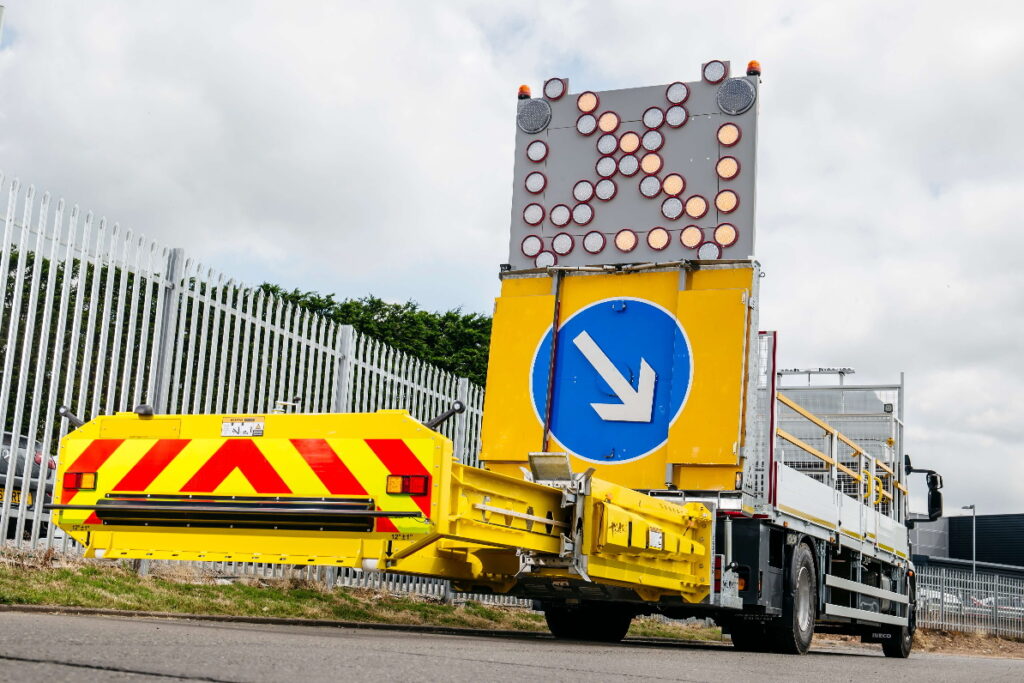
The industries that rely most on truck mounted attenuators are road construction, highway maintenance, utility services, and government transportation agencies. Any sector that places workers or vehicles in live traffic lanes needs this type of crash protection. The sections below break down exactly which industries use TMAs, how they deploy them, and what the legal requirements look like across different work zone types.
Which work zones require a truck mounted attenuator by law?
Most jurisdictions require truck mounted attenuators in any moving or stationary work zone where a shadow vehicle is positioned between live traffic and workers. In the United States, the Manual on Uniform Traffic Control Devices (MUTCD) and state-level traffic control plans typically mandate TMA use on roads with posted speeds above 45 mph, though many agencies enforce it at lower speeds as well.
The legal threshold varies by country and region, but the common trigger is worker exposure to high-speed traffic. Key situations where regulations most commonly require a TMA include:
- Moving work zones where a convoy of vehicles travels slowly along an active lane
- Stationary work zones on high-speed roads where a shadow vehicle protects a crew working ahead
- Lane closures on highways and motorways where traffic is redirected around equipment or workers
- Bridge and tunnel maintenance in confined, high-speed corridors
Compliance requirements often specify the crash test standard the TMA must meet. In the US, MASH 2016 (Manual for Assessing Safety Hardware) is now the current standard for federally funded projects. European projects follow EN standards, while other international markets reference NCHRP 350. Always verify which standard applies to your project before selecting equipment.
What types of road construction companies use TMAs?
Road construction companies that work on live roads are the largest users of truck mounted attenuators. This includes highway contractors, pavement resurfacing crews, line marking teams, and bridge construction firms. Any contractor whose scope of work requires operating within or adjacent to moving traffic lanes will typically have TMAs as part of their standard equipment fleet.
The scale of TMA use varies by project type. Large highway contractors running multi-lane closures on interstate projects may operate several TMAs simultaneously, one per active work zone. Smaller resurfacing or patching contractors working on secondary roads may operate a single unit per crew. In both cases, the TMA serves the same function: absorbing the energy of an errant vehicle before it reaches workers or stationary equipment.
Specialty road construction segments that rely heavily on TMAs include:
- Pavement marking and thermoplastic crews who travel slowly along road surfaces in live traffic
- Milling and overlay contractors operating heavy, slow-moving machinery in active lanes
- Guardrail and barrier installation teams working at the road edge with limited clearance
- Traffic signal and sign installation crews working at intersections or overhead structures
Do utility and maintenance crews need truck mounted attenuators?
Yes, utility and maintenance crews working in or near live traffic lanes need truck mounted attenuators in most regulated environments. This applies to electrical utility workers repairing overhead lines near roads, telecom crews laying fiber alongside carriageways, drainage and water main teams, and municipal street maintenance workers. The determining factor is not the industry itself but whether the work creates exposure to moving traffic.
Utility work is often less predictable than scheduled road construction. A crew responding to an emergency outage at night on a busy road may have little time to set up a full traffic management scheme. In these situations, a TMA-equipped shadow vehicle provides immediate protection while the broader work zone is established. This makes TMAs particularly valuable for reactive maintenance rather than planned projects.
Municipal maintenance departments managing tasks like pothole repair, drain cleaning, and street sweeping also operate TMAs regularly. These crews often work on roads that remain partially open, making a crash-absorbing buffer between traffic and workers a practical necessity rather than just a regulatory requirement.
How do government agencies and municipalities use TMAs?
Government agencies and municipalities use truck mounted attenuators both directly through their own maintenance fleets and indirectly by requiring contractors to deploy them under public works contracts. Transportation departments at the national, regional, and local levels typically specify TMA standards in their procurement contracts and traffic management guidelines.
At the national level, highway agencies use TMAs across motorway maintenance operations, incident management responses, and long-term construction projects. At the municipal level, city and county transportation departments deploy them for street resurfacing, utility coordination, and event-related traffic management.
Government agencies also play a regulatory role. They set the crash test standards TMAs must meet, approve or reject equipment through acceptance processes, and audit contractor compliance during inspections. In the US, FHWA acceptance letters confirm that a TMA meets the required MASH standard for use on federally funded projects, and agencies use these letters as a procurement filter.
What’s the difference between industries in how they deploy TMAs?
The key difference lies in how predictable, mobile, and large-scale the work zone is. Road construction companies tend to deploy TMAs in planned, structured work zones with full traffic management schemes. Utility and maintenance crews often deploy them reactively in smaller, shorter-duration setups. Government agencies span both approaches depending on whether they are managing planned infrastructure programs or responding to incidents.
Deployment patterns also differ by vehicle configuration and accessory needs:
- Road construction contractors often pair TMAs with arrow boards and variable message signs to manage lane changes across wide, high-speed corridors
- Utility crews typically need compact, quickly deployable units that attach to standard work trucks without requiring a dedicated fleet vehicle
- Government incident management teams frequently use TMAs integrated with lighting systems and communication equipment to manage unplanned events at night or in poor visibility
- Municipal maintenance departments often prioritize lightweight, lower-speed-rated units suited to urban road environments
The crash test standard required also differs between industries. Federally funded highway construction in the US requires MASH 2016 compliance, while some municipal or utility applications may still accept equipment tested to the older NCHRP 350 standard. Confirming the applicable standard before procurement avoids compliance issues on site.
How Verdegro Supports Your TMA Requirements
We manufacture a range of truck mounted attenuator systems designed for road construction contractors, utility operators, and government agencies across international markets. Our TMA lineup includes the TMA-US 100K, TTMA-US 100K, LTMA-US 70K, and BLADE TMA, all tested and approved to recognized crash safety standards including NCHRP 350 TL-3 and MASH 2016.
Here is what our TMA systems offer across different deployment needs:
- MASH 2016 compliance with FHWA acceptance letters, making them eligible for federally funded projects in the US
- Optional LED arrow boards for moving work zones and lane change management
- Full-color VMS displays for dynamic messaging in complex or high-speed environments
- Hydraulic LED-lift masts for improved visibility in low-light or night work conditions
- Durable construction suited to both planned construction projects and reactive maintenance deployments
Whether you are a highway contractor running a multi-lane closure, a utility crew working reactive call-outs, or a government agency specifying equipment for a public works contract, we can help you find the right system for your operational requirements and compliance obligations.
Contact us to discuss your project requirements and find out which TMA configuration is the right fit for your work zone setup.
Related Articles
- What makes one truck mounted attenuator model better suited to your project?
- What is NCHRP-350 and how does it apply to truck mounted attenuators?
- Is NCHRP-350 still valid or has it been replaced by MASH for truck mounted attenuators?
- What is a trailer truck mounted attenuator?
- What speed can you safely crash into a truck mounted attenuator at?