
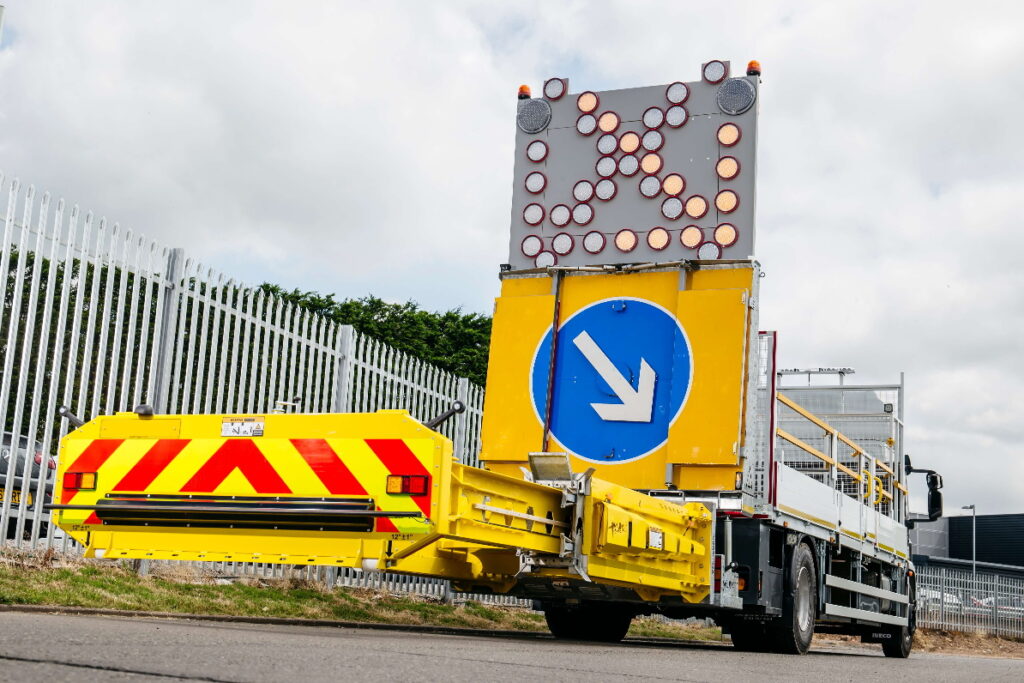
An LED-lift accessory on a truck-mounted attenuator is a hydraulic or pneumatic mast system mounted to the TMA that raises a set of LED lights to an elevated position above the work zone. This gives road workers and approaching drivers a clear, high-visibility warning signal that is visible from a much greater distance than ground-level lighting alone. Below, we answer the most common questions about how these systems work, what they require, and whether you can add one to an existing TMA.
What does an LED-lift accessory do on a TMA?
An LED-lift accessory raises a lighting unit, typically an arrow board or warning light array, to an elevated height above the host vehicle using a hydraulic or pneumatic mast. This positions the warning signal higher than cab rooflines, barriers, and passing traffic, making the work zone visible to approaching drivers from a longer distance and at a wider angle.
On a truck-mounted attenuator, the lift system serves two purposes. First, it increases the effective range of the warning signal, giving drivers more time to react and merge away from the work zone. Second, it reduces the risk of the lighting unit being obscured by the TMA host vehicle itself, by other trucks, or by roadside infrastructure such as noise barriers and gantries.
Most LED-lift systems on TMAs are designed to fold down when the vehicle is traveling between sites. This keeps the overall vehicle height within legal transport limits and protects the lighting unit from wind loading at motorway speeds. Once the vehicle is positioned in the work zone, the operator raises the mast to its working height in a matter of minutes.
What types of LED lights are used with TMA lift systems?
The most common LED light types used with TMA lift systems are arrow boards, variable message signs (VMS), and high-intensity warning beacons. Arrow boards are the most widely deployed, displaying directional arrows or chevron patterns to guide traffic away from the protected lane. Full-color VMS displays add text-based messaging for more complex traffic management instructions.
Arrow boards on lift systems typically use a matrix of high-brightness LEDs arranged in a rectangular panel. These panels are engineered to remain legible in direct sunlight, which is a real challenge for any daytime work zone application. At night, automatic dimming prevents the display from blinding approaching drivers while still maintaining the required visibility distance.
Some TMA configurations use a combination of a primary arrow board and supplementary amber beacon lights on the same mast. This layered approach ensures that even if a driver misses the directional signal, the flashing amber beacons serve as a secondary alert. The specific light types you choose will depend on the traffic management plan for your project and the regulatory requirements in your operating region.
How does an LED-lift improve work zone safety?
An LED-lift improves work zone safety by placing warning signals at a height where they are visible above other vehicles and roadside obstructions, giving drivers earlier and clearer notice that a work zone is ahead. Earlier notice translates directly into more reaction time, which reduces the frequency and severity of rear-end approaches toward the protected work area.
In motorway and high-speed road environments, vehicles travel at speeds where every extra second of warning distance matters. A light mounted at cab height may be visible for a few hundred meters. The same light elevated on a mast can be seen from significantly further back, especially in queuing traffic where heavy goods vehicles would otherwise block sightlines to a lower-mounted signal.
There is also a practical benefit for workers on foot in the work zone. An elevated arrow board is visible from inside the work zone itself, helping workers orient themselves relative to live traffic lanes. This situational awareness supports better decision-making, particularly during lane transitions or when equipment is moving within the protected space.
For crash protection systems like TMAs, the LED-lift functions as a forward-facing complement to the attenuator’s rear-impact protection. The attenuator absorbs the energy of an errant vehicle; the LED-lift works to prevent that impact from happening in the first place by maximizing driver awareness well before they reach the TMA.
What standards must a TMA LED-lift accessory meet?
A TMA LED-lift accessory must comply with the traffic safety standards applicable in your operating region. In the United States, arrow boards and warning lights used in work zones must conform to the Manual on Uniform Traffic Control Devices (MUTCD), which specifies minimum luminance, panel size, and display pattern requirements. The TMA itself must meet crash-testing standards such as MASH 2016 or NCHRP-350 TL-3.
It is important to understand that the LED-lift accessory and the TMA are evaluated as a combined system in some certification frameworks. Adding an accessory that changes the vehicle’s height, weight distribution, or rear-end geometry may affect the crash-test acceptance of the TMA. This means you should always verify that any accessory you add is either included in the original FHWA acceptance documentation for the TMA or has been separately evaluated for compatibility.
In European markets, relevant standards include national road authority specifications and CE marking requirements for electrical equipment. Requirements vary by country, so verifying compliance with the specific authority responsible for the roads where you will be operating is always the right first step.
Can an LED-lift accessory be retrofitted to an existing TMA?
Yes, an LED-lift accessory can often be retrofitted to an existing TMA, but compatibility depends on the specific TMA model, its structural mounting points, and whether the retrofit is covered by the manufacturer’s documentation. Not all TMAs are designed with accessory mounting provisions, and adding a mast system to a TMA that was not engineered for it can introduce structural and compliance risks.
Before retrofitting, you should check two things. First, confirm that the TMA manufacturer supports the accessory configuration and that the retrofit does not void any existing crash-test acceptance or compliance documentation. Second, verify that the host vehicle’s hydraulic or electrical system can support the lift mechanism, since some lift systems draw power from the vehicle’s PTO or auxiliary hydraulics.
When retrofitting is supported by the manufacturer, it is typically a straightforward installation involving a mounting frame, the mast and light unit, and the relevant hydraulic or electrical connections. A certified installer should carry out the work and provide documentation confirming the installation meets the required specifications.
How Verdegro Supports TMA LED-Lift Integration
We design and manufacture truck-mounted attenuators with optional LED-lift accessories as integrated, factory-supported configurations. Our TMA range, including the TMA-US 100K, TTMA-US 100K, LTMA-US 70K, and BLADE TMA, is tested and approved to MASH 2016 and NCHRP-350 TL-3 standards. We hold multiple FHWA acceptance letters, so you can deploy with confidence that the complete system, attenuator and accessory, meets current compliance requirements.
Here is what you get when you specify a Verdegro TMA with an LED-lift accessory:
- Integrated hydraulic LED-lift masts engineered specifically for our TMA platforms, with no guesswork around structural compatibility
- Arrow board and full-color VMS display options to match your traffic management plan requirements
- MASH 2016 compliance documentation covering the complete system configuration
- MobilityPlanner platform access for real-time GPS tracking, status monitoring, and remote control of your deployed units
- Support for retrofit configurations on compatible existing Verdegro TMA units, with full manufacturer documentation
If you are specifying a new TMA or looking to add an LED-lift to an existing unit, contact us and we will help you identify the right configuration for your project and compliance requirements.
Related Articles
- What determines which type of impact attenuator you need?
- Who is responsible for positioning a truck mounted attenuator correctly on site?
- What maintenance schedule do truck mounted attenuator manufacturers recommend?
- How often are truck mounted attenuators hit by vehicles?
- What is the difference between the Blade and Armadillo truck mounted attenuator?