
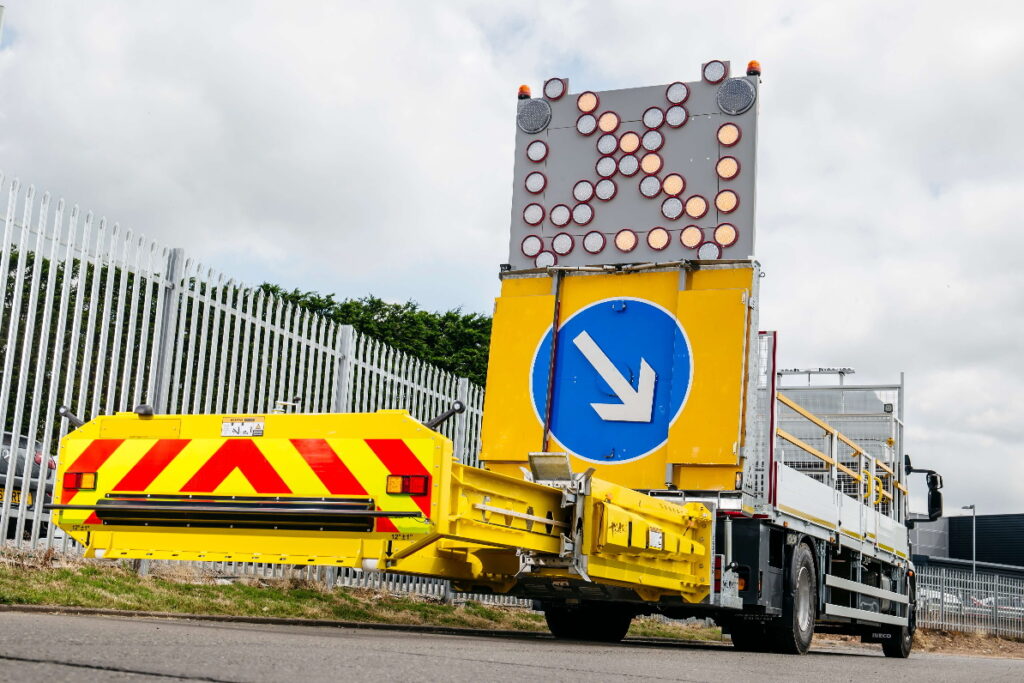
The United States is by far the biggest market for truck mounted attenuators. Strict federal work zone safety regulations, a vast highway network, and high volumes of road construction activity create consistent, large-scale demand for certified crash protection systems. Other significant markets include the United Kingdom, Australia, Germany, and the Netherlands, where comparable safety standards drive adoption. Below, we cover the key questions buyers and fleet managers ask about the global TMA market.
Which country has the highest demand for truck mounted attenuators?
The United States has the highest demand for truck mounted attenuators worldwide. The country’s extensive interstate highway system, combined with federal and state-level mandates requiring crash protection in active work zones, creates a consistent and large-scale procurement market. American road construction activity alone accounts for a significant share of global TMA deployments each year.
Several factors reinforce US dominance in this market. The Federal Highway Administration (FHWA) requires that safety equipment used on federally funded projects meets recognized crash test standards, which effectively makes TMAs a non-negotiable requirement on major road works. The sheer scale of highway maintenance contracts, infrastructure renewal programs, and municipal road projects generates ongoing demand from both contractors and government agencies.
Outside the US, the United Kingdom, Australia, and several Northern European countries, including Germany and the Netherlands, maintain strong TMA markets. These countries have adopted comparable work zone safety frameworks and operate large road maintenance programs that require certified crash attenuation equipment on a regular basis.
What regulations drive TMA adoption in major markets?
TMA adoption is primarily driven by crash test standards that define the minimum performance requirements equipment must meet before it can be deployed in work zones. In the United States, the two dominant standards are NCHRP-350 and MASH 2016 (Manual for Assessing Safety Hardware). MASH 2016 is the current benchmark, and the FHWA requires new projects to use MASH-compliant equipment.
In the UK, the BS EN 1317 standard governs road restraint systems, including crash cushions. Australia follows the NCHRP-350 framework with additional national guidelines from Austroads. European markets increasingly reference EN 1317 alongside national transport authority requirements.
What these regulations share is a common principle: equipment must demonstrate, through controlled crash testing, that it can absorb impact energy at defined speeds and vehicle weights without posing unacceptable risk to occupants or bystanders. Compliance with these standards is typically a prerequisite for government contract eligibility, which is why regulatory requirements are the single strongest driver of TMA purchasing decisions across all major markets.
Which industries use truck mounted attenuators the most?
Highway construction and road maintenance are the dominant industries using truck mounted attenuators. Any operation that places workers or equipment in live traffic lanes requires a TMA-equipped shadow vehicle to absorb potential rear-end collisions and protect the work zone behind it.
The industries with the highest TMA usage include:
- Highway construction contractors deploying TMAs on motorway widening, resurfacing, and bridge repair projects
- Road maintenance crews performing pothole repairs, line marking, and drainage works on active roads
- Municipal transportation departments managing urban road works and utility installations
- Civil engineering firms operating on large infrastructure projects such as tunnels, interchanges, and bypass construction
- Incident management operators using TMAs on response vehicles that attend breakdowns and accidents on live carriageways
- Traffic management companies providing temporary traffic control services to other contractors
Government agencies and large contractors tend to own TMA fleets outright, while smaller operators often procure equipment through hire or subcontract arrangements. Across all these sectors, the shared priority is protecting workers from the most common and serious hazard in road work environments: vehicles failing to slow down or change lanes before reaching the work zone.
How is the global TMA market expected to grow?
The global market for truck mounted attenuators is on a growth trajectory, supported by increasing infrastructure investment, tightening work zone safety regulations, and a broader international push to reduce worker fatalities on roads. As more countries update their safety standards and align with MASH or EN 1317 requirements, demand for compliant TMA systems expands beyond traditional markets.
Several factors are shaping this growth in 2026 and beyond:
- Infrastructure spending programs in the US, Europe, and Asia-Pacific are increasing the volume of active road construction projects requiring crash protection
- Regulatory updates are prompting fleet operators to replace older NCHRP-350 certified equipment with newer MASH 2016 compliant systems
- Emerging markets in Southeast Asia, the Middle East, and Latin America are introducing work zone safety legislation that creates new demand
- Technology integration is adding value to TMA systems through features like LED arrow boards, variable message signs, and remote monitoring platforms
The shift toward smarter, connected work zone equipment is also influencing purchasing decisions. Buyers increasingly look for TMAs that integrate with fleet management tools and provide real-time operational data, which raises the functional value of newer systems compared to basic mechanical units.
What factors should buyers consider when choosing a TMA?
When choosing a truck mounted attenuator, buyers should prioritize crash test certification, compatibility with their host vehicle, and the operational requirements of their specific work environment. A TMA that meets the right standard for your market, fits your truck’s weight class, and carries useful integrated features will deliver far better long-term value than a cheaper unit that compromises on any of these points.
Key factors to evaluate include:
- Certification standard: Confirm the TMA holds acceptance under the standard required in your market. In the US, MASH 2016 is the current requirement for federally funded projects. FHWA acceptance letters provide the clearest proof of compliance.
- Vehicle compatibility: TMAs are rated by vehicle weight class. Match the system to your host truck’s gross vehicle weight to ensure the crash performance data applies to your actual setup.
- Impact speed rating: Different TMA models are tested at different impact speeds. Higher-speed motorway work requires a system rated for those conditions.
- Integrated features: Arrow boards, VMS displays, and hydraulic lift masts add operational capability. Consider whether these features are available as factory-integrated options or require aftermarket fitting.
- Ease of deployment and reset: In high-turnover work zone environments, how quickly a TMA can be deployed, repositioned, and reset after a minor impact directly affects productivity.
- After-sales support and parts availability: A TMA is only effective if it can be maintained and repaired quickly. Verify that your supplier offers responsive support and stocks replacement components.
How Verdegro Helps with Truck Mounted Attenuators
We manufacture a range of truck mounted attenuator systems designed for road construction contractors and traffic management operators who need certified, durable crash protection. Our TMA lineup includes the TMA-US 100K, TTMA-US 100K, LTMA-US 70K, and BLADE TMA, all tested and approved to NCHRP-350 TL-3 and MASH 2016 standards. We hold multiple FHWA acceptance letters, which means you can deploy our systems on federally funded US projects with confidence.
Here is what our TMA systems offer:
- MASH 2016 and NCHRP-350 compliance across multiple vehicle weight classes, giving you flexibility across different fleet configurations
- Optional integrated accessories including LED arrow boards, full-color VMS displays, and hydraulic LED lift masts, so you can configure a complete work zone protection unit from a single supplier
- Durable construction built for repeated deployment in demanding road environments
- Access to Mobilityplanner, our web platform that gives you real-time status updates, GPS tracking, and remote control capabilities for your deployed equipment
Whether you are outfitting a single shadow vehicle or procuring a full fleet, we can help you identify the right system for your application. Contact us to discuss your requirements and get guidance on the TMA configuration that fits your vehicle, your market, and your work zone conditions.