
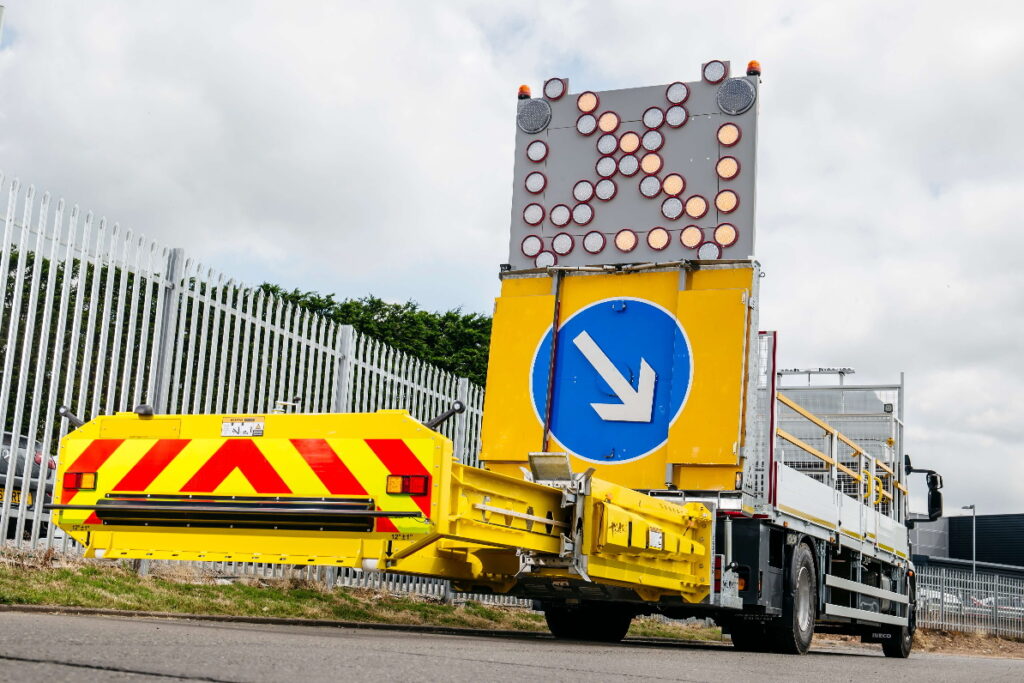
The Blade TMA and Armadillo TMA are both truck-mounted attenuators designed to protect road workers and drivers in active work zones, but they differ in crash energy absorption design, MASH compliance ratings, host vehicle requirements, and deployment context. The Blade is engineered for higher-speed highway environments, while the Armadillo targets lighter-duty and urban applications. The sections below break down each key difference so you can choose the right system for your operation.
How do the Blade and Armadillo TMAs absorb crash energy differently?
The Blade TMA uses a telescoping cartridge system that collapses progressively on impact, distributing crash forces across multiple stages to decelerate an errant vehicle gradually. The Armadillo relies on a rigid foam-core and polymer-shell construction that deforms and absorbs energy through controlled material compression. Both approaches protect occupants, but the mechanism and the severity of impact each system is built to handle differ significantly.
In a telescoping design like the Blade, the attenuator extends rearward in sections. When struck, each section collapses into the next, spreading the deceleration load over a longer distance and time. This makes it particularly effective at managing high-speed rear-end impacts where kinetic energy is greatest.
The Armadillo’s foam-and-shell design is purpose-built for lower-speed impacts. The outer polymer casing deflects initial contact, while the internal foam core compresses to absorb remaining energy. This construction is lighter, simpler to replace after a strike, and well suited to urban or low-speed road environments where impacts are less severe. After a collision, replacement modules can be swapped in without replacing the entire unit, which reduces downtime and cost.
What MASH compliance ratings do the Blade and Armadillo hold?
The Blade TMA holds MASH 2016 (TL-3) acceptance, which is the most current crash-testing standard and covers impacts at highway speeds up to 100 km/h (62 mph). The Armadillo is typically rated to MASH TL-2, covering lower-speed work zones up to 70 km/h (44 mph). Your choice of system should align with the posted work zone speed on your specific project.
MASH 2016 (Manual for Assessing Safety Hardware) replaced the earlier NCHRP-350 standard and introduced more demanding test protocols, including heavier test vehicles and stricter occupant risk criteria. A TL-3 rating confirms the system performs safely under conditions that reflect real highway work zone scenarios. If your project involves a highway or motorway environment, a TL-3-rated system is the appropriate specification.
For urban road maintenance, municipal resurfacing, or lower-speed infrastructure work, a TL-2-rated system like the Armadillo meets the required standard without the added weight and complexity of a full highway-rated attenuator. Always verify that the compliance rating of your chosen TMA matches what is required by the project specification or local authority.
Which TMA is better suited for highway versus urban work zones?
The Blade TMA is the stronger choice for highway work zones where posted speeds exceed 70 km/h and the risk of high-energy rear-end impacts is elevated. The Armadillo is better suited to urban or low-speed environments such as city road maintenance, utility works, or residential construction zones where traffic speeds are lower and a lighter, more manoeuvrable system is practical.
Highway deployments demand a system that can withstand a full-speed impact from a passenger vehicle or light truck without transferring dangerous deceleration forces to the host vehicle cab or work crew. The Blade’s telescoping structure and MASH TL-3 rating make it the right fit for these conditions.
Urban work zones present different challenges. Traffic is slower, but the work truck may need to reposition frequently, navigate tight spaces, or operate on roads where a heavy TMA would be impractical. The Armadillo’s lighter weight and simpler mounting make it easier to deploy and redeploy across multiple sites in a single shift. It also tends to have a lower initial cost, which matters when you are equipping a large fleet of maintenance vehicles.
How do the Blade and Armadillo differ in setup and recovery time?
The Blade TMA generally requires more time to set up and inspect due to its telescoping mechanism and the checks needed to confirm the system is correctly extended and locked before deployment. The Armadillo is faster to deploy because its fixed-form construction involves fewer moving parts. After a collision, the Armadillo’s modular foam replacement can restore the unit to service more quickly than repairing or replacing a telescoping cartridge assembly.
For operations that involve frequent repositioning throughout a shift, such as rolling slow-speed operations or multi-site urban maintenance, the Armadillo’s faster turnaround is a practical advantage. For highway projects where the truck stays in position for longer periods, the additional setup time of the Blade is less of a concern and is outweighed by the higher protection level it provides.
Post-impact recovery is an important operational consideration. A telescoping TMA that has been struck at highway speed will likely require a full cartridge replacement and a structural inspection before it can return to service. The Armadillo’s foam-core modules are designed to be field-replaceable, which means a struck unit can often be restored on-site rather than returned to a depot.
What host vehicle requirements does each TMA have?
The Blade TMA requires a heavier host vehicle, typically a truck with a minimum gross vehicle weight rating (GVWR) that supports the mounting loads and impact forces of a TL-3-rated system. The Armadillo is compatible with lighter host vehicles, making it suitable for smaller work trucks commonly used in urban maintenance fleets.
Host vehicle weight matters because the attenuator must redirect crash forces through the mounting frame and into the vehicle structure. If the host vehicle is too light, a high-speed impact can push the entire truck forward rather than being absorbed by the attenuator, which defeats the purpose of the system. MASH testing specifies minimum host vehicle weights for each test level, and you must ensure your truck meets those requirements for the TMA rating you intend to use.
Beyond weight, you should also consider the rear mounting interface. The Blade typically uses a dedicated hitch or subframe mount engineered for high-load conditions. The Armadillo uses a simpler mounting bracket that fits a wider range of standard truck configurations. If you are equipping a mixed fleet, the Armadillo’s broader vehicle compatibility can simplify procurement and reduce the need for custom mounting solutions.
How Verdegro Supports Your TMA Selection
We manufacture a range of truck-mounted attenuators tested and approved to both NCHRP-350 TL-3 and MASH 2016 standards, including the Blade TMA for high-speed highway environments. Our systems are built for road construction contractors and traffic management operators who need certified, durable crash protection across a range of work zone conditions.
When you work with us, you get:
- MASH 2016-compliant systems backed by FHWA acceptance letters, so you can meet project specification requirements with confidence
- Optional accessories including LED arrow boards, full-colour VMS displays, and hydraulic LED-lift masts to build a complete work zone protection setup
- Technical guidance on host vehicle compatibility and mounting requirements for your specific fleet
- Real-time fleet visibility through our Mobilityplanner platform, giving you GPS tracking and status monitoring across all deployed units
If you are deciding between the Blade, the Armadillo, or another system in our range, we can help you match the right attenuator to your work zone speed, host vehicle, and operational requirements. Contact us to discuss your project and get a recommendation tailored to your situation.
Related Articles
- Can you survive a crash into a truck mounted attenuator?
- What is another name for a truck mounted attenuator?
- Do you need a special license to tow a trailer truck mounted attenuator?
- Does a heavier truck mounted attenuator offer better protection?
- Can a damaged truck mounted attenuator be repaired or does it need replacing?