
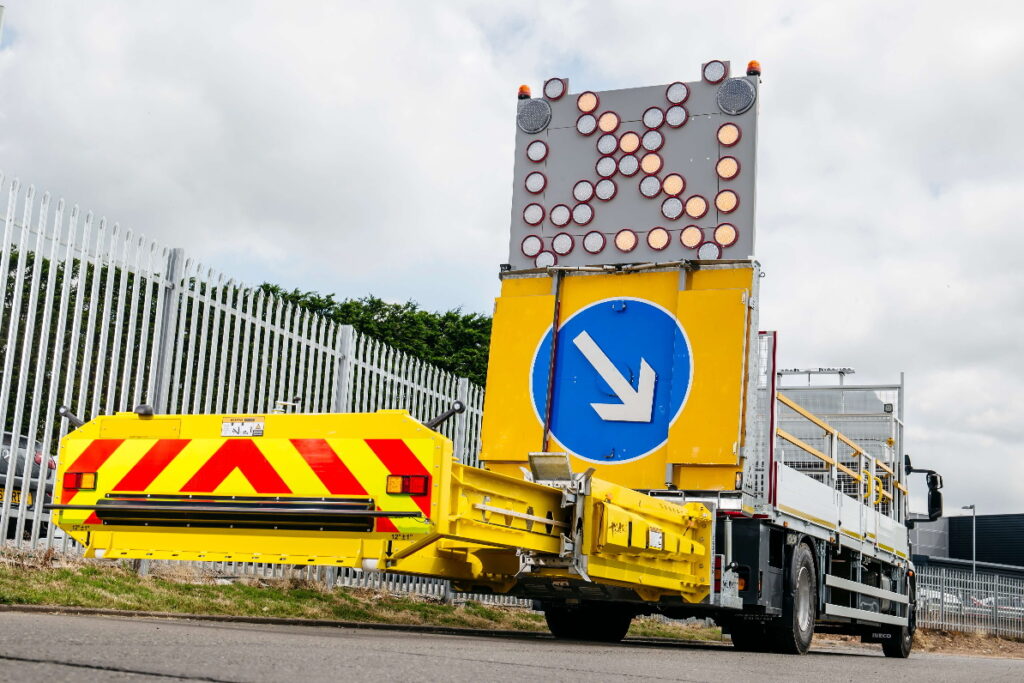
The MASH standard for truck mounted attenuators is the Manual for Assessing Safety Hardware (MASH), a crash testing protocol developed by AASHTO and TRB that defines how roadside safety devices must perform in controlled impact scenarios. For TMAs, MASH sets the specific test conditions, vehicle speeds, and performance criteria a crash cushion system must meet before it can be approved for use on public roads in the United States and increasingly worldwide.
MASH 2016, the most current version of the standard, raised the bar from its predecessor by using updated test vehicles and stricter occupant risk criteria. Any TMA deployed in federally funded work zones today must hold FHWA acceptance under MASH 2016 to remain compliant.
Below, we answer the most common questions about MASH compliance for truck mounted attenuators, from how the standard works to how you can verify a TMA is genuinely certified.
How does MASH differ from the older NCHRP 350 standard?
MASH replaced NCHRP 350 as the governing crash test standard for roadside safety hardware in the United States. The most significant difference is that MASH uses heavier, more realistic test vehicles and applies stricter occupant risk thresholds, making it a more demanding benchmark for any truck mounted attenuator to pass.
Under NCHRP 350, the standard passenger car test vehicle weighed approximately 1,800 lb. MASH updated that to a 2,420 lb vehicle, reflecting the actual average weight of modern passenger cars on the road. This change alone means a TMA that passed NCHRP 350 testing does not automatically meet MASH requirements, because the impact energy in the test is substantially higher.
MASH also introduced revised occupant risk factors, which measure the forces experienced by vehicle occupants during a crash. The acceptable limits are tighter, meaning a device must not only redirect or absorb the vehicle but must do so in a way that reduces injury risk more effectively than older standards required.
For contractors and fleet operators, this distinction matters practically. The FHWA set a deadline after which only MASH-compliant devices qualify for use on federally funded projects. Equipment certified only under NCHRP 350 no longer meets current federal requirements for new installations.
What crash tests does a truck mounted attenuator need to pass under MASH?
Under MASH, a truck mounted attenuator must pass a series of test level 3 (TL-3) crash tests, which represent high-speed highway work zone conditions. These tests include a passenger car impacting the rear of the TMA at 100 km/h (62 mph) at both a direct angle and an oblique angle, as well as a pickup truck impact at the same speed.
The specific tests most relevant to TMAs under MASH TL-3 are:
- Test 3-50: A 2,420 lb passenger car strikes the TMA head-on at 100 km/h
- Test 3-51: A 2,420 lb passenger car strikes the TMA at a 5-degree angle at 100 km/h
- Test 3-52: A 5,000 lb pickup truck strikes the TMA head-on at 100 km/h
Each test evaluates several performance criteria. The TMA must absorb the impact energy without allowing the impacting vehicle to penetrate the host truck cab. It must also limit the occupant impact velocity and ridedown acceleration to within MASH’s defined thresholds. After the impact, the host truck must remain stable and the debris field must stay within acceptable limits to avoid endangering nearby workers or other road users.
Passing all required tests at TL-3 demonstrates that the TMA performs safely across the range of real-world impact scenarios that occur in active work zones on high-speed roads.
What does an FHWA acceptance letter mean for a TMA?
An FHWA acceptance letter is an official document issued by the Federal Highway Administration confirming that a specific TMA model has been tested according to MASH procedures and meets the required performance criteria. It is the formal authorization that allows a TMA to be used on federally funded highway projects in the United States.
The letter identifies the exact product, the test standard it was evaluated under (such as MASH 2016), and any conditions or limitations on its approved use. It is not a general endorsement of the manufacturer but a model-specific approval tied to the exact configuration that was crash tested.
For buyers and fleet managers, the FHWA acceptance letter is the most reliable way to confirm that a TMA has genuinely been tested, not just marketed as compliant. Manufacturers are required to maintain the tested configuration in production, meaning the unit you purchase must match the approved design to retain its accepted status.
Importantly, an acceptance letter under MASH 2016 carries more weight than one issued under NCHRP 350 or earlier MASH versions, because it reflects the most current and stringent testing requirements.
Does MASH 16 replace all previous TMA certifications?
Yes, MASH 2016 effectively supersedes all previous TMA certifications for new installations on federally funded projects in the United States. The FHWA issued guidance requiring that only MASH-compliant devices be used for new permanent and temporary installations after specific transition deadlines, which means NCHRP 350 certifications are no longer sufficient for new deployments.
This does not mean that every TMA currently in the field must be immediately replaced. Devices already installed and in service under previous certifications were generally permitted to remain in use through their operational life. However, when organizations procure new crash protection systems, MASH 2016 compliance is the standard they must meet.
Some manufacturers hold acceptance letters under both NCHRP 350 and MASH 2016 for different product variants. When reviewing a TMA for purchase, always confirm that the specific model you are evaluating holds a current FHWA acceptance letter under MASH 2016, not an older certification carried over from a previous standard.
How do you verify a TMA is genuinely MASH compliant?
You verify MASH compliance by requesting the FHWA acceptance letter for the specific TMA model and cross-referencing it against the FHWA’s publicly available roadside safety hardware acceptance database. This database lists every accepted device, the standard under which it was tested, and the letter date, giving you an independent way to confirm a manufacturer’s claims.
When reviewing the acceptance letter, check the following:
- Test standard: Confirm it references MASH 2016, not NCHRP 350 or an earlier MASH version
- Model name and configuration: Verify the letter covers the exact variant you are purchasing, including weight class and any integrated accessories
- Conditions of acceptance: Note any restrictions on host vehicle weight, speed limits, or installation requirements
- Letter date: Confirm the acceptance is current and has not been superseded or withdrawn
Beyond the paperwork, reputable manufacturers will provide full test reports on request. These reports document the actual crash test results, vehicle kinematics, and occupant risk measurements, giving you a complete picture of how the device performed rather than just a pass/fail outcome.
Be cautious of vague claims such as “tested to MASH standards” without a corresponding FHWA acceptance letter. Testing and acceptance are two different things. A device may have undergone testing without receiving formal FHWA acceptance, which means it does not meet the compliance threshold for federally funded projects.
How Verdegro Helps with MASH Compliance for Truck Mounted Attenuators
We design and manufacture a range of truck mounted attenuators built specifically to meet current international crash safety standards, including MASH 2016. Our TMA product line includes several models suited to different host vehicle weights and operational requirements:
- TMA-US 100K and TTMA-US 100K: Designed for heavier host trucks, tested and accepted under MASH 2016
- LTMA-US 70K: A lighter-weight option for smaller host vehicles, also tested to current standards
- BLADE TMA: A compact, high-performance system for work zones where space and maneuverability matter
We hold multiple FHWA acceptance letters under MASH 2016, which means you can request the relevant documentation for any model in our range and verify compliance directly through the FHWA database. Our systems are also available with integrated accessories, including LED arrow boards, full-color VMS displays, and hydraulic LED-lift masts, all within a single certified configuration.
If you are procuring TMAs for a government contract, a highway construction fleet, or a traffic management operation, we can help you identify the right system for your host vehicle class and project requirements, and provide the compliance documentation you need.
Contact us to discuss your specific requirements or to request FHWA acceptance documentation for any of our TMA models.
Related Articles
- How do you protect the end of a temporary work zone?
- What are signs that a truck mounted attenuator needs to be replaced?
- What is the average lifespan of a truck mounted attenuator?
- Can you survive a crash into a truck mounted attenuator?
- What is the difference between a truck mounted attenuator and a crash cushion?