
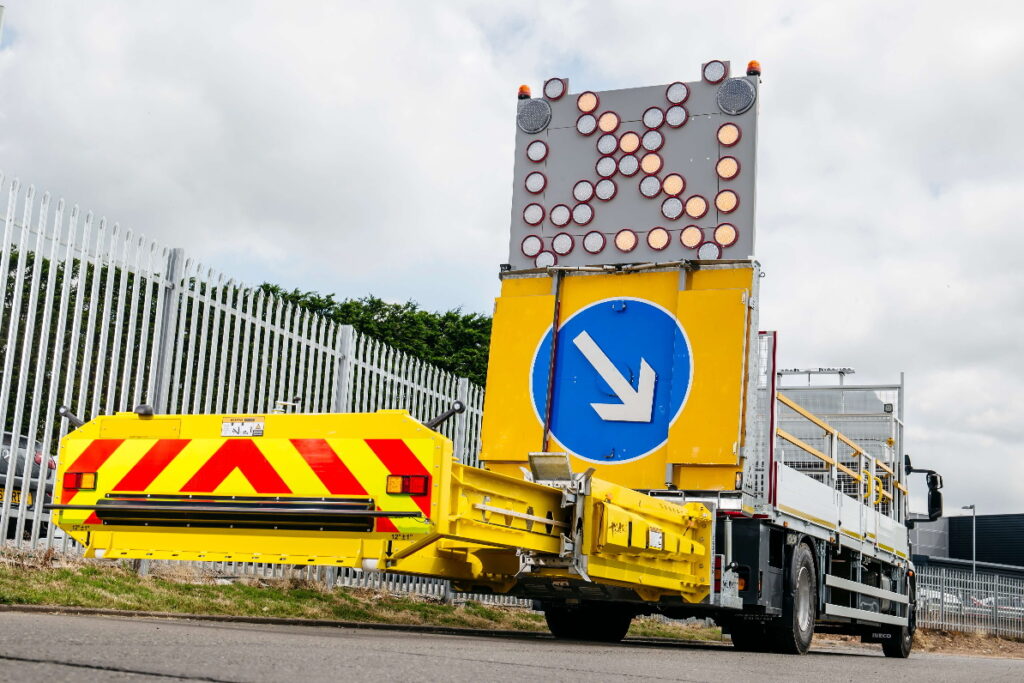
Most truck mounted attenuators are rated for impacts up to 100 km/h (62 mph), which corresponds to the TL-3 test level under both NCHRP 350 and MASH 2016 standards. Some lighter-duty models are rated to 70 km/h (43 mph). These ratings define the maximum speed at which the device is designed to absorb crash energy and redirect the striking vehicle away from workers in the work zone.
The rated speed is not a guarantee of zero harm at that speed. It means the attenuator performed within defined safety criteria during standardized crash testing. Below, we break down exactly how these ratings work, what happens when they are exceeded, and what else influences the outcome of a real-world crash.
How are truck mounted attenuators rated for crash speed?
Truck mounted attenuators are rated by test level, a classification assigned after controlled crash tests at specific speeds and angles. Test Level 3 (TL-3) is the most common rating, requiring the attenuator to survive a head-on impact at 100 km/h (62 mph) from a standardized vehicle of a specified weight. The rating confirms the device absorbed crash energy, kept the striking vehicle from penetrating the work zone, and limited occupant injury to acceptable thresholds.
Testing bodies such as the Federal Highway Administration (FHWA) in the United States evaluate attenuators against published standards. A TMA must pass multiple test scenarios, not just a single speed run, before it earns a test level rating. These scenarios include different vehicle weights and impact angles to simulate real-world conditions as broadly as possible.
The rating printed on a TMA’s certification documents reflects the worst-case scenario the device successfully handled during testing. Operating within that rated speed is what keeps the system performing as designed.
What is the maximum impact speed a TMA is designed to absorb?
For most commercially available truck mounted attenuators, the maximum rated impact speed is 100 km/h (62 mph) under TL-3 certification. This is the standard used across the majority of highway work zones in the United States and in many international markets. Lower-rated models, such as those certified to TL-2, are designed for impacts up to 70 km/h (43 mph) and are typically deployed in lower-speed environments such as urban roads or temporary construction zones with reduced speed limits.
It is worth noting that 100 km/h is a tested maximum, not an operational recommendation. Work zone speed limits are typically set well below that threshold, which gives the attenuator a meaningful safety margin in practice. When a driver hits the TMA at 80 km/h in a 90 km/h posted zone, the system is absorbing significantly less energy than it was designed and tested to handle.
What happens to a TMA when a vehicle exceeds its rated speed?
When a vehicle strikes a truck mounted attenuator above its rated speed, the energy transfer exceeds what the system was designed to manage. The attenuator may still slow the vehicle and reduce harm, but it can no longer guarantee the safety outcomes it was certified for. Structural components may fail in ways that allow the vehicle to penetrate the work zone, and the host truck may experience forces that compromise its stability.
Above-rated impacts do not necessarily result in catastrophic failure every time. The attenuator still absorbs some energy and provides more protection than no barrier at all. However, the controlled, predictable behavior the device was engineered to deliver breaks down. Injury severity to vehicle occupants increases sharply, and the risk to workers behind the host truck rises significantly.
This is why posted work zone speed limits matter beyond regulatory compliance. They directly influence whether the attenuator can perform within its tested parameters.
Does the angle of impact affect how much speed a TMA can handle?
Yes, the angle of impact significantly affects how a truck mounted attenuator performs. Crash testing standards require attenuators to be tested at both head-on (0 degrees) and angled impacts, typically around 15 degrees. An angled impact introduces lateral forces that the system must redirect without allowing the vehicle to spin into the work zone or the host truck to be destabilized sideways.
Angled impacts are often more dangerous than straight-on collisions at the same speed. The attenuator must manage both the forward energy and the sideways momentum simultaneously. A system that performs well in a straight-line test may behave differently when the vehicle approaches at an angle, which is why multi-angle testing is a required part of the certification process rather than an optional extra.
In real-world crashes, the majority of impacts are not perfectly head-on. Drivers often brake and steer before impact, which means the actual angle of contact varies widely. A well-certified attenuator accounts for this variability in its design.
How do MASH 16 and older NCHRP 350 ratings compare for TMAs?
MASH 2016 (Manual for Assessing Safety Hardware) and NCHRP 350 are both accepted crash testing standards for truck mounted attenuators, but MASH 2016 uses heavier test vehicles and more demanding criteria. NCHRP 350 used a 2,000 kg (4,400 lb) vehicle for TL-3 testing. MASH 2016 increased this to a 2,270 kg (5,000 lb) pickup truck, reflecting the actual weight of vehicles more commonly on roads today.
The practical difference is that a TMA certified under MASH 2016 has demonstrated it can handle a heavier real-world vehicle at the same rated speed. This makes MASH 2016 certification the more rigorous standard. Many government procurement requirements, particularly in the United States, now specify MASH 2016 compliance for new equipment purchases, phasing out acceptance of NCHRP 350-only devices over time.
A device holding only an NCHRP 350 approval is not necessarily unsafe, but it was tested against a lighter vehicle profile. For projects requiring the most current compliance, MASH 2016 certification is the relevant benchmark.
What other factors determine how safe a TMA crash actually is?
The rated speed is one variable in a system with many moving parts. Vehicle weight, road surface conditions, the host truck’s weight, and the attenuator’s maintenance state all influence how a real crash unfolds. A heavily loaded striking vehicle carries more kinetic energy than a light car at the same speed, placing greater demand on the attenuator even within the rated speed range.
Road surface plays a role too. Wet or icy roads affect how the striking vehicle behaves before and during impact, and how the host truck responds to the forces transferred through the attenuator. A truck that slides or rotates during impact may not provide the stable backstop the attenuator needs to function correctly.
Maintenance is another important factor that operators sometimes underestimate. An attenuator that has absorbed a previous impact and has not been properly inspected or reset may not perform to its rated specification in a subsequent crash. Regular inspection and reset procedures after any impact, even a minor one, are part of keeping the system within its certified performance window.
Finally, proper mounting matters. The attenuator must be correctly attached to the host truck at the specified mounting points and within the weight class the device was tested on. An improperly mounted TMA introduces variables that no crash test standard can account for.
How Verdegro Helps with Truck Mounted Attenuator Safety
We manufacture a range of truck mounted attenuators built and tested to meet the standards covered in this article. Our TMA lineup gives you options matched to the speed environment and compliance requirements of your specific project:
- TMA-US 100K and TTMA-US 100K are tested and approved to MASH 2016 TL-3, rated for impacts up to 100 km/h and suited to highway work zones where the most current certification is required.
- LTMA-US 70K is approved to NCHRP 350 TL-2, designed for lower-speed environments where a lighter-duty solution is appropriate.
- BLADE TMA combines compact design with certified crash performance, offering flexibility for contractors working across varied site conditions.
All our attenuators are available with optional LED arrow boards, full-color VMS displays, and hydraulic LED-lift masts, so you can build a complete work zone safety setup around a single certified platform. We also hold multiple FHWA acceptance letters under MASH 2016, which simplifies the compliance documentation process for government contracts and tenders.
If you need guidance on which TMA is the right fit for your speed environment, vehicle fleet, or compliance requirements, contact us directly and we will help you match the right system to your work zone.
Related Articles
- Why is Verdegro's truck mounted attenuator called Armadillo?
- What should fleet managers look for in a roadwork safety vehicle?
- Who typically buys truck mounted attenuators?
- What accessories improve truck mounted attenuator visibility at night?
- How do you choose the right truck mounted attenuator for your fleet?