
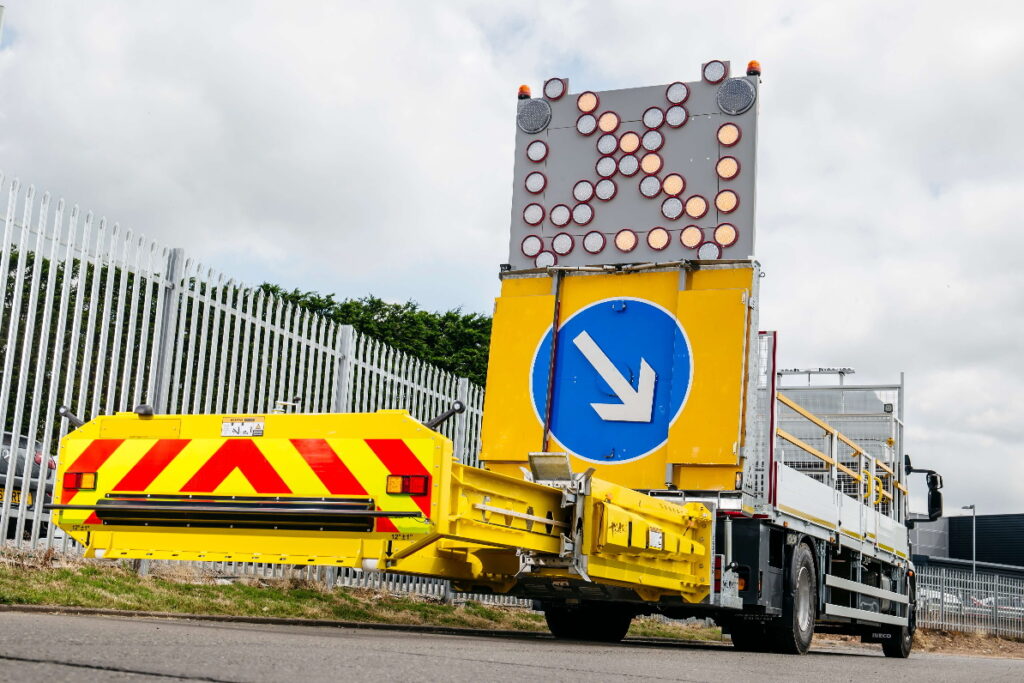
Trucks have truck mounted attenuators attached because work zone vehicles are stationary or slow-moving targets on live roads, and distracted or impaired drivers regularly crash into them. A truck mounted attenuator absorbs the energy of that impact, protecting both the road workers ahead of the truck and the driver of the striking vehicle. The sections below answer the most common questions about how these systems work, who needs them, and what the standards require.
What happens when a vehicle crashes into a work zone truck?
When a vehicle crashes into a work zone truck without a mounted attenuator, the impact is catastrophic. The striking vehicle hits a rigid, heavy object with no energy absorption, meaning the full force of the collision transfers directly into the cab of the striking vehicle and through the truck to any workers standing nearby. Fatalities and serious injuries are the predictable result.
Work zone crashes are not rare events. Shadow trucks and arrow board trucks operate in live traffic lanes every day, and even at moderate highway speeds, the energy involved in a collision is enormous. The truck itself can be pushed forward violently, turning it into a secondary hazard that endangers workers on foot in the work zone ahead.
This is exactly why regulators and highway agencies require attenuator systems on these vehicles. The goal is not just to protect the striking driver but to keep the work zone truck in place and prevent it from becoming a projectile.
What does a truck mounted attenuator actually do?
A truck mounted attenuator is a crash cushion device bolted to the rear of a work zone truck that absorbs and redirects the energy of an errant vehicle impact. It decelerates the striking vehicle progressively rather than stopping it instantly, which dramatically reduces the forces experienced by the vehicle occupants. The attenuator itself is designed to be sacrificial, meaning it absorbs the damage so the truck and the workers ahead do not.
The mechanism works through controlled deformation. The attenuator’s structure compresses in a calculated sequence on impact, converting kinetic energy into heat and deformation energy. This controlled collapse keeps the striking vehicle from penetrating the rear of the work truck or bouncing back into adjacent traffic lanes unpredictably.
Modern truck mounted attenuators also provide a degree of redirective performance, guiding an impacting vehicle away from the work zone rather than allowing it to spin into oncoming traffic. Many units are also equipped with LED arrow boards or variable message signs mounted directly to the attenuator frame, so the same unit that provides crash protection also delivers active traffic guidance.
Which trucks are required to carry a mounted attenuator?
Shadow trucks and mobile work zone vehicles that operate in or adjacent to live traffic lanes are typically required to carry a mounted attenuator. This includes trucks used as moving barriers during lane closures, arrow board trucks that guide traffic around work zones, and any vehicle that positions itself between active traffic and road workers.
The specific requirement depends on jurisdiction and project type. In the United States, the Manual on Uniform Traffic Control Devices (MUTCD) and individual state departments of transportation set the rules. Most highway construction contracts on federal-aid projects require TMA-equipped shadow trucks as a standard condition. Municipal and local road projects may have different thresholds, but the trend across all levels of government is toward mandatory use on any project where workers are exposed to live traffic.
In practice, any contractor bidding on highway maintenance, resurfacing, or construction work should assume that a compliant truck mounted attenuator is a contract requirement, not an optional upgrade.
What is MASH 16 and why does it matter for attenuator compliance?
MASH 16 refers to the Manual for Assessing Safety Hardware, 2016 edition, which is the current standard used in the United States to evaluate and certify roadside safety hardware, including truck mounted attenuators. It replaced the older NCHRP-350 standard and defines more rigorous crash test protocols, vehicle weights, and performance criteria that certified hardware must meet before it can be used on federally funded road projects.
MASH 16 matters for attenuator compliance because the Federal Highway Administration (FHWA) now requires all new hardware installations on National Highway System projects to meet MASH 2016 criteria. An attenuator that was certified only under NCHRP-350 may no longer be acceptable for new federally funded contracts. Contractors and agencies that purchase equipment without checking the certification status risk having their equipment rejected during project audits.
Certification under MASH 16 is demonstrated through an FHWA acceptance letter, which confirms that the specific product model has been tested and accepted under the current standard. When evaluating any TMA for purchase, verifying that the product holds a current FHWA acceptance letter under MASH 2016 is a practical first step.
How is a truck mounted attenuator different from a road barrier?
A truck mounted attenuator is a mobile, vehicle-mounted crash cushion designed to absorb the energy of a single impact event and protect the vehicle and workers behind it. A road barrier is a fixed or semi-fixed longitudinal device designed to contain and redirect vehicles over the full length of a work zone. They serve different functions and are not interchangeable.
Road barriers such as concrete jersey barriers or water-filled plastic barriers run along the edge of a lane closure to prevent vehicles from crossing into the work area. They are passive, stationary, and designed to handle repeated glancing impacts along their length.
A truck mounted attenuator, by contrast, moves with the truck. It is designed to absorb a direct head-on or near-head-on impact from behind, decelerating the striking vehicle and protecting the work zone ahead. It does not guide traffic along a corridor. The two systems are often used together on the same project: barriers define the work zone boundary, and the TMA-equipped shadow truck operates at the rear of the work zone as a moving shield.
How long does it take to replace a TMA after an impact?
After a significant impact, a truck mounted attenuator typically needs to be replaced before the truck returns to active work zone duty. Replacement time varies depending on the severity of the impact and the attenuator model, but a full unit swap on a properly equipped truck can generally be completed in a few hours when a replacement unit is available on-site or nearby.
Most modern TMA designs use a bolt-on mounting system that allows the damaged unit to be unbolted and a new unit installed without specialized tools or heavy equipment. The truck itself may be undamaged and fully operational; only the attenuator needs replacement. This is intentional. The attenuator is engineered to absorb and sacrifice itself in the impact so the truck can return to service quickly.
Planning for this is important for contractors managing active projects. Keeping a spare attenuator unit in the equipment yard or arranging a rapid-delivery agreement with your supplier means a struck truck is out of service for hours rather than days. Some project specifications also require that a replacement unit be on-site before work begins, precisely to avoid delays after an impact.
How Verdegro Helps with Truck Mounted Attenuators
We manufacture a range of truck mounted attenuators built and tested to meet current international crash safety standards, including MASH 2016 and NCHRP-350 TL-3. Our product line covers multiple weight classes and operational requirements, so you can match the right system to your truck and project type without compromise.
Our TMA range includes:
- TMA-US 100K and TTMA-US 100K for standard and tandem truck applications, both tested to MASH 2016
- LTMA-US 70K for lighter-duty truck configurations
- BLADE TMA, a compact and durable option for contractors needing a lower-profile system
All units are available with optional accessories including LED arrow boards, full-color VMS displays, and hydraulic LED-lift masts, so your shadow truck provides both certified crash protection and active traffic guidance from a single integrated system.
We hold multiple FHWA acceptance letters under MASH 16, which means our attenuators meet the requirements for use on federally funded projects in the United States. If you are preparing a bid or specifying equipment for an upcoming project, we can provide the documentation you need to confirm compliance.
If you want to discuss which system fits your fleet and project requirements, contact us directly and we will help you find the right solution.
Related Articles
- When is a light truck mounted attenuator sufficient instead of a full truck mounted attenuator?
- What accessories improve truck mounted attenuator visibility at night?
- What are the advantages of a trailer-mounted attenuator?
- What crash test levels apply to truck mounted attenuators?
- What speed can you safely crash into a truck mounted attenuator at?