
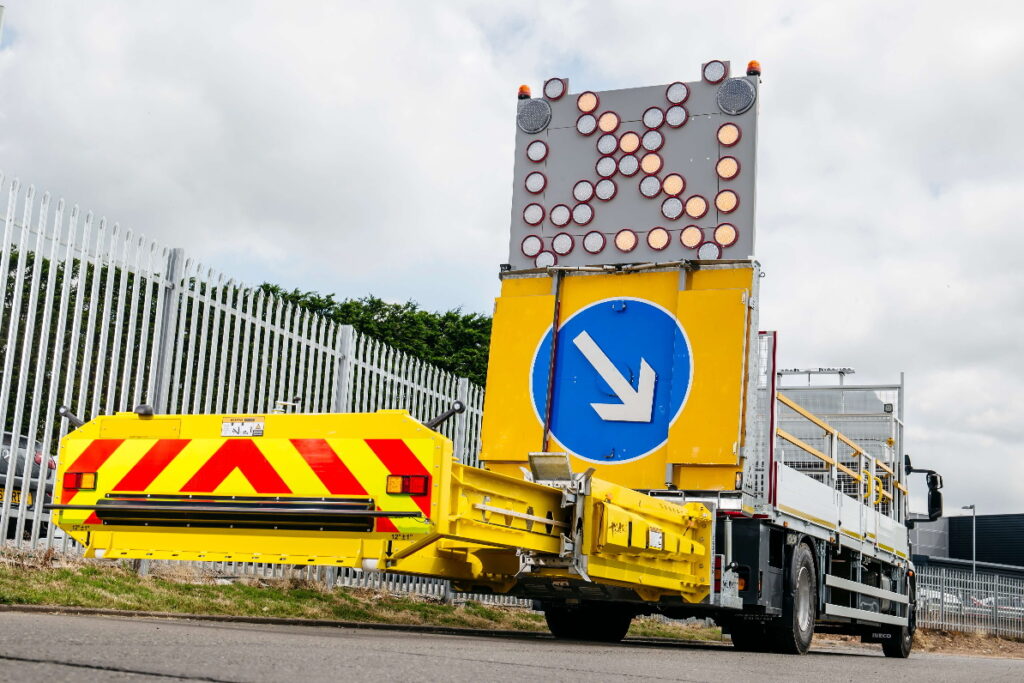
A damaged truck-mounted attenuator can often be repaired, but replacement is sometimes the only safe option. The deciding factor is the extent of structural damage to the energy-absorbing cartridges, the mounting frame, and the connection to the host vehicle. Minor impacts that affect only outer panels or secondary components are typically repairable, while severe deformation of core crash elements usually requires full replacement.
For road construction contractors and traffic management operators, making the right call quickly matters, both for worker safety and operational continuity. The sections below work through the most important questions surrounding TMA damage, repair decisions, and compliance.
What factors determine whether a TMA can be repaired?
The key factors are the location of the damage, the severity of structural deformation, and whether the impact-absorbing components can be restored to their original certified performance. A TMA that has absorbed a low-speed rear-end impact may have damaged only its outermost cartridge or housing, making targeted repair both practical and safe. Higher-speed or off-angle impacts are more likely to compromise structural integrity deeper within the system.
When assessing whether repair is viable, you should evaluate:
- Cartridge condition: Are the energy-absorbing cartridges crushed beyond the manufacturer’s serviceable limits?
- Frame and mounting hardware: Is the main frame bent, cracked, or twisted at the host vehicle attachment points?
- Hydraulic components: If the unit includes a hydraulic lift or folding mechanism, are cylinders, hoses, or pivot points damaged?
- Attachment integrity: Is the hitch receiver, pin assembly, or mounting bracket still within tolerance?
- Secondary systems: Arrow boards, VMS displays, or lighting systems may be damaged independently and are generally easier to replace without affecting crash performance.
In practice, a thorough post-impact inspection by a qualified technician is the only reliable way to determine repairability. Visual checks from the outside are not sufficient after any significant collision.
What types of damage automatically require full TMA replacement?
Full TMA replacement is required when the primary energy-absorbing structure is severely deformed, when the mounting frame is cracked or permanently bent, or when the unit has been involved in a high-speed impact that exceeds its rated test level. These conditions mean the system can no longer be trusted to perform as tested, regardless of how it looks externally.
Specific conditions that typically trigger automatic replacement include:
- Collapsed or fused cartridges that cannot be individually replaced according to manufacturer specifications
- Cracks or fractures in the main longitudinal frame members
- Permanent deformation of the host vehicle attachment assembly that affects alignment or load transfer
- Impact forces that visibly displaced the TMA laterally or vertically, indicating the frame absorbed loads it was not designed to handle
- Any impact where the host truck itself sustained significant structural damage at the hitch point
When in doubt, replacement is the safer and often more cost-effective long-term choice. A repaired unit that fails in a subsequent impact puts workers and road users at risk and exposes your organization to serious liability.
Can a repaired TMA still meet MASH 16 compliance standards?
A repaired TMA can meet MASH 16 compliance standards, but only if the repair restores all structural and energy-absorbing components to their original certified specifications. Repairs that use non-OEM parts, deviate from manufacturer-approved procedures, or leave structural elements outside tolerance will void the unit’s MASH 2016 certification and make it non-compliant for use in work zones where certification is required.
MASH 2016 (Manual for Assessing Safety Hardware) is the current standard in the United States for crash-testing roadside hardware. TMAs that hold FHWA acceptance letters under MASH 16 have been tested and approved at specific impact speeds and angles. Any repair that alters the geometry, material properties, or energy absorption sequence of the system effectively creates a modified device that has not been crash-tested.
To maintain compliance after a repair:
- Use only manufacturer-approved replacement cartridges and structural components
- Follow the manufacturer’s documented repair procedures exactly
- Obtain written confirmation from the manufacturer that the repaired unit meets original certification requirements
- Keep repair records on file for inspection and audit purposes
If you cannot confirm that a repair restores the unit to its certified state, treat it as non-compliant and remove it from service.
How does repair cost compare to full TMA replacement?
Repair is generally more cost-effective than full replacement for minor to moderate damage, but the cost advantage narrows quickly as damage severity increases. A cartridge replacement or panel repair may cost a fraction of a new unit, while a repair involving frame work, hydraulic components, and multiple structural parts can approach or exceed the cost of replacement when labor is factored in.
Consider these cost dimensions when making the decision:
- Parts cost: Replacement cartridges and secondary components are typically the lowest-cost repairs. Frame fabrication or custom structural work is significantly more expensive.
- Labor cost: Complex repairs require skilled technicians and workshop time. If your fleet is large, downtime costs also factor in.
- Certification risk: An improperly repaired unit that fails inspection or causes a secondary incident carries financial and legal consequences that far outweigh the cost of replacement.
- Unit age and condition: Repairing an older TMA that is already near the end of its service life rarely makes financial sense. Replacement gives you a fully certified unit with a full service life ahead.
A useful rule of thumb: if the repair cost exceeds 50 to 60 percent of the replacement cost of a comparable certified unit, replacement is usually the better investment.
Who is qualified to assess and repair a damaged TMA?
Only trained technicians with direct knowledge of the specific TMA model and its certification requirements are qualified to assess and carry out structural repairs. This typically means the manufacturer’s own service team, an authorized dealer or repair center, or a certified technician who has received model-specific training from the manufacturer. General welders or vehicle mechanics without crash hardware experience should not perform structural repairs on TMAs.
For the assessment itself, the technician needs access to:
- The manufacturer’s post-impact inspection checklist for the specific model
- Dimensional tolerances and structural specifications for all load-bearing components
- Documentation of the original crash-test configuration to compare against current condition
After any repair, the unit should be re-inspected before returning to service. For crash attenuator systems that hold MASH 16 acceptance letters, the manufacturer is the definitive authority on whether a repaired unit remains compliant. Do not rely solely on a third-party assessment if the manufacturer offers a direct inspection or certification service.
How can operators reduce TMA damage severity in future impacts?
Operators can reduce TMA damage severity by ensuring the system is correctly mounted, properly positioned during deployment, and maintained according to the manufacturer’s schedule. Many secondary impacts cause more damage than necessary because the TMA was not set at the correct angle, the host vehicle was not positioned within the system’s design parameters, or worn components reduced the unit’s ability to absorb energy as intended.
Practical steps to reduce damage severity include:
- Correct deployment positioning: Follow the manufacturer’s guidelines for host vehicle placement, shadow vehicle distance, and attenuator angle. Improper positioning can cause off-axis loading that concentrates forces on components not designed to handle them.
- Regular pre-deployment inspections: Check cartridge condition, mounting hardware torque, and hydraulic system integrity before every deployment. A unit with pre-existing wear absorbs impacts less effectively.
- Driver training: Operators should understand how the TMA functions and what to do immediately after an impact, including securing the scene and initiating the inspection process before moving the vehicle.
- Documented maintenance records: Keeping accurate service records helps identify units that have absorbed multiple minor impacts and may be approaching the end of their reliable service life before a major failure occurs.
No TMA can prevent all damage in a significant collision, but a well-maintained, correctly deployed system will consistently perform closer to its tested performance levels and sustain less secondary damage in the process.
How Verdegro Supports Your TMA Decisions
When one of your truck-mounted attenuators takes a hit, you need fast, reliable guidance on whether to repair or replace, and you need confidence that whatever decision you make keeps your crew compliant and protected. Here is how we can help:
- MASH 16-certified TMA range: Our TMA-US 100K, TTMA-US 100K, LTMA-US 70K, and BLADE TMA are all tested and approved to current crash safety standards, giving you a clear baseline for compliance when replacement is the right call.
- Manufacturer-level technical knowledge: As the manufacturer, we hold the original certification documentation and design specifications for our systems. We can tell you definitively whether a damaged unit can be restored to its certified state.
- Optional integrated accessories: If secondary systems such as LED arrow boards, VMS displays, or hydraulic lift masts were damaged in an impact, we supply these as integrated components so you can restore full functionality alongside structural repairs or replacement.
- Fleet visibility through Mobilityplanner: Our online platform gives you real-time status updates and GPS tracking across your deployed units, helping you monitor condition and respond faster when an impact occurs.
If you are working through a post-impact assessment right now or planning ahead for your 2026 fleet requirements, get in touch with us and we will help you make the right call.