
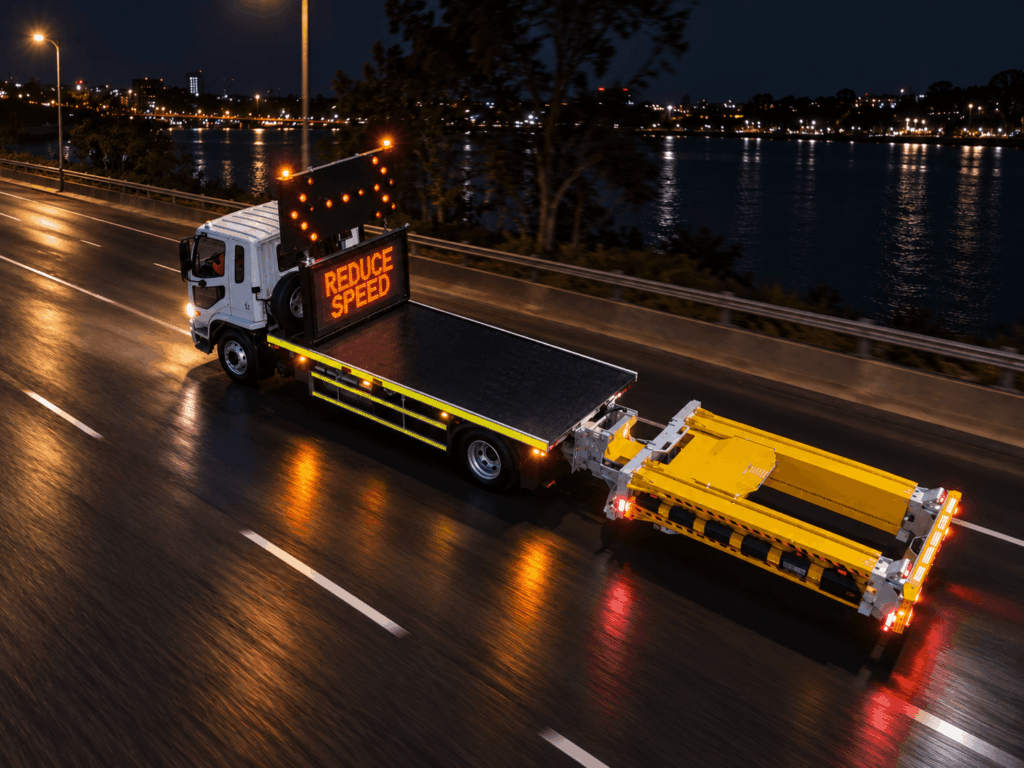
Yes, one impact protection vehicle can be used across different types of roadwork, but only if it is properly configured for each scenario. A truck mounted attenuator fitted to the right host vehicle, with the correct crash certifications and adaptable equipment, can serve highway resurfacing, lane closures, utility maintenance, and more. The sections below walk through the key questions you need to answer before committing to a single-vehicle approach.
What types of roadwork require an impact protection vehicle?
Any roadwork that places workers or equipment in or near live traffic requires an impact protection vehicle. The core function is always the same: absorb or redirect errant vehicles before they reach the work zone. The specific operations that consistently require this protection include highway resurfacing and patching, lane closures, bridge inspections, utility work on or near carriageways, and incident management operations.
Within each of these categories, the risk profile differs. A highway resurfacing crew operating at 100 km/h on a motorway faces a very different threat than a utility team working in a 30 km/h urban zone. The speed of surrounding traffic, the duration of the operation, the width of the available lane, and the number of workers present all shape what kind of truck mounted attenuator setup is appropriate. Short-duration operations such as pothole repairs may require a vehicle that deploys and retracts quickly. Long-duration projects such as multi-week resurfacing contracts benefit from a system that can remain in position reliably over extended periods without repeated maintenance.
Incident management is a separate category worth noting. When emergency crews respond to a motorway collision, the impact protection vehicle must be positioned rapidly and often on irregular surfaces. In these situations, deployment speed and mechanical simplicity become especially important factors.
What is the difference between a dedicated and a multi-role impact protection vehicle?
A dedicated impact protection vehicle is configured for one specific type of operation and remains in that configuration permanently. A multi-role impact protection vehicle is designed or adapted to serve different roadwork scenarios by changing its configuration, attachments, or operating mode between deployments. The key difference is flexibility versus optimization: dedicated vehicles perform one job exceptionally well, while multi-role vehicles trade some specialization for broader utility.
In practice, multi-role truck mounted attenuators achieve their flexibility through modular design. Systems that use quick-connect brackets allow operators to swap arrow boards, variable message signs, or other accessories between jobs. A vehicle used for a motorway lane closure one week can be reconfigured with different signage for a lower-speed urban operation the following week, provided the crash cushion itself is rated for both scenarios.
Dedicated vehicles are common in large fleet operations where a government agency or major contractor runs enough simultaneous projects to justify specialization. Multi-role vehicles make more sense for smaller contractors, rental fleets, or organizations that need to cover a wide range of job types without maintaining a large number of assets.
What safety certifications apply when one vehicle is used across different work zones?
The certifications that apply depend on the speed limit and the regulatory framework of each work zone. In most markets, truck mounted attenuators must meet a recognized crash test standard at the speed of the highest-risk environment in which they will be deployed. If one vehicle is used across multiple work zones, its certification must cover the most demanding scenario it will encounter.
The current benchmark in international markets is MASH 2016 (Manual for Assessing Safety Hardware), which defines Test Level 3 (TL-3) as the standard for operations at speeds up to 100 km/h. A TMA certified to MASH 2016 TL-3 is approved for use across the full range of typical roadwork environments, including high-speed motorways. In the United Kingdom, the optional 110K test under TD49/07 adds a further layer of validation for higher-speed conditions.
When one vehicle is deployed across different work zones, the certification requirement does not change based on the job, it is fixed by the standard the attenuator was tested to. What does change is whether that certification is sufficient for each specific location. A system certified only to a lower test level cannot legally or safely be used in a higher-speed environment, regardless of how it performs in other contexts. Always verify that the TMA’s acceptance documentation covers the speed and regulatory requirements of every work zone where you plan to deploy it.
How does vehicle configuration change between different roadwork scenarios?
Vehicle configuration changes primarily in three areas: signage and visibility equipment, crash cushion position, and host vehicle type. The crash cushion itself typically remains constant, but the surrounding setup adapts to match the traffic management requirements of each specific operation.
Signage and visibility equipment
Arrow boards, variable message signs, and lighting arrays are the most frequently swapped components. A motorway lane closure requires large, highly visible arrow boards that comply with national specifications for high-speed environments. A lower-speed urban maintenance job may call for a smaller arrow board or a VMS sign displaying specific instructions to road users. Systems with modular quick-connect brackets make these swaps straightforward and allow a single vehicle to meet the signage requirements of multiple job types without structural modification.
Crash cushion position and deployment mode
Some truck mounted attenuator systems offer multiple mounting configurations: rear mounted, top mounted, or swing mounted variants. The swing-mounted configuration, for example, allows the crash cushion to rotate sideways so that the rear doors of the host vehicle remain accessible. This matters in scenarios where the vehicle also carries tools, materials, or equipment that crews need to retrieve during the operation. Choosing the right mounting variant for each job type is part of effective multi-role deployment planning.
What are the limitations of using one impact protection vehicle for multiple job types?
The main limitations are certification boundaries, physical constraints of the host vehicle, and operational availability. A single truck mounted attenuator can only be in one place at one time, and if it is committed to one project, it cannot cover another, a straightforward but often overlooked constraint for contractors managing multiple simultaneous operations.
Certification boundaries are the most critical limitation. If your attenuator is certified to MASH 2016 TL-3 for speeds up to 100 km/h, you cannot deploy it in environments that require a higher test level, even if the cushion appears physically capable. Regulatory compliance is non-negotiable, and using a vehicle outside its certified parameters exposes both workers and operators to serious legal and safety risk.
Physical constraints also matter. The host vehicle must fall within the weight range specified for the attenuator system. A cushion designed for a truck in the 7,000 to 12,000 kg range cannot simply be transferred to a lighter van or a heavier rigid vehicle without re-evaluation. Similarly, transport height affects where the vehicle can travel, a system with a transport height of nearly 4,000 mm requires route planning that accounts for low bridges and restricted-height infrastructure.
Finally, multi-role use increases cumulative wear on a single asset. A vehicle that operates across many different job types accumulates hours faster than a dedicated unit. Maintenance scheduling becomes more demanding, and any downtime affects your ability to cover all the roles that vehicle was expected to fill.
When should a fleet include multiple dedicated impact protection vehicles?
A fleet should include multiple dedicated impact protection vehicles when simultaneous deployments are required, when job types have significantly different certification or configuration requirements, or when a single vehicle’s downtime would create unacceptable gaps in work zone coverage. For most professional contractors operating at scale, a mixed fleet, combining a versatile multi-role vehicle with one or more dedicated units, offers the best balance of flexibility and reliability.
Consider dedicated vehicles when:
- You regularly run two or more active work zones at the same time
- Your operations span both high-speed motorway work and lower-speed urban environments with different certification requirements
- A specific project type has unique configuration needs that would require constant reconfiguration of a shared vehicle
- Regulatory requirements in different regions demand different crash test standards that a single system cannot satisfy
- Your maintenance schedule cannot guarantee that one vehicle will always be available when needed
For government agencies managing large road networks, dedicated vehicles for specific operation types are often the standard approach. For smaller contractors or rental operators, a well-specified multi-role truck attenuator can cover a wide range of scenarios cost-effectively, provided its certification and configuration genuinely match every environment where it will be used.
How We Can Help You Choose the Right Impact Protection Vehicle
At Verdegro, we design and manufacture truck mounted attenuators built for real-world road maintenance conditions. Our range gives you practical options whether you need a single flexible system or multiple dedicated units for a larger fleet.
Our Armadillo TMA, introduced in 2026, is fully tested and approved to MASH 2016 TL-3 at 100 km/h. It deploys in a single continuous motion in under 20 seconds while driving at 80 km/h, and its compact 2,300 mm width allows it to operate in narrow lanes and constrained work zones. The system uses no sensors or electronic feedback components, only a hydraulic power pack, which makes it straightforward to maintain across a wide variety of job types.
Our VanGuard TMA is the world’s first truck mounted attenuator designed for closed vans, available in rear-mounted, top-mounted, and swing-mounted variants. It gives smaller operations access to certified crash protection on a lighter host vehicle, with full access to the rear doors maintained in the top and swing-mounted versions.
Both systems are available with Mobitrack, our GPS tracking and safety alert integration that connects your vehicles to platforms including Waze, Flitsmeister, and your national traffic control system in real time.
Here is a quick comparison to help you match the right system to your operation:
| Feature | Armadillo TMA | VanGuard TMA |
|---|---|---|
| Host vehicle type | Truck (7,228 to 12,475 kg) | Closed van (L3H2) |
| Crash standard | MASH 2016 TL-3, UK 110K | Up to 80 km/h impact speed |
| Deployment time | Under 20 seconds at 80 km/h | Remote control or touch panel |
| Mounting options | Single cushion, upright transport | Rear, top, or swing mounted |
| Rear access in transport | Full flatbed access retained | Full rear door access (top/swing) |
| Tracking | Optional Mobitrack | Optional Mobitrack |
If you want to discuss which system fits your specific operations, get in touch with our team and we will help you find the right solution. You can also explore our full range of crash protection systems to see how each product is built and certified.
Related Articles
- What are signs that a truck mounted attenuator needs to be replaced?
- How often should a truck mounted attenuator be inspected?
- What should you consider before buying a truck mounted attenuator?
- What is the difference between a truck mounted attenuator and a trailer truck mounted attenuator?
- What is the most popular truck mounted attenuator model for highway work?