
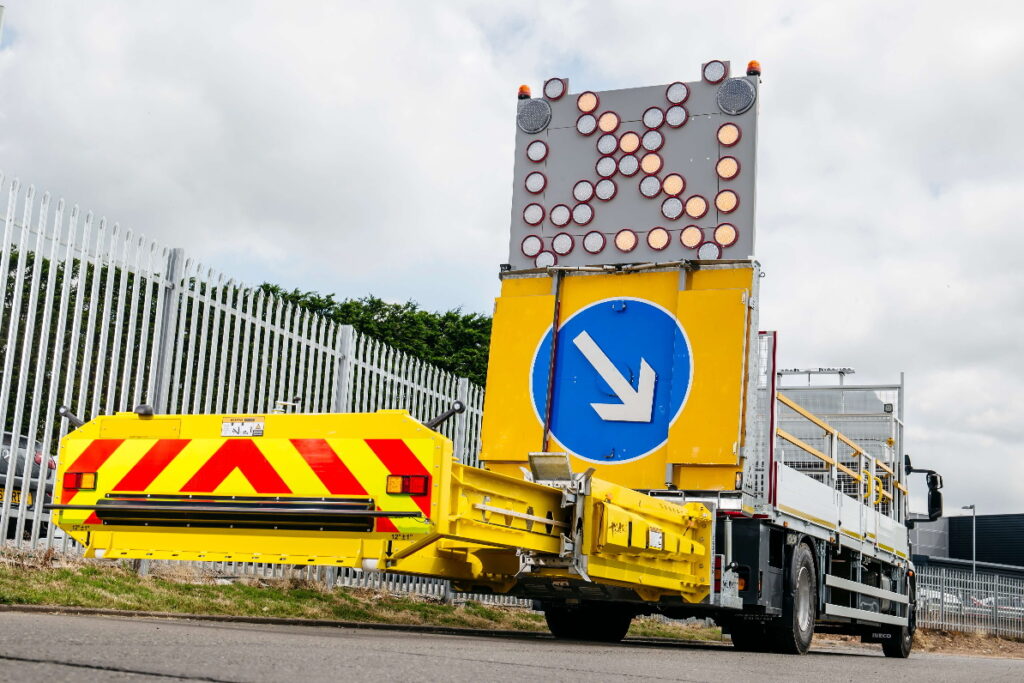
A trailer light truck mounted attenuator (TMA) is a crash cushion system towed behind a host vehicle on a trailer, designed to absorb the energy of an errant vehicle striking a work zone from the rear. Unlike self-propelled or directly mounted systems, the trailer configuration keeps the attenuator separate from the tow truck, reducing damage to the host vehicle on impact. The sections below cover how this system works, when to use it, and what to look for when selecting one.
How does a trailer light TMA differ from a self-propelled attenuator?
A trailer light TMA attaches to a standard tow vehicle via a hitch and trails behind it, while a self-propelled attenuator is integrated directly onto a dedicated truck. The key operational difference is that a trailer TMA decouples the crash cushion from the host vehicle, which means a rear-end collision is absorbed by the attenuator unit without necessarily destroying the truck cab or injuring the driver.
Self-propelled truck mounted attenuators are permanently or semi-permanently fixed to the rear of a work truck. They offer faster deployment because no separate trailer needs to be hitched or positioned. However, the host vehicle takes more structural stress in a high-speed impact.
Trailer light TMAs, by contrast, are well suited for operations where the host vehicle needs to be reused quickly after an impact event. The trailer unit can be inspected, repaired, or replaced independently. This separation also gives contractors flexibility: one tow vehicle can serve multiple trailer units across different project sites.
What safety standards must a trailer light TMA meet?
A trailer light TMA must meet recognized crash testing standards to be approved for use on public roads and work zones. In the United States, the two primary standards are NCHRP-350 TL-3 and MASH 2016 (Manual for Assessing Safety Hardware). MASH 2016 is the most current standard, and the Federal Highway Administration (FHWA) now requires new products to meet it for federally funded projects.
MASH 2016 testing subjects attenuators to impact scenarios using updated vehicle weights and speeds that better reflect modern traffic conditions compared to the older NCHRP-350 criteria. Products that pass receive an FHWA acceptance letter, which contractors and agencies should request as proof of compliance before purchasing or deploying any TMA system.
Beyond crash performance, trailer light TMAs used in active work zones typically need to comply with local traffic control device regulations, which may govern visibility requirements, lighting, and arrow board specifications. Always verify that the unit you deploy carries the appropriate acceptance documentation for your jurisdiction.
When is a trailer light TMA the right choice for a work zone?
A trailer light TMA is the right choice when your operation involves a moving or slow-moving work zone where the host vehicle needs to protect workers from rear-end traffic, but you also need the flexibility to separate the crash cushion from the truck after an impact. It is particularly useful for road resurfacing, lane marking, and maintenance operations that progress along a highway at low speed.
Consider a trailer TMA over a directly mounted system in these situations:
- Your fleet uses standard commercial trucks without rear-mount TMA brackets
- You need to move the attenuator between multiple vehicles or job sites
- Your operation requires the host truck to remain operational immediately after an impact
- Project specifications or contract requirements call for a trailer-based configuration
- You want to add an arrow board or VMS functionality to the trailer unit itself
For stationary work zones, a shadow truck with a directly mounted TMA may be more practical. But for moving operations on high-speed roads, the trailer configuration offers a practical balance of protection and operational continuity.
How is a trailer light TMA set up and positioned on site?
Setting up a trailer light TMA involves hitching the trailer unit to the tow vehicle, confirming the crash cushion is locked in its deployed position, and verifying that all lighting and signage on the unit are active before entering the work zone. The process is straightforward but requires a pre-deployment checklist to ensure the system performs correctly under impact.
Follow these steps for a standard setup:
- Inspect the unit before hitching: check for structural damage, hydraulic connections, and lighting function
- Hitch the trailer to the host vehicle and secure safety chains
- Deploy the attenuator to its operational position, typically lowered or extended rearward
- Activate arrow boards or VMS displays mounted on the trailer
- Position the host vehicle at the correct distance behind the work crew, following your traffic control plan
- Monitor the system throughout the operation and re-inspect after any impact event
Positioning depends on road speed, work zone layout, and national or local traffic control standards. Always follow the approved traffic management plan for the specific project, and ensure the TMA operator is trained on the unit’s deployment and recovery procedures.
What features should you look for in a trailer light TMA?
When evaluating a trailer light TMA, prioritize crash test certification, integrated visibility systems, and ease of maintenance. A unit that holds a current MASH 2016 FHWA acceptance letter gives you confidence in its performance. Beyond certification, the features that make a TMA genuinely useful in daily operations are what separate a good unit from a great one.
Look for these features when comparing trailer TMA options:
- LED arrow board integration: A built-in, high-visibility arrow board reduces the need for separate signage trailers
- Hydraulic lift mast: Raises the arrow board or lighting to the correct height for maximum visibility from approaching traffic
- Full-color VMS display: Allows you to communicate dynamic messages to drivers in real time
- Lightweight construction: Reduces tow vehicle wear and improves fuel efficiency during long operations
- Modular or replaceable components: After an impact, you want to replace only the damaged section rather than the entire unit
- Remote monitoring capability: GPS tracking and status updates let you manage equipment across multiple sites
Weight class is also worth checking. Different TMA models are rated for different impact energy levels, so match the unit’s rating to the speed limit of the road where you will be operating.
How Verdegro Helps with Trailer Light TMAs
We manufacture a range of truck mounted attenuators built and tested to both NCHRP-350 TL-3 and MASH 2016 standards, including trailer-based configurations suited for moving and stationary work zones. Our TMA lineup includes models such as the TMA-US 100K, TTMA-US 100K, LTMA-US 70K, and BLADE TMA, each designed for specific operational weight classes and deployment scenarios.
Here is what you get when you work with us:
- FHWA acceptance letters under MASH 2016, giving you documentation ready for federally funded projects
- Optional integrated accessories including LED arrow boards, full-color VMS displays, and hydraulic LED-lift masts on the trailer unit
- MobilityPlanner platform access for real-time GPS tracking, status updates, and remote control of your deployed equipment
- Support for road construction contractors and traffic management operators across international markets
- Durable, field-serviceable construction designed to minimize downtime after an impact event
If you are specifying or sourcing a trailer light TMA for an upcoming project, contact our team to discuss which model fits your operational requirements and compliance obligations.
Related Articles
- What should you look for when getting a truck mounted attenuator quote?
- How is a truck mounted attenuator tested before it's approved?
- What speed rating do truck mounted attenuators have?
- What is the difference between a truck mounted attenuator and a crash cushion?
- How do you choose the right truck mounted attenuator weight class?