
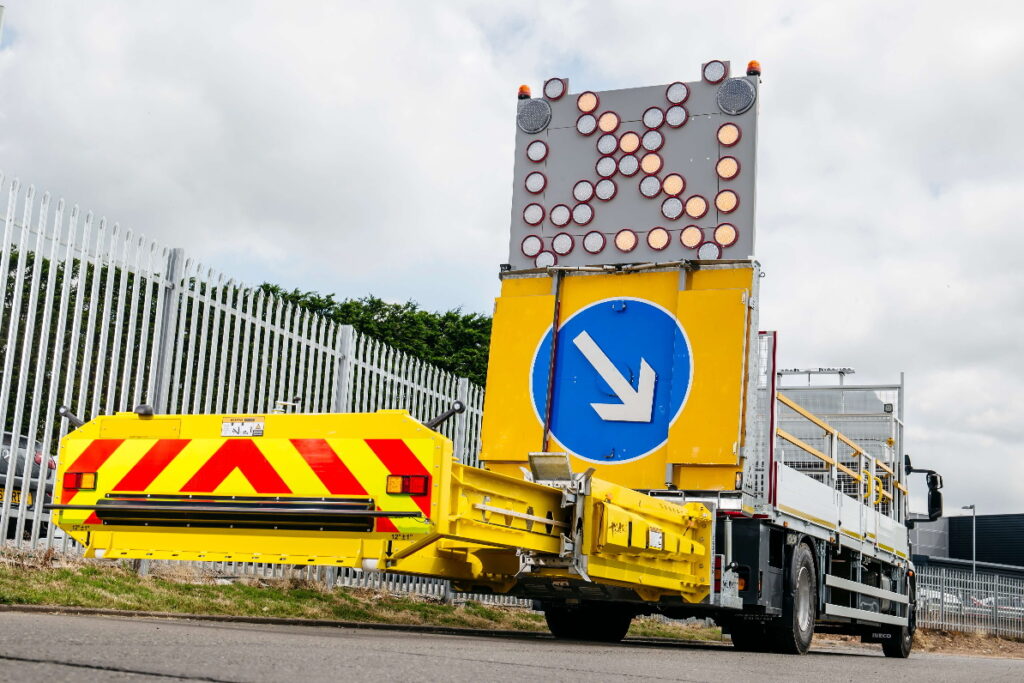
MASH (Manual for Assessing Safety Hardware) is the standard that governs truck-mounted attenuators in the United States, while CEN/TS 16786 applies across European markets. The two frameworks differ in their crash test protocols, performance classification systems, and compliance requirements, meaning a TMA approved under one standard does not automatically qualify under the other. The sections below walk through the key differences contractors and fleet managers need to understand before sourcing or deploying a TMA.
Which markets require MASH and which require CEN/TS 16786?
MASH applies in the United States and Canada, where federal and state highway authorities require crash safety hardware to meet this standard before it can be used on public roads. The Federal Highway Administration (FHWA) issues acceptance letters confirming compliance. CEN/TS 16786 is the European technical specification, developed by the European Committee for Standardization, and applies across EU member states and other countries that align with European road safety frameworks.
In practice, the market split is straightforward: if you are deploying truck-mounted attenuators on North American highways, MASH compliance is the requirement. If you are operating in Europe, CEN/TS 16786 sets the benchmark. Some markets outside these regions reference one or the other standard depending on their national adoption policies, so it is worth verifying local requirements before procurement.
What testing procedures does each standard require for TMAs?
Both standards require full-scale crash testing using instrumented vehicles, but they differ significantly in test conditions, vehicle masses, and impact configurations. MASH specifies a series of tests using defined vehicle types, including a small car and a pickup truck, at set speeds and angles. The tests simulate realistic crash scenarios at work zone speeds and measure how well the attenuator absorbs impact energy and redirects errant vehicles.
CEN/TS 16786 follows a similar principle but uses different vehicle categories, impact speeds, and evaluation criteria. European test vehicles and their masses reflect the European vehicle fleet, which differs from North American norms. The evaluation metrics also diverge: MASH uses occupant risk factors and vehicle trajectory criteria, while CEN/TS 16786 applies its own set of performance indicators aligned with European road safety research.
One practical consequence is that a TMA cannot simply carry over test results from one standard to the other. Separate physical crash tests must be conducted under each framework, which is why manufacturers who serve both markets invest in independent testing programs for each.
How do MASH and CEN/TS 16786 classify TMA performance levels?
MASH classifies TMAs by Test Level (TL), with TL-2 and TL-3 being the most relevant for truck-mounted attenuators. TL-3 is the higher classification and is required on most high-speed roads in the US, reflecting impact conditions at speeds up to 100 km/h. TL-2 covers lower-speed applications. The test level is tied directly to the crash test conditions the device has successfully passed.
CEN/TS 16786 uses a different classification structure based on performance categories that define the speed, impact angle, and vehicle mass conditions under which the TMA has been validated. These categories do not map directly onto MASH test levels, which is one reason why comparing products across the two standards requires careful reading of the actual test documentation rather than relying on headline classifications alone.
Can a TMA certified under one standard be used where the other applies?
No, certification under MASH does not satisfy CEN/TS 16786 requirements, and vice versa. Each standard has its own test protocols, vehicle parameters, and approval processes. Regulatory bodies in the US and Europe require documentation specific to their own framework, and a FHWA acceptance letter carries no authority in a European tender, just as a CEN/TS 16786 certificate does not fulfill US federal requirements.
This matters practically when contractors operate across multiple markets or when equipment is transferred between regions. If you are running work zones in both the US and Europe, you need TMAs that have been independently tested and approved under each applicable standard. Some manufacturers produce models that have been put through both test programs, which simplifies procurement for international operators.
What should contractors check when sourcing a compliant TMA?
Before purchasing a truck-mounted attenuator, verify that the specific model holds documented approval under the standard that applies to your market. For MASH, this means a current FHWA acceptance letter referencing the specific product model and test level. For CEN/TS 16786, look for a valid test report from an accredited test facility confirming the performance category achieved.
Key things to check include:
- Which standard version applies: MASH 2016 (also referred to as MASH 16) is the current US standard. Earlier NCHRP-350 approvals may no longer be accepted on new projects.
- The test level or performance category: Confirm it matches the speed environment where the TMA will be deployed.
- Model-specific documentation: Approval letters apply to specific models and configurations. Adding accessories or modifying the base vehicle can affect compliance.
- Acceptance by the relevant authority: Some state DOTs or national road authorities maintain their own approved product lists, check these in addition to the manufacturer’s documentation.
Asking the manufacturer directly for copies of the acceptance letter or test report is standard practice. A reputable supplier will provide this documentation without hesitation.
How Verdegro Helps with TMA Compliance Across Standards
We manufacture a range of truck-mounted attenuators that have been tested and approved to international crash safety standards, including MASH 2016. Our TMA product line includes the TMA-US 100K, TTMA-US 100K, LTMA-US 70K, and BLADE TMA, each designed to meet the demands of active work zones on high-speed roads. We hold multiple FHWA acceptance letters under MASH 16, the most current standard, so you can deploy our systems on US federal and state highway projects with confidence.
When you source a TMA from us, you get:
- Full documentation including FHWA acceptance letters for the relevant test level
- Models available with optional LED arrow boards, full-color VMS displays, and hydraulic LED-lift masts
- Systems built for road construction contractors and traffic management operators who need certified, durable crash protection
- Support in understanding which model and configuration suits your specific project requirements
If you are unsure which standard applies to your market or which TMA configuration fits your fleet, contact us and we will help you work through the compliance requirements for your specific situation.
Related Articles
- Why is Verdegro's truck mounted attenuator called Armadillo?
- What are signs that a truck mounted attenuator needs to be replaced?
- What is another name for a truck mounted attenuator?
- Is a trailer truck mounted attenuator safer than a truck mounted attenuator?
- Which countries require MASH-certified truck mounted attenuators?