
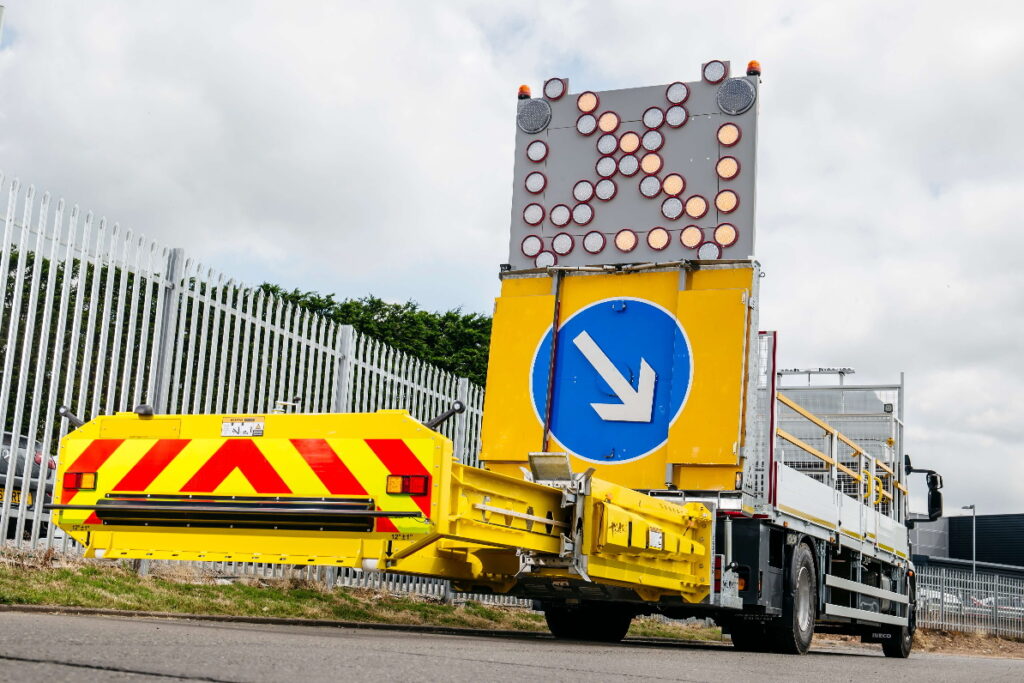
MASH (Manual for Assessing Safety Hardware) and NCHRP 350 are two different crash test standards used to certify truck mounted attenuators, and the core difference is test methodology and impact severity. MASH, introduced in 2009 and updated in 2016, uses heavier test vehicles, more realistic crash angles, and stricter occupant risk criteria than NCHRP 350. If you are buying or specifying a TMA today, MASH 2016 compliance is the standard that matters most on federally funded projects in the United States.
Below, we answer the most common questions contractors and traffic safety professionals ask when navigating these two standards.
Why did NCHRP 350 get replaced by MASH?
NCHRP 350 was replaced because vehicle fleets changed significantly after the standard was written in the 1990s, and crash testing needed to reflect those changes. The test vehicles specified in NCHRP 350 no longer represented the cars and trucks actually traveling on roads, which meant certified hardware was not being evaluated against realistic real-world impacts.
MASH addressed this by updating the test vehicle weights and dimensions to match modern fleets. The small car used in MASH testing is heavier than its NCHRP 350 equivalent, and the pickup truck test vehicle was also revised. These changes produced more demanding crash scenarios and, as a result, more meaningful safety data. The Federal Highway Administration (FHWA) began requiring MASH for new projects on the National Highway System, making NCHRP 350 progressively obsolete for new equipment purchases.
What are the main technical differences between MASH and NCHRP 350?
The main technical differences between MASH and NCHRP 350 lie in test vehicle weights, impact conditions, and occupant risk evaluation criteria. MASH uses a 2,420 lb (1,100 kg) small car and a 5,000 lb (2,270 kg) pickup truck, both heavier than NCHRP 350 equivalents, and applies stricter limits on how much a crash cushion can deform or redirect an impacting vehicle.
Key differences at a glance:
- Test vehicle weight: MASH vehicles are heavier, creating higher kinetic energy in impact tests
- Occupant risk factors: MASH sets tighter thresholds for occupant impact velocity (OIV) and ridedown acceleration (ORA)
- Crash angles: MASH includes additional angled impact scenarios not required under NCHRP 350
- Vehicle trajectory: MASH evaluates post-impact vehicle behavior more rigorously to reduce secondary collision risk
- Documentation requirements: MASH requires more detailed reporting, making test results easier to compare across products
For truck mounted attenuators specifically, these differences matter because a TMA absorbs impact from a moving vehicle at highway speeds. A heavier test vehicle hitting at a more demanding angle produces meaningfully different structural demands on the attenuator system.
Are NCHRP 350 certified TMAs still legal to use on job sites?
NCHRP 350 certified truck mounted attenuators are still legal to use on many job sites, but they are no longer accepted for new installations on federally funded National Highway System projects in the United States. The FHWA set a cutoff date after which only MASH-tested hardware qualifies for federal funding, though existing NCHRP 350 equipment already in service was generally grandfathered in.
Whether NCHRP 350 TMAs are acceptable on your specific project depends on three factors:
- Funding source: Federally funded NHS projects require MASH compliance for new purchases
- State or local policy: Individual state DOTs may have their own cutoff timelines and acceptance policies
- Equipment age: Equipment purchased and in service before FHWA cutoff dates may still be permitted under grandfathering provisions
If you are procuring new equipment today, purchasing NCHRP 350-only certified TMAs creates compliance risk. Always verify the applicable standard with the project owner before specifying hardware.
How does MASH 16 differ from the original MASH standard?
MASH 16 refers to the 2016 edition of the Manual for Assessing Safety Hardware, which updated and clarified the original 2009 version. The 2016 edition introduced refinements to test procedures, updated guidance on evaluation criteria, and resolved ambiguities that had created inconsistencies in how manufacturers and testing labs interpreted the original standard.
For truck mounted attenuators, MASH 16 is the current benchmark. The FHWA acceptance letters that confirm a product meets federal requirements reference specific test editions, so a TMA holding MASH 16 acceptance carries stronger and more current credentials than one tested only to the 2009 version. When reviewing product documentation, confirm that the FHWA acceptance letter explicitly references MASH 2016, not just “MASH” generically.
What should contractors look for when buying a MASH-compliant TMA?
When buying a MASH-compliant truck mounted attenuator, the most important thing to verify is that the product holds a current FHWA acceptance letter referencing MASH 2016 testing at the appropriate test level for your application. Test Level 3 (TL-3) is the standard for highway work zones where traffic travels at speeds up to 100 km/h (62 mph).
Beyond the compliance documentation, evaluate these factors:
- FHWA acceptance letter: Confirm it is current, references MASH 2016, and covers the specific TMA model you are purchasing
- Test level: Match TL-2 or TL-3 certification to the posted speed limit of your work zone
- Host vehicle compatibility: TMAs are rated for specific host vehicle weight classes; mismatching reduces system performance
- Reusability after impact: Some systems are designed for single-use replacement; others allow component repair and reuse
- Integrated accessories: Arrow boards, VMS displays, and lighting masts add operational value if they are built to work with the TMA system
- Manufacturer support: Replacement parts availability and technical support matter when equipment needs repair after a strike
How Verdegro Helps with MASH-Compliant Truck Mounted Attenuators
We manufacture a range of truck mounted attenuator systems that are tested and approved to MASH 2016 and NCHRP 350 TL-3 standards, including the TMA-US 100K, TTMA-US 100K, LTMA-US 70K, and BLADE TMA. Each system holds FHWA acceptance letters under MASH 16, the most current standard, so you can specify our products with confidence on federally funded projects.
Here is what you get when you work with us:
- MASH 16 certified systems with current FHWA acceptance letters for each model
- Multiple host vehicle weight classes covered across our TMA range, so you can match the right system to your fleet
- Optional integrated accessories including LED arrow boards, full-color VMS displays, and hydraulic LED-lift masts
- Real-time fleet visibility through our Mobilityplanner platform, which gives you GPS tracking, status updates, and remote control capabilities for deployed equipment
- Support for international projects with systems designed to meet compliance requirements across multiple markets
If you are specifying TMAs for an upcoming project and want to confirm which system fits your host vehicle, test level requirements, and project funding conditions, contact our team directly and we will help you find the right match.
Related Articles
- What should you look for when getting a truck mounted attenuator quote?
- What is the difference between the Blade and Armadillo truck mounted attenuator?
- Is NCHRP-350 still valid or has it been replaced by MASH for truck mounted attenuators?
- How does a truck mounted attenuator work?
- What is a truck mounted attenuator used for?