
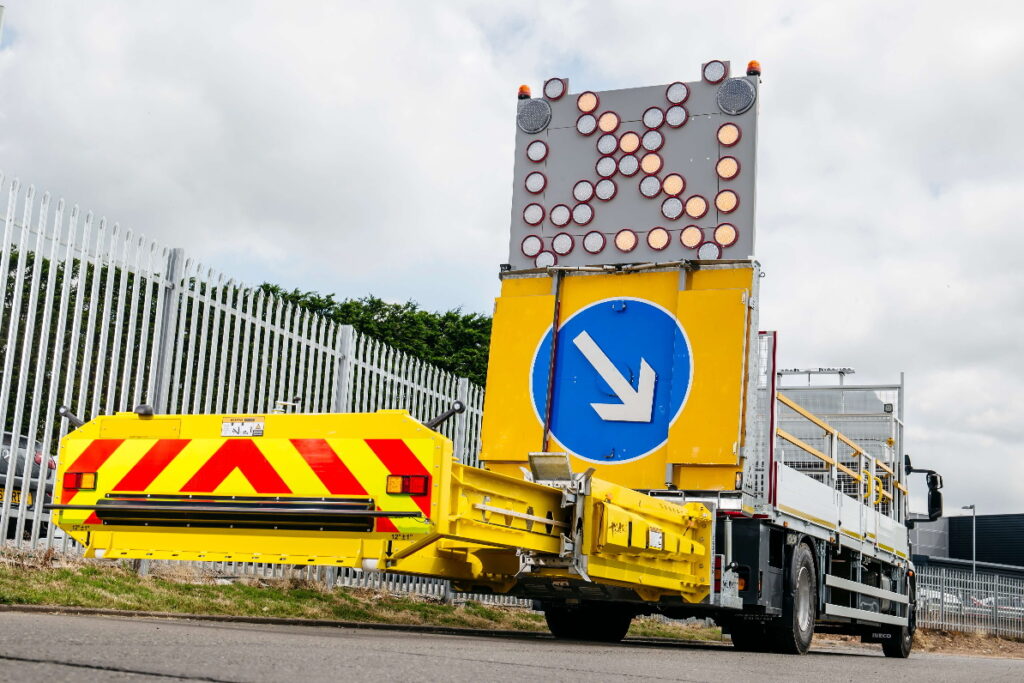
The VanGuard truck-mounted attenuator is a crash cushion system mounted to the rear of a shadow or host truck to absorb impact energy when a vehicle strikes the back of a work zone vehicle. It protects road workers and errant drivers by redirecting or cushioning the collision force before it reaches the people working ahead. Below, we answer the most common questions about how these systems work, when you need one, and how to choose the right setup.
How does a truck-mounted attenuator protect road workers?
A truck-mounted attenuator protects road workers by acting as a sacrificial energy-absorbing barrier between live traffic and the work zone. When an errant vehicle strikes the rear of the host truck, the TMA’s crash cartridge or cushion system compresses and deforms in a controlled way, absorbing kinetic energy and slowing the impacting vehicle before it can penetrate the work area.
The host truck, often called a shadow truck or attenuator truck, positions itself at the tail end of the work zone. Workers operate ahead of it, shielded from the rear. The TMA does not prevent all damage to the striking vehicle, but it significantly reduces the severity of the impact and keeps the host truck from being pushed forward into the crew.
Modern systems are designed to handle impacts at highway speeds. The crash cartridge is typically replaceable after a significant strike, which means the truck can return to service quickly once the damaged component is swapped out. This replaceability is a practical advantage in busy road construction environments where downtime costs money and delays protection for workers still on site.
What are the key specifications of the VanGuard TMA?
The VanGuard TMA is a truck-mounted attenuator designed and tested to meet current international crash safety standards, including MASH 2016 and NCHRP 350 TL-3. These are the most rigorous standards applied to work zone crash protection equipment in North America and internationally, and meeting them means the system has passed real-world crash tests at defined impact speeds and angles.
Key specification highlights for the VanGuard and the broader range we manufacture include:
- Test level: TL-3 under MASH 2016 and NCHRP 350, covering impacts up to 100 km/h (62 mph)
- Weight class compatibility: Models available for trucks ranging from 70K to 100K pound gross vehicle weight ratings
- Mounting: Rear-mount hitch attachment, compatible with a range of host vehicles
- Optional accessories: LED arrow boards, full-color Variable Message Sign (VMS) displays, and hydraulic LED-lift masts
- Replaceability: Crash cartridge designed for field replacement after impact
- FHWA acceptance: We hold multiple FHWA acceptance letters under MASH 16, the most current standard
The integration of arrow boards and VMS displays directly onto the TMA unit is a practical benefit. It reduces the number of separate vehicles needed in a work zone, simplifying setup and lowering operational costs for contractors managing tight budgets and timelines.
When is a truck-mounted attenuator required on a work zone?
A truck-mounted attenuator is required whenever a moving or stationary work vehicle is exposed to live traffic and workers are operating in the lane or shoulder area ahead of it. In most jurisdictions, traffic control plans for highway maintenance, road construction, and lane closure operations specify TMA use as a standard protective measure when work is performed in or adjacent to travel lanes.
The specific trigger points vary by country and jurisdiction, but common scenarios where a TMA is required or strongly recommended include:
- Moving operations such as line striping, pothole patching, or mowing along active roadways
- Stationary lane closures on high-speed roads where workers are exposed for extended periods
- Night work on highways where driver visibility is reduced
- Work zones on motorways or freeways with speed limits above 80 km/h (50 mph)
- Any situation where a traffic management plan or government contract specifies rear-impact protection
Government agencies and contractors working under public tenders are often contractually required to deploy certified TMA systems. Failing to meet these requirements can result in contract penalties or liability exposure in the event of an incident. If you are unsure whether your specific operation requires one, reviewing the applicable traffic control manual for your region is the right starting point.
What’s the difference between a TMA and a crash cushion?
The key distinction is mobility. A truck-mounted attenuator is attached to a vehicle and moves with the work zone, while a crash cushion is a fixed or semi-permanent device installed at a specific hazard point such as a gore area, bridge pier, or barrier end. Both absorb impact energy, but they serve different deployment contexts.
A crash cushion is designed to protect a stationary hazard that cannot be removed from the roadway. It stays in place and redirects or absorbs vehicles that leave the travel lane and strike the protected object. You can explore our crash protection systems to see how fixed and mobile options compare in practice.
A TMA, by contrast, travels with the host truck throughout the operation. It is the right choice when the hazard moves, such as a patching crew working down a highway, or when the work zone setup and teardown happen frequently. TMAs are also subject to specific vehicle weight and crash test certifications that differ from those applied to fixed crash cushions, so the two product categories follow separate compliance pathways.
Who is responsible for deploying a truck-mounted attenuator?
Responsibility for deploying a truck-mounted attenuator typically falls on the contractor or road authority managing the work zone. In most cases, the traffic control plan, which is submitted and approved before work begins, specifies whether a TMA is required and what standard it must meet. The contractor is then responsible for sourcing, operating, and maintaining a compliant system.
In practice, this means the project supervisor or traffic management officer on site carries day-to-day responsibility for ensuring the TMA is correctly positioned, in working condition, and operated by a trained driver. Government agencies that own the road may set the specification, but the contractor deploying the equipment bears operational accountability.
For equipment rental companies and fleet operators, responsibility extends to ensuring the TMA units they supply are certified to the required standard and that any post-impact damage is assessed before the unit returns to service. A TMA that has absorbed a significant strike may look intact but have a compromised crash cartridge, reducing its protective capacity.
How Verdegro Helps with Truck-Mounted Attenuator Selection and Deployment
We manufacture a full range of truck-mounted attenuators tested and certified to MASH 2016 and NCHRP 350 TL-3 standards, including the TMA-US 100K, TTMA-US 100K, LTMA-US 70K, and BLADE TMA. Each system is built for real-world work zone conditions and designed to integrate with the accessories your operation actually needs.
Here is what working with us gives you:
- Certified compliance: Multiple FHWA acceptance letters under MASH 16, so you can meet tender requirements and government specifications with confidence
- Flexible configurations: Optional LED arrow boards, full-color VMS displays, and hydraulic LED-lift masts available as integrated add-ons
- Weight class options: Systems matched to your host vehicle’s GVW rating, from 70K to 100K
- Replaceability by design: Crash cartridges built for field replacement, reducing downtime after an impact event
- Fleet visibility: Our Mobilityplanner platform gives you real-time GPS tracking, status updates, and remote monitoring across your deployed equipment
Whether you are equipping a single shadow truck or managing a fleet of work zone vehicles across multiple projects, we can help you find the right system. Contact us to discuss your requirements and get guidance on the best TMA configuration for your operation.
Related Articles
- Which countries require CEN/TS 16786-certified truck mounted attenuators?
- What accessories improve truck mounted attenuator visibility at night?
- What is the difference between a truck mounted attenuator and an arrow board?
- Should you choose a truck-mounted or trailer-mounted attenuator?
- How does a truck mounted attenuator work?