
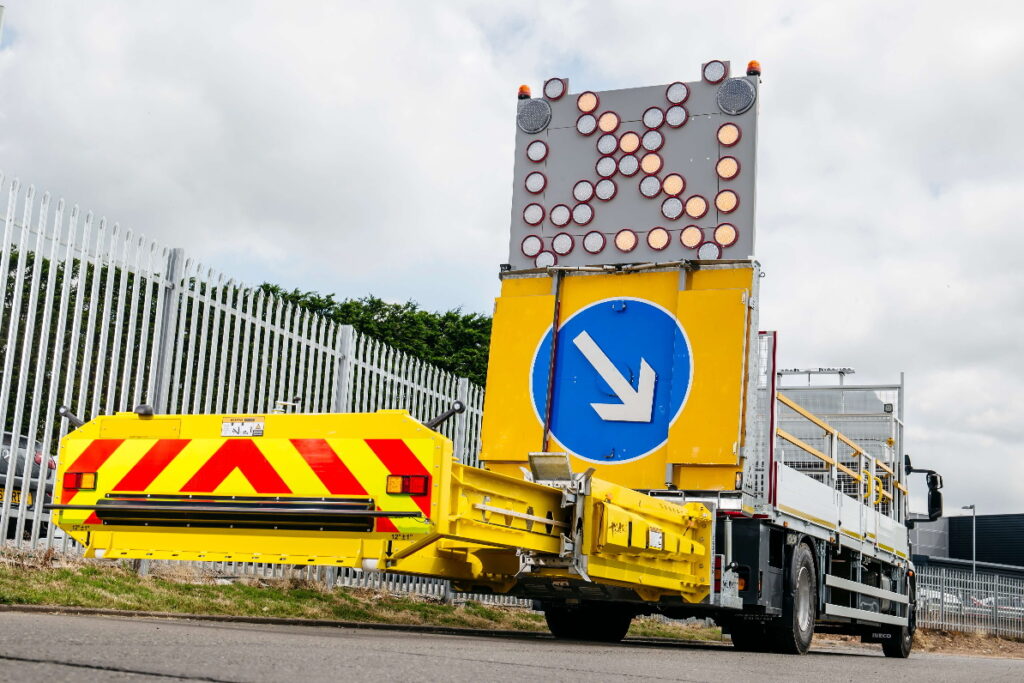
Truck mounted attenuators are speed-rated based on the impact conditions they are designed to withstand during crash testing. Most TMAs on the market today carry ratings for either 70 km/h (43 mph) or 100 km/h (62 mph) impact speeds, with the specific rating determined by the crash test standard the unit has been tested and approved under.
The speed rating tells you the maximum speed at which an errant vehicle can strike the attenuator and still have the crash energy managed within acceptable limits for occupant safety. Choosing the right rating for your work zone is not just a performance consideration, it is a compliance requirement on most public roads and highway projects. The sections below break down how these ratings work, what the standards require, and what factors influence which rating applies to your operation.
How are truck mounted attenuator speed ratings determined?
A truck mounted attenuator’s speed rating is determined through standardized full-scale crash testing. During these tests, a vehicle of a specified weight travels at a defined speed and strikes the rear of the attenuator head-on. The attenuator passes if it absorbs the impact energy within limits that protect both the occupants of the striking vehicle and the workers ahead of the host truck.
The two most widely referenced crash test standards for TMAs are NCHRP-350 and MASH 2016 (Manual for Assessing Safety Hardware). Each standard defines test vehicles, impact angles, speeds, and the performance criteria the device must meet. An attenuator is assigned a Test Level (TL) based on the most demanding conditions it successfully passes. The speed embedded in that test level becomes the device’s official speed rating.
It is worth noting that a speed rating is not a manufacturer’s claim, it is a verified result. Without a passing crash test report from an accredited testing facility, a TMA cannot carry a legitimate speed rating for use on public infrastructure projects.
What are the standard speed rating categories for TMAs?
Truck mounted attenuators are generally rated at one of two test levels: Test Level 2 (TL-2) for lower-speed environments and Test Level 3 (TL-3) for high-speed highway work zones. These test levels correspond to specific impact speeds used during crash testing.
- TL-2: Covers impact speeds up to 70 km/h (approximately 43 mph). This rating is suited for urban roads, local streets, and lower-speed work zones where traffic is managed to slower posted speeds.
- TL-3: Covers impact speeds up to 100 km/h (approximately 62 mph). This rating is required for most highway and motorway work zones where traffic continues to travel at or near full highway speeds.
Some manufacturers refer to their products using weight-based designations such as “70K” or “100K,” which correspond to the test vehicle weight (in pounds) used during TL-2 and TL-3 testing, respectively. These designations are common in North American markets but refer to the same underlying test level categories.
There is no universal TL-4 or higher rating currently applied to TMAs. TL-3 represents the highest standard in regular use for truck mounted attenuator systems deployed on public roads today.
What does MASH 16 compliance mean for a TMA’s speed rating?
MASH 16 compliance means the attenuator has been tested and approved according to the 2016 edition of the Manual for Assessing Safety Hardware, which is the most current and rigorous crash test standard for roadside safety devices in use today. For TMAs, MASH 2016 TL-3 approval means the unit has passed a 100 km/h impact test using updated vehicle models that better reflect the modern vehicle fleet.
MASH 2016 replaced the older NCHRP-350 standard and introduced heavier, more realistic test vehicles. This matters for speed ratings because a device that passed NCHRP-350 TL-3 was tested under less demanding conditions than one that passed MASH 2016 TL-3. The underlying speed is the same, but the structural demands on the attenuator are greater under MASH 2016.
For contractors and agencies working on federally funded road projects in the United States, MASH 2016 compliance is now the accepted benchmark. Many state DOTs and international procurement bodies are also moving toward requiring MASH 2016 certification rather than accepting NCHRP-350 approvals for new purchases. When evaluating a TMA’s speed rating, always confirm which standard the approval was issued under, not just the test level number.
Does the host vehicle affect the attenuator’s speed rating?
Yes, the host vehicle plays a direct role in how a TMA performs during an impact, and most crash test standards specify minimum host vehicle weight requirements that must be met for the speed rating to remain valid. If the host truck is too light, it will move forward too far upon impact, reducing the attenuator’s ability to absorb energy within the tested parameters.
Under MASH 2016, host vehicle weight requirements are defined as part of the approval conditions. A TMA approved at TL-3 will specify a minimum host vehicle gross weight, typically in the range of 10,000 to 15,000 kg depending on the specific product, and operating below that weight can compromise the rated performance.
Beyond weight, the mounting configuration also matters. The attenuator must be mounted at the correct height and attachment points specified in the approval documentation. Using an incompatible mounting setup, even on a correctly weighted truck, can void the speed rating in practice. Always verify that your host vehicle meets the manufacturer’s specifications before deploying a TMA in a rated work zone.
Which speed rating do most highway work zones require?
Most highway and motorway work zones require a TL-3-rated TMA, which corresponds to an impact speed of 100 km/h (62 mph). This is the standard applied on roads where traffic is not reduced below highway speeds, which covers the majority of active lane closures and shadow vehicle operations on major roads.
TL-2-rated attenuators at 70 km/h are appropriate for urban work zones, temporary road closures with enforced speed reductions, and lower-speed environments where traffic management measures reliably keep vehicle speeds below 70 km/h. On any road where vehicles may still travel at highway speeds, even in a posted work zone, TL-3 is the safer and often legally required choice.
Project specifications typically state the required test level explicitly. Government agencies and highway authorities will reference the applicable standard (MASH 2016 or NCHRP-350) and the test level in their tender documents. If you are unsure which rating applies to your project, review the contract specifications or consult with the relevant transport authority before selecting equipment.
How Verdegro Helps with TMA Speed Ratings
We manufacture a range of truck mounted attenuators tested and approved to both NCHRP-350 TL-3 and MASH 2016 standards, so you can match the right product to your project’s compliance requirements without compromise. Our TMA range includes:
- TMA-US 100K – approved to MASH 2016 TL-3, rated for 100 km/h highway work zones
- TTMA-US 100K – a truck-mounted variant with the same TL-3 highway rating
- LTMA-US 70K – designed for lower-speed urban and local road environments at TL-2
- BLADE TMA – a compact, high-performance option tested to current crash standards
All our attenuators come with FHWA acceptance letters under MASH 2016, which means you have the documentation needed to meet procurement requirements on federally funded and government-specified projects. We also offer optional accessories including LED arrow boards, full-color VMS displays, and hydraulic LED-lift masts, so your host vehicle can serve multiple functions in the work zone.
If you are selecting a TMA for an upcoming project and want to confirm which speed rating and standard applies to your specific road environment, contact our team and we will help you identify the right product for your compliance needs.
Related Articles
- How can contractors make roadwork safety vehicles more versatile?
- What is the role of an impact protection vehicle in temporary traffic management?
- Are truck mounted attenuators mandatory on highways?
- What should you look for when getting a truck mounted attenuator quote?
- What is a light truck mounted attenuator?