
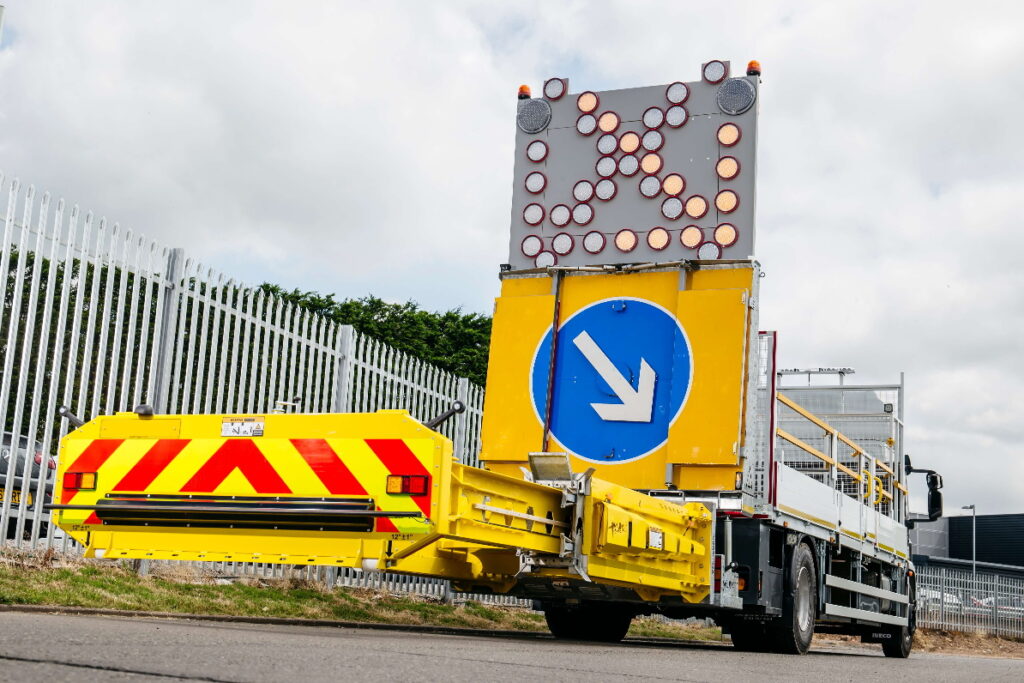
Truck mounted attenuator standards differ between the US and Europe because each region developed its own independent testing and certification framework. In the US, standards are governed by federal highway safety bodies and follow protocols like MASH 2016, while Europe applies EN 1317 under a harmonized regulatory structure. These parallel systems reflect different road environments, vehicle fleets, regulatory histories, and liability frameworks, which means a TMA approved in one region is not automatically accepted in the other.
The sections below unpack the specific questions that matter most when you are working across both markets or evaluating which standard applies to your project.
What specific safety tests do US and European TMA standards require?
In the US, truck mounted attenuators must pass crash tests defined by MASH (Manual for Assessing Safety Hardware) or the older NCHRP-350 protocol. These tests involve a vehicle striking the TMA at defined speeds and angles, with pass criteria covering occupant risk factors, structural behavior, and vehicle trajectory. In Europe, EN 1317 defines equivalent crash test procedures, but uses different vehicle masses, impact speeds, and performance categories.
Under MASH, the standard crash test for a TMA involves a passenger car impacting the rear of the attenuator at 100 km/h (Test Level 3). The test measures whether the impacting vehicle stays within a defined exit box, whether the host truck moves within acceptable limits, and whether occupant deceleration forces remain survivable. European EN 1317 tests follow a similar logic but use different vehicle types and classify performance using a separate grading system, TB (Test Level) categories rather than TL designations.
Both systems evaluate structural integrity, energy absorption, and occupant protection, but the specific vehicle weights, impact angles, and pass/fail thresholds differ enough that testing to one standard does not automatically satisfy the other.
Why did the US and Europe develop separate TMA certification systems?
The US and Europe developed separate certification systems because each region built its road safety infrastructure independently, shaped by different regulatory bodies, vehicle standards, and legal frameworks. The US system is coordinated through the Federal Highway Administration (FHWA), while Europe operates through a mix of national standards bodies unified under CEN (the European Committee for Standardization).
Vehicle fleets also differ significantly. Average passenger car weights, truck configurations, and highway design standards vary between the two regions, which means the real-world crash scenarios a TMA must handle are not identical. A standard calibrated to European road conditions and vehicle types will not necessarily reflect the impact dynamics common on US interstate highways.
Beyond the technical differences, procurement law, liability structures, and government contracting requirements reinforced the separation. US highway agencies require FHWA acceptance letters to approve safety hardware for federally funded projects, creating a formal gatekeeping mechanism that has no direct European equivalent.
What does MASH 16 compliance actually mean for a TMA?
MASH 16 compliance means a truck mounted attenuator has been crash tested and accepted under the 2016 edition of the Manual for Assessing Safety Hardware, which is currently the most up-to-date US testing standard. It replaced the older NCHRP-350 protocol and introduced more demanding test conditions, updated vehicle models, and stricter occupant risk criteria.
For a TMA to claim MASH 16 compliance, it must undergo physical crash testing at an accredited facility, produce documented test reports, and receive an FHWA acceptance letter. That letter is the formal mechanism by which the FHWA confirms the device meets federal eligibility for use on the National Highway System.
In practical terms, MASH 16 compliance signals that the attenuator has been validated against the most current safety benchmarks. Many US state departments of transportation now require MASH 16 acceptance as a condition of project approval, particularly on federally funded work zones. Products still carrying only NCHRP-350 approval may face restrictions or phase-out requirements depending on the state and project type.
Can a TMA certified in Europe be used legally on US roads?
No, a TMA certified only under European EN 1317 cannot automatically be used on US roads. To be eligible for use on federally funded US highways, a TMA must hold an FHWA acceptance letter based on MASH or NCHRP-350 testing. European certification does not substitute for this requirement, regardless of how rigorous the EN 1317 testing process was.
If a manufacturer wants to sell a European-certified TMA in the US market, the product must go through separate MASH crash testing at a US-recognized facility and obtain its own FHWA acceptance letter. This is a significant investment in time and cost, which is why not all European TMA manufacturers pursue US market access.
The reverse is also true: a MASH-certified TMA does not carry automatic approval for use in European markets. European procurement processes typically require CE marking and EN 1317 compliance documentation, which involves its own testing and certification pathway.
Which standard is stricter, MASH or EN 1317?
Neither standard is universally stricter; they are different, not hierarchical. MASH and EN 1317 test for similar outcomes (occupant protection, structural performance, vehicle trajectory) but use different methodologies, vehicle specifications, and pass criteria. Comparing them directly is not straightforward because they are calibrated to different baseline conditions.
MASH uses heavier test vehicles in some scenarios and applies specific occupant risk factor thresholds (the OIV and ORA values) that define acceptable deceleration forces. EN 1317 uses its own vehicle classes and measures performance through a different set of indices, including the ASI (Acceleration Severity Index) and THIV (Theoretical Head Impact Velocity).
Industry experience shows that meeting one standard does not guarantee meeting the other without modification. A TMA designed to pass MASH TL-3 may need structural or geometric adjustments to satisfy EN 1317 test requirements, and vice versa. The practical takeaway is that if you need to deploy in both markets, you should plan for dual certification from the outset rather than assuming one approval transfers.
How do TMA standards affect purchasing decisions for international projects?
TMA standards directly determine which products are legally eligible for use on a given project, which makes certification one of the first filters in any international purchasing decision. If your project involves federally funded US roads, MASH compliance and an FHWA acceptance letter are non-negotiable. If you are procuring for European public contracts, EN 1317 and CE marking are typically required.
For contractors and agencies managing work across multiple countries, the certification landscape adds complexity to procurement planning. You need to verify not just that a TMA meets a general safety standard, but that it holds the specific documentation required by the contracting authority in each jurisdiction.
Cost and lead time are also affected. Dual-certified products command a premium because manufacturers absorb the cost of running two separate crash test programs. However, for organizations operating internationally, a dual-certified TMA often represents better long-term value than maintaining separate product inventories for each market.
Supplier transparency matters here. When evaluating a TMA, ask for the actual FHWA acceptance letter or EN 1317 test report, not just a claim of compliance. These documents confirm which specific product configuration was tested and under which conditions, which is important because modifications to a tested design can affect certification validity.
How Verdegro Helps with TMA Certification and Compliance
We manufacture a range of truck mounted attenuators that are tested and accepted to both MASH 2016 and NCHRP-350 TL-3 standards, with FHWA acceptance letters in place. Our TMA lineup includes the TMA-US 100K, TTMA-US 100K, LTMA-US 70K, and BLADE TMA, each designed to meet the specific requirements of road construction contractors and traffic management operators working in regulated environments.
Here is what that means in practical terms for your procurement process:
- FHWA acceptance letters available: We hold acceptance letters under MASH 16, the most current US standard, so you can verify eligibility for federally funded projects without uncertainty.
- Documented crash test results: Every TMA in our range has been physically tested at accredited facilities, and we can provide the supporting documentation your contracting authority requires.
- Optional accessories included in certification scope: Our TMAs are available with LED arrow boards, full-color VMS displays, and hydraulic LED-lift masts, integrated configurations that have been evaluated as part of the overall system.
- Support for international projects: If you are working across markets with different certification requirements, we can help you identify which product configuration fits your specific regulatory context.
If you are planning a project and need to confirm which TMA standard applies or which of our products holds the right certification for your jurisdiction, contact us directly and we will give you a straight answer.