
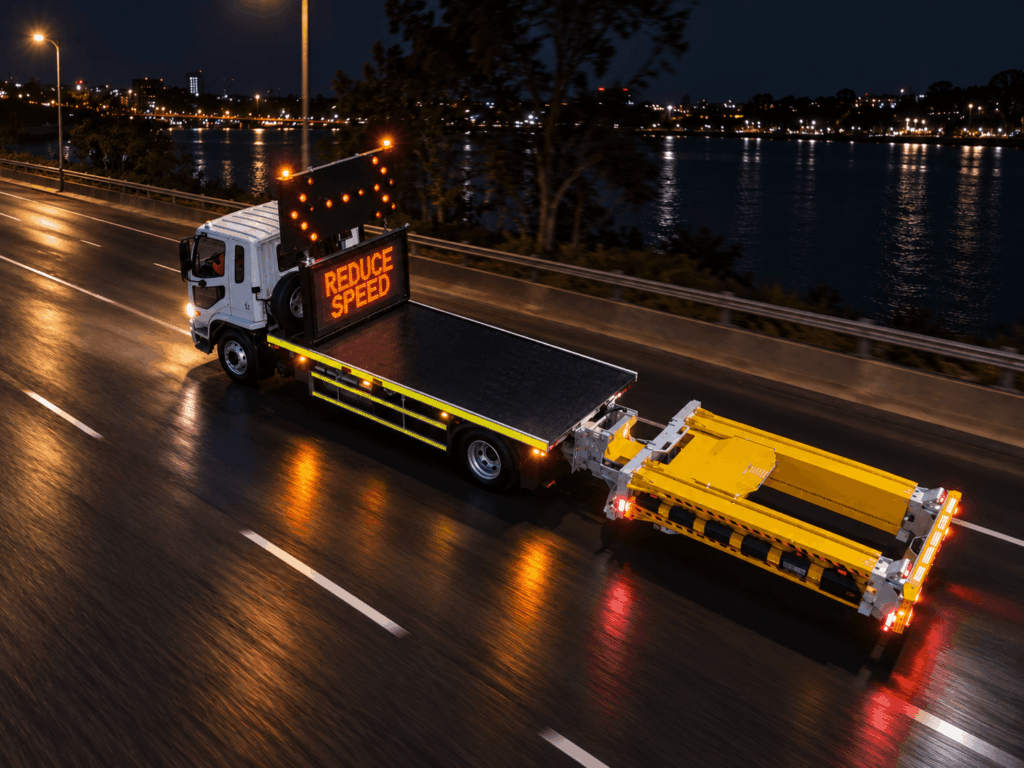
The type of impact attenuator you need depends on four main factors: the posted speed limit of the work zone, the applicable crash test standard in your jurisdiction, the nature of the hazard being shielded, and whether the protection point is fixed or mobile. Get those four factors right and the selection process becomes straightforward. The sections below walk through each factor in detail so you can make a confident, compliant choice.
What are the main categories of impact attenuators used in work zones?
Impact attenuators used in work zones fall into two broad categories: fixed crash cushions and truck-mounted attenuators (TMAs). Fixed crash cushions are installed in front of stationary hazards such as barrier ends, gore areas, and bridge piers. Truck-mounted attenuators are fitted to the rear of a shadow vehicle and move with the work crew, absorbing impacts from errant drivers in mobile operations.
Within those two categories, products vary by energy absorption method, test level, and deployment mechanism. Some fixed cushions are redirective, guiding an errant vehicle back toward the travel lane after impact. Others are non-redirective, bringing the vehicle to a controlled stop. TMAs are always non-redirective because the attenuator moves forward on impact, dissipating energy through controlled deformation of the cushion element.
A third, less common category covers portable attenuators designed for temporary placement without a host vehicle. These are typically used at low-speed locations where a full TMA or permanent crash cushion is not practical. However, for most highway and arterial work zones, the choice comes down to a fixed crash cushion or a truck-mounted attenuator.
How does work zone speed limit affect attenuator selection?
The posted or regulatory speed limit of the work zone directly determines the test level (TL) an attenuator must meet. Higher speeds require attenuators tested at higher impact velocities, which generally means larger, heavier, and more robust systems. Selecting an attenuator rated below the actual operating speed puts workers and road users at serious risk and will fail regulatory review.
Crash test standards divide performance into test levels that correspond to speed ranges. The most common breakdown under MASH 2016 is:
- TL-1 and TL-2: Low-speed environments such as parking areas, urban streets, and work zones with posted limits up to around 70 km/h (45 mph)
- TL-3: High-speed roads including motorways and dual carriageways where impact speeds reach 100 km/h (62 mph), the most frequently required level for highway work zones
- TL-4 and above: High-speed or high-mass scenarios involving heavier vehicles, typically specified by transport authorities for specific bridge or barrier applications
In practice, most highway work zones require a TL-3-rated product. If your operation involves a reduced speed zone, confirm with the relevant authority whether the reduced limit or the normal limit governs the attenuator specification. Many jurisdictions require TL-3 compliance regardless of temporary speed reductions, because drivers do not always slow to the posted work zone speed.
What role do MASH and NCHRP standards play in choosing an attenuator?
MASH (Manual for Assessing Safety Hardware) and its predecessor, NCHRP 350, are the two crash test standards that define whether an attenuator is accepted for use on public roads in the United States and in many international markets. MASH 2016 is the current standard, and it uses more demanding test conditions than NCHRP 350, including heavier test vehicles and revised occupant risk criteria. Choosing an attenuator that only holds NCHRP 350 acceptance may no longer satisfy procurement requirements on federally funded projects.
Outside North America, equivalent standards apply. The UK uses TD49/07 with its own optional test conditions, including the 110K test for higher-speed scenarios. European markets reference EN standards and national guidelines. When you operate across borders, verify which standard governs in each jurisdiction before specifying a product.
FHWA acceptance letters are the formal documentation confirming that a product has passed MASH testing and is eligible for use on National Highway System projects. Always request and review these letters when evaluating any attenuator. A product that is “tested to MASH” but does not hold a current FHWA acceptance letter may not be compliant for your project.
Does the type of hazard being shielded change which attenuator you need?
Yes, the geometry and permanence of the hazard directly influence attenuator selection. Wide, rigid hazards such as concrete barrier ends require redirective crash cushions that can guide an impacting vehicle back into the travel lane safely. Narrow or point hazards such as sign supports or small barrier noses may be shielded with non-redirective systems that bring the vehicle to a controlled stop in line with the hazard.
The width of the hazard matters because it determines how wide the attenuator’s protective envelope needs to be. A crash cushion must cover the full face of the hazard it protects. If the attenuator is narrower than the hazard, an offset impact could bypass the device entirely and strike the unprotected structure directly.
Permanence also plays a role. A long-term construction site with a fixed concrete barrier end warrants a permanent or semi-permanent crash cushion designed for repeated impacts and straightforward reset. A short-duration maintenance operation with a moving hazard point, such as a road marking crew or a pothole repair team, calls for a mobile solution, which is where a truck attenuator becomes the right answer.
When should a truck-mounted attenuator be used instead of a fixed crash cushion?
A truck-mounted attenuator is the right choice whenever the hazard moves with the work crew rather than remaining at a fixed location. Mobile operations, including line marking, pothole patching, sweeping, and inspection, require protection that travels with the team. A fixed crash cushion cannot provide that. A TMA mounted on a shadow truck positions itself between traffic and the work crew at all times, regardless of where the crew moves.
TMAs are also preferred when site access or project duration makes installing a fixed crash cushion impractical. Short-duration work, emergency repairs, and operations that shift location throughout a shift all benefit from the flexibility a truck attenuator provides. The shadow truck can reposition quickly, and the TMA reaches operational status in under a minute on modern systems.
There is one scenario where the choice is less obvious: a stationary work zone that runs for a full shift but breaks down and relocates daily. Here, a TMA often wins on logistics because setup and removal are faster than installing and recovering a fixed system each day. The trade-off is that a TMA occupies a vehicle and driver throughout the operation, which adds to running costs. Weigh that cost against the time saved on installation and the flexibility gained.
The size and weight class of the host vehicle also matter. Standard TMAs require a minimum support truck weight to function correctly and absorb impact energy as designed. If your fleet uses closed vans rather than flatbed trucks, verify that the TMA you specify is rated and tested for that vehicle class.
What site and logistical factors influence the final attenuator decision?
Beyond speed limits and standards, several practical site factors shape which attenuator is the right fit. Lane width is one of the first constraints to check: a wide attenuator in a narrow lane can itself become a hazard or prevent the host vehicle from staying within its lane. Compact designs that minimize lateral overhang are easier to operate in constrained environments.
Other factors worth evaluating before making a final decision include:
- Fleet compatibility: The attenuator must match the weight class and mounting configuration of the trucks or vans already in your fleet
- Deployment speed: Operations that require frequent repositioning benefit from systems that deploy and retract quickly without complex procedures
- Maintenance requirements: Simpler mechanical designs with fewer electronic components reduce downtime and repair costs in demanding field conditions
- Regulatory acceptance in your region: An attenuator accepted in one country may not hold the relevant certification in another, confirm acceptance letters before procurement
- Arrow board and signage integration: Many work zones require the shadow vehicle to display directional arrows or variable message signs alongside the attenuator, so check that the system supports the accessories you need
- Tracking and telematics: Projects with reporting requirements or fleet management needs benefit from attenuators that integrate with GPS and safety alert systems
Logistics also extend to storage and transport. Some attenuator designs fold or retract to a compact transport height that fits under bridge clearances and in depot storage. Others maintain a taller transport profile in exchange for a simpler deployment mechanism. Neither approach is universally better, the right choice depends on your route network and storage facilities.
How Verdegro Helps You Choose the Right Truck-Mounted Attenuator
We design and manufacture truck-mounted attenuators specifically for the conditions described throughout this article, from high-speed motorway work zones to compact urban maintenance operations. Our product range gives you tested, certified options across different vehicle classes and operational requirements.
- Armadillo TMA: Our newest truck attenuator, fully tested and approved to MASH 2016 TL-3 at 100 km/h. It deploys in a single stage in under 20 seconds while driving at 80 km/h, operates without sensors or electronic feedback systems, and weighs approximately 950 kg, making it one of the most mechanically straightforward TL-3 systems available. It is suited to flatbed trucks between 7,228 kg and 12,475 kg.
- VanGuard TMA: The world’s first TMA designed for closed vans, available in rear-mounted, top-mounted, and swing-mounted configurations. It protects at impact speeds up to 80 km/h and keeps rear door access and the tow hitch usable, giving van-based crews maximum operational flexibility.
- Mobitrack integration: All our attenuators can be fitted with Mobitrack, our GPS and telematics module. It provides real-time location data, location history, and automatic integration with safety alert platforms including Google Maps, Waze, and Flitsmeister, so drivers receive advance warning of your work zone before they reach it.
- FHWA acceptance and CE marking: Our products hold current FHWA acceptance letters under MASH 2016 and carry CE marking, supporting compliance on both US federal projects and European public contracts.
If you are comparing attenuator options for an upcoming project or want to confirm which system fits your truck class and jurisdiction, contact our team directly. We will help you match the right product to your operational requirements.