
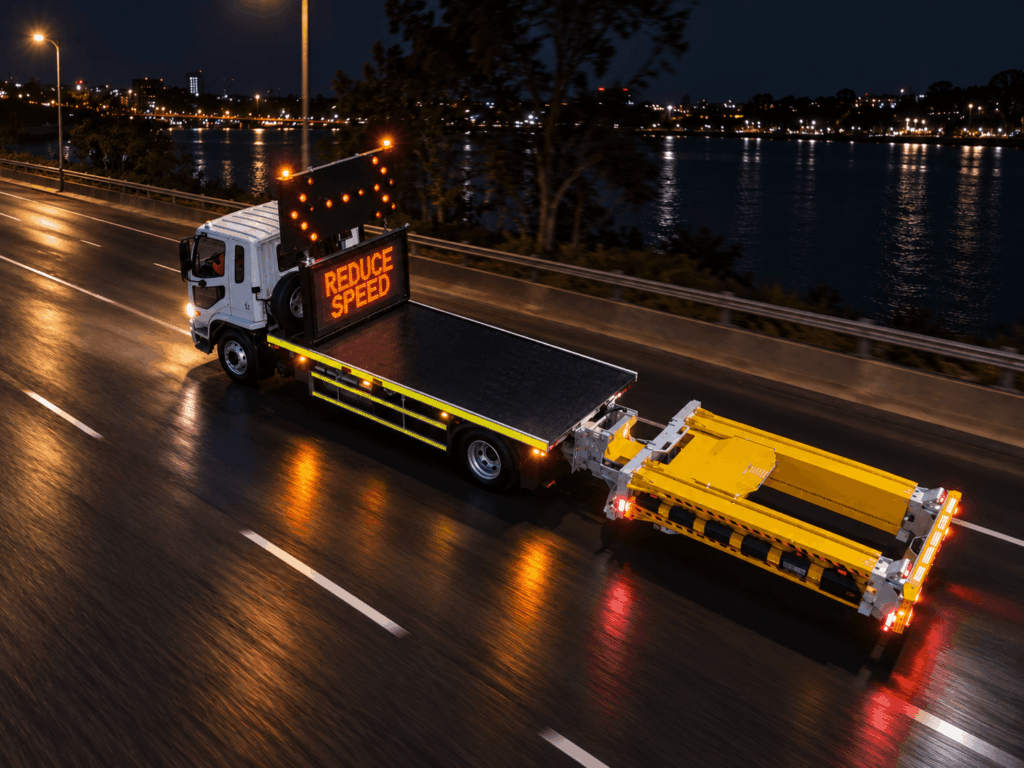
Road workers are protected during a lane closure through a combination of physical barriers, impact-absorbing equipment, and clear traffic control measures. The most important piece of protective equipment is the truck-mounted attenuator (TMA), a crash cushion mounted on the rear of a slow-moving or stationary truck that absorbs the force of an errant vehicle before it reaches workers. Alongside TMAs, teams use arrow boards, cones, signage, and speed reduction measures to create a safe work zone.
What equipment is used to protect road workers during a lane closure?
Road workers during a lane closure rely on several layers of equipment working together. A truck-mounted attenuator sits at the rear of the shadow truck, absorbing crash energy. Arrow boards direct traffic away from the work zone. Traffic cones and barriers physically separate workers from live lanes. Variable message signs warn approaching drivers well in advance.
Each piece of equipment serves a distinct purpose within the overall traffic management setup:
- Truck-Mounted Attenuators (TMAs): Absorb impact energy from errant vehicles, preventing them from reaching workers on foot or operating machinery.
- Arrow boards: Display lit directional arrows to guide drivers into the correct lane ahead of the closure.
- Variable Message Signs (VMS): Communicate real-time information such as speed limits, lane closures, and hazard warnings to approaching road users.
- Traffic cones and channelizing devices: Create a physical buffer between live traffic and the active work area.
- Rumble mats: Alert inattentive drivers through vibration before they enter the work zone.
The combination of these tools creates a layered defense. No single item is sufficient on its own. A well-equipped lane closure uses all of them in coordination, with the TMA acting as the last line of defense when a driver fails to respond to earlier warnings.
How does a truck-mounted attenuator protect workers in a work zone?
A truck-mounted attenuator protects workers by absorbing and redirecting the kinetic energy of a vehicle that enters the work zone unintentionally. Mounted on the rear of a shadow truck positioned behind the active crew, the attenuator deforms in a controlled way upon impact, slowing the errant vehicle and preventing it from penetrating the work area.
The physics behind a TMA are straightforward: a high-speed impact carries enormous energy, and that energy must go somewhere. Without an attenuator, it transfers directly to the truck, the workers, and surrounding equipment. With a TMA in place, the crash cushion absorbs that energy progressively, reducing the forces experienced by both the errant driver and anyone nearby.
Modern truck attenuators are tested and approved under rigorous crash standards such as MASH 2016 TL-3, which requires the system to perform safely at impact speeds up to 100 km/h (62 mph). These tests simulate real-world crash scenarios to confirm the attenuator performs consistently under the conditions road crews actually face.
Beyond the crash cushion itself, the shadow truck’s position matters. The truck parks or moves slowly at the tail of the work zone, keeping the TMA between live traffic and the crew at all times. This moving buffer zone is what makes the setup effective for both stationary operations and slow-moving maintenance convoys.
What are the standard steps for safely closing a traffic lane?
A safe lane closure follows a structured sequence designed to give drivers maximum warning time while protecting workers throughout the setup process. The steps progress from advance warning to the physical closure and finally to the protected work zone itself.
The typical sequence for a lane closure looks like this:
- Advance warning signs: Place signs well ahead of the closure to alert drivers to the upcoming change. Distance depends on road speed and type.
- Speed reduction signage: Reduce posted speed progressively through the transition zone using temporary speed limit signs or VMS boards.
- Taper setup: Use traffic cones or delineators arranged in a diagonal line to merge traffic from the closed lane into the open one.
- Shadow truck positioning: Position the shadow truck with its TMA deployed at the rear of the work zone, facing oncoming traffic.
- Arrow board activation: Switch on the arrow board to provide a clear, visible directional signal to approaching drivers.
- Work zone establishment: Workers and equipment move into position behind the protected buffer created by the shadow truck and TMA.
The order matters. Workers should never enter the work zone before the physical protection and signage are in place. Closing down follows the reverse sequence: workers clear the area first, then equipment is retrieved, then signage is removed from the farthest point back toward the closure.
What safety standards govern lane closure procedures?
Lane closure procedures are governed by national and international traffic safety standards that define how work zones must be set up, what equipment must be used, and how that equipment must perform. The most widely referenced standards include MASH 2016 (Manual for Assessing Safety Hardware) in the United States, the UK’s TD49/07, and various European national standards.
MASH 2016 is the current benchmark for crash testing safety hardware in North America. It replaced the earlier NCHRP 350 standard and sets stricter requirements for how attenuators, barriers, and other roadside hardware must perform in controlled crash scenarios. Equipment approved under MASH 2016 has been tested at Test Level 3 (TL-3), which represents highway speeds up to 100 km/h (62 mph).
In the UK, the optional 110K test under TD49/07 extends certification to impact speeds of 110 km/h, reflecting the higher speed limits on some British motorways. Equipment that passes both MASH 2016 and the UK 110K test demonstrates performance across a wider range of real-world conditions.
Beyond equipment standards, most countries publish traffic management guidelines that specify taper lengths, sign placement distances, minimum buffer zones, and speed reduction requirements. In the United States, the Manual on Uniform Traffic Control Devices (MUTCD) provides this framework. Compliance with these standards is not optional for contractors working on public roads.
How does technology improve road worker safety during lane closures?
Technology improves road worker safety during lane closures by adding real-time awareness, automated alerts, and remote monitoring to the physical protection measures already in place. GPS tracking, integrated safety alert systems, and digital management platforms give teams better situational awareness and help warn drivers before they reach the work zone.
GPS-based tracking systems allow fleet managers and traffic control centers to see the exact location of every shadow truck, TMA, and arrow board in real time. If equipment moves outside a designated area or a vehicle enters an unexpected position, supervisors can respond immediately. This level of visibility was not possible with purely physical setups.
Driver alert integrations take this further. When a TMA or work zone vehicle is equipped with a tracking module connected to navigation platforms such as Waze, Google Maps, or national traffic control systems, approaching drivers receive automatic warnings before they reach the closure. This early warning reduces the likelihood of a distracted or speeding driver entering the work zone without slowing down.
Remote monitoring of equipment status, including whether a crash cushion is deployed or an arrow board is active, adds another layer of operational control. Supervisors can verify that all equipment is functioning correctly without needing a physical check on every unit, which saves time and reduces the need for workers to move through active traffic zones unnecessarily.
How Verdegro Helps Protect Road Workers During Lane Closures
We design and manufacture the equipment that road crews depend on when closing a lane. Our product range covers the full scope of work zone protection, from truck-mounted attenuators to arrow boards, VMS signs, and integrated tracking technology.
Here is what we offer for lane closure safety:
- Armadillo TMA: Our newest truck attenuator, introduced in 2026 and fully tested to MASH 2016 TL-3 at 100 km/h (62 mph). The Armadillo deploys in a single continuous motion in under 20 seconds while driving at 80 km/h, operates without sensors or electronic components (only a hydraulic power pack), and weighs approximately 950 kg. Its compact 2300 mm width makes it well suited to narrow lanes and constrained work zones.
- VanGuard TMA: The world’s first TMA designed for closed vans, available in rear-mounted, top-mounted, and swing-mounted versions. The VanGuard can absorb impacts at speeds up to 80 km/h and is fully customizable to match your fleet.
- Mobitrack: Our GPS tracking and safety alert module integrates with Google, Waze, Flitsmeister, Monotch, and national traffic control systems to warn approaching drivers of nearby workers. We are the only manufacturer with this level of integration across safety alert platforms.
- Mobilityplanner: Our online platform gives you real-time status updates, GPS tracking, remote control capabilities, and equipment statistics across your entire fleet.
All our crash systems are delivered with official crash test certifications and CE marking. Whether you operate a single shadow truck or manage a large fleet across multiple projects, we can provide the right combination of hardware and technology to keep your crews protected.
Contact us to discuss your work zone safety requirements and find out which TMA configuration fits your operation.
Related Articles
- How is roadwork impact protection changing for lighter vehicles?
- What is the safe following distance behind a truck mounted attenuator?
- Who is responsible for positioning a truck mounted attenuator correctly on site?
- What is inside a truck mounted attenuator?
- What is the most popular truck mounted attenuator model for highway work?