
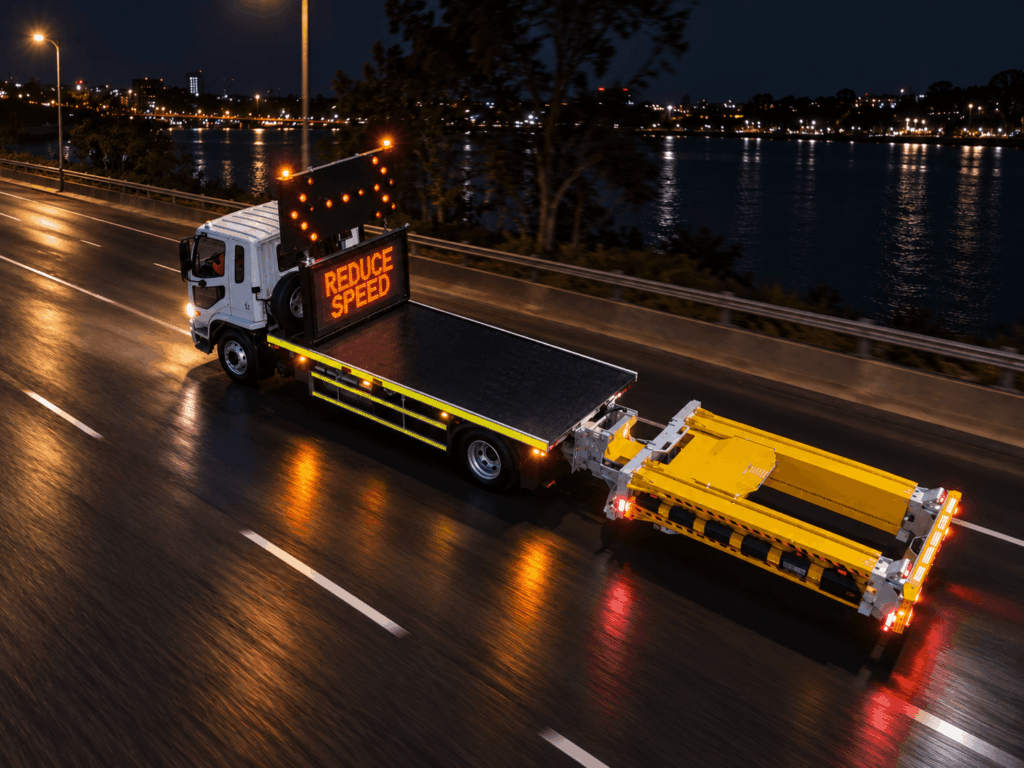
A road maintenance fleet prepares for different work zones by equipping each vehicle with the right combination of safety equipment matched to the specific environment, including traffic speed, lane configuration, work duration, and road type. The right preparation depends on whether your crew is working on a high-speed motorway, an urban arterial, or a short-duration maintenance stop. Below, we answer the most common questions fleet managers ask when planning work zone deployments.
What types of work zones does a road maintenance fleet typically encounter?
Road maintenance fleets typically encounter four main work zone types: long-term stationary zones, short-term stationary zones, moving operations, and intermittent work zones. Each type has distinct traffic management requirements, and your equipment selection must reflect the specific conditions of each setup rather than applying a one-size-fits-all approach.
- Long-term stationary zones involve fixed lane closures lasting days or weeks, common during resurfacing or bridge work. These require full signage sequences, barriers, and crash protection.
- Short-term stationary zones last hours, such as pothole patching or utility inspections. Equipment must deploy and retract quickly.
- Moving operations involve a crew advancing along the road, mowing, line marking, or sweeping, where the work zone travels with the vehicles.
- Intermittent work zones involve repeated stops at multiple locations along a route, requiring fast repositioning of safety equipment between sites.
Understanding which zone type you are entering before deployment is the first step toward matching your fleet’s equipment to the actual risk profile on the ground.
What safety equipment is required for different work zone setups?
The safety equipment required for a work zone depends on its type, duration, and traffic exposure. At minimum, every work zone needs advance warning signs, channelizing devices, and worker visibility gear. Higher-risk zones, particularly those on high-speed roads, additionally require truck mounted attenuators, arrow boards, and variable message signs to manage approaching traffic safely.
Here is a practical overview of typical equipment requirements by work zone type:
- Long-term stationary zones: Advance warning signs, lane closure tapers, concrete or water-filled barriers, arrow boards, variable message signs (VMS), and truck attenuators on shadow vehicles.
- Short-term stationary zones: Cones, portable warning signs, arrow boards, and a shadow vehicle with a truck mounted attenuator where traffic speeds exceed 50 km/h.
- Moving operations: A lead vehicle with warning lights and an arrow board, a rear shadow vehicle equipped with a truck mounted attenuator, and appropriate lighting if working at night.
- Intermittent work zones: Portable, quick-deploy equipment, compact attenuators, lightweight arrow boards, and traffic cones that can be repositioned rapidly between stops.
Compliance standards in your jurisdiction will define the minimum equipment thresholds. Always verify that your equipment meets the applicable certification standard for the road class you are working on.
How does traffic speed affect work zone equipment selection?
Traffic speed is one of the most direct factors in work zone equipment selection. The higher the posted speed limit, the greater the impact energy a crash protection system must absorb, and the more advance warning distance drivers need to react safely. On roads above 80 km/h (50 mph), a truck mounted attenuator on the shadow vehicle is a standard requirement in most regulatory frameworks.
At lower urban speeds, typically below 50 km/h, a shadow vehicle with warning lights and basic channelizing devices may be sufficient for short-duration work. As speeds increase, the equipment requirements escalate accordingly:
- Up to 50 km/h: Cones, portable signs, and warning lights on the work vehicle.
- 50 to 80 km/h: Arrow boards, additional advance warning signs, and a shadow vehicle with a truck attenuator recommended.
- Above 80 km/h: Full lane closure setup with a certified truck mounted attenuator, VMS boards, and extended advance warning distances.
Speed also affects the type of attenuator you need. Systems deployed on high-speed roads must meet higher test level standards, such as MASH 2016 TL-3, which covers impacts at 100 km/h (62 mph), to provide adequate protection for workers and the shadow vehicle operator.
How can fleet managers ensure compliance across multiple simultaneous work zones?
Fleet managers ensure compliance across multiple simultaneous work zones by standardizing equipment specifications, maintaining clear deployment checklists, and using digital tracking tools to monitor the location and status of each asset in real time. Without a centralized system, it becomes difficult to confirm that every active site has the correct equipment deployed and functioning.
Practical steps that support multi-site compliance include:
- Standardize your equipment inventory so that each vehicle type in your fleet carries a defined set of certified safety equipment matched to its typical deployment context.
- Use pre-deployment checklists that crew supervisors complete before each job, covering equipment condition, certification status, and site-specific requirements.
- Implement GPS and asset tracking to confirm that shadow vehicles and attenuators are positioned correctly at each active site.
- Conduct regular audits of equipment certifications to ensure nothing has expired or fallen out of compliance with current standards.
- Train crews on site-specific requirements rather than generic procedures, so workers understand why a particular setup is required for a given road class or speed environment.
Digital fleet management platforms that integrate with your safety equipment can simplify this significantly, giving managers a live overview of all deployed assets without requiring manual check-ins from each site.
When should a fleet deploy mobile lighting versus fixed lighting systems?
A fleet should deploy mobile lighting when the work zone is temporary, moves along the road, or requires rapid setup and relocation. Fixed lighting is more appropriate for long-term stationary zones where a permanent or semi-permanent installation is practical and cost-effective. The key distinction is flexibility: mobile lighting travels with your crew, while fixed systems serve a defined location.
Mobile lighting systems are the right choice when:
- The work zone shifts position during the shift, such as during moving operations or multi-stop maintenance routes.
- Setup and takedown time must be minimized to reduce traffic disruption.
- Power infrastructure is unavailable at the site, making self-contained or solar-powered units necessary.
- The terrain or road geometry changes between deployments, requiring adjustable positioning.
Fixed lighting suits long-term construction projects where the zone boundary does not change, and where the cost of a more permanent installation is justified by the duration of the work. For most road maintenance fleets handling routine maintenance across varied locations, mobile lighting offers the operational flexibility that fixed systems cannot match.
What are the most common work zone preparation mistakes fleet operators make?
The most common work zone preparation mistakes include deploying equipment that does not match the speed environment, skipping pre-deployment equipment checks, underestimating setup time, and failing to account for nighttime or low-visibility conditions. These errors increase risk for both workers and road users, and they are largely preventable with better planning protocols.
Specific mistakes to avoid:
- Using uncertified or outdated equipment – attenuators and arrow boards must meet current standards for the road class where they are deployed. Equipment certified under older standards may not provide adequate protection.
- Positioning the shadow vehicle incorrectly – a truck attenuator only provides protection when the shadow vehicle is correctly positioned in the traffic lane upstream of the work crew.
- Ignoring advance warning distances – at higher speeds, drivers need significantly more distance to react. Placing signs too close to the work zone gives approaching traffic insufficient time to merge or slow down.
- Neglecting equipment maintenance – hydraulic systems, arrow boards, and lighting units require regular inspection. A system that fails during deployment creates exactly the hazard it was meant to prevent.
- Not adapting to changing conditions – weather, daylight, and traffic volume can change during a shift. A setup that was adequate at the start of the day may be insufficient after dark or during peak traffic hours.
How Verdegro Helps You Prepare for Any Work Zone
We design and manufacture traffic safety equipment built for the full range of work zone conditions your fleet encounters. Whether you are running moving operations on a motorway or managing short-duration stops on urban roads, our product range covers the protection and signaling equipment you need.
- Armadillo TMA – our newest truck mounted attenuator, fully tested and approved to MASH 2016 TL-3 at 100 km/h (62 mph). It deploys in under 20 seconds while driving at 80 km/h, making it well-suited for moving operations and fast-changing work zones. Its compact width of 2300 mm and mechanical simplicity, no sensors, no electronic feedback systems, reduce maintenance demands and keep your fleet operational.
- VanGuard TMA – the world’s first truck mounted attenuator designed for closed vans, available in rear-mounted, top-mounted, and swing-mounted configurations. This gives smaller fleet vehicles the same crash protection capability as larger shadow vehicles.
- Mobitrack – our GPS tracking and safety alert integration module, compatible with Google, Waze, Flitsmeister, Monotch, and your country’s traffic control system. It gives fleet managers real-time visibility of every deployed asset and can send alerts to approaching drivers to improve worker safety.
- Mobilityplanner – our web platform that lets you monitor product status, location, and operational data across all your active sites from a single dashboard.
If you want to match your fleet’s equipment to the specific work zones you operate in, contact us and we will help you find the right configuration.
Related Articles
- Are all truck mounted attenuators built the same way?
- What is a wings add-on used for on a truck mounted attenuator?
- What is NCHRP-350 and how does it apply to truck mounted attenuators?
- What makes one truck mounted attenuator model better suited to your project?
- Does a heavier truck mounted attenuator offer better protection?