
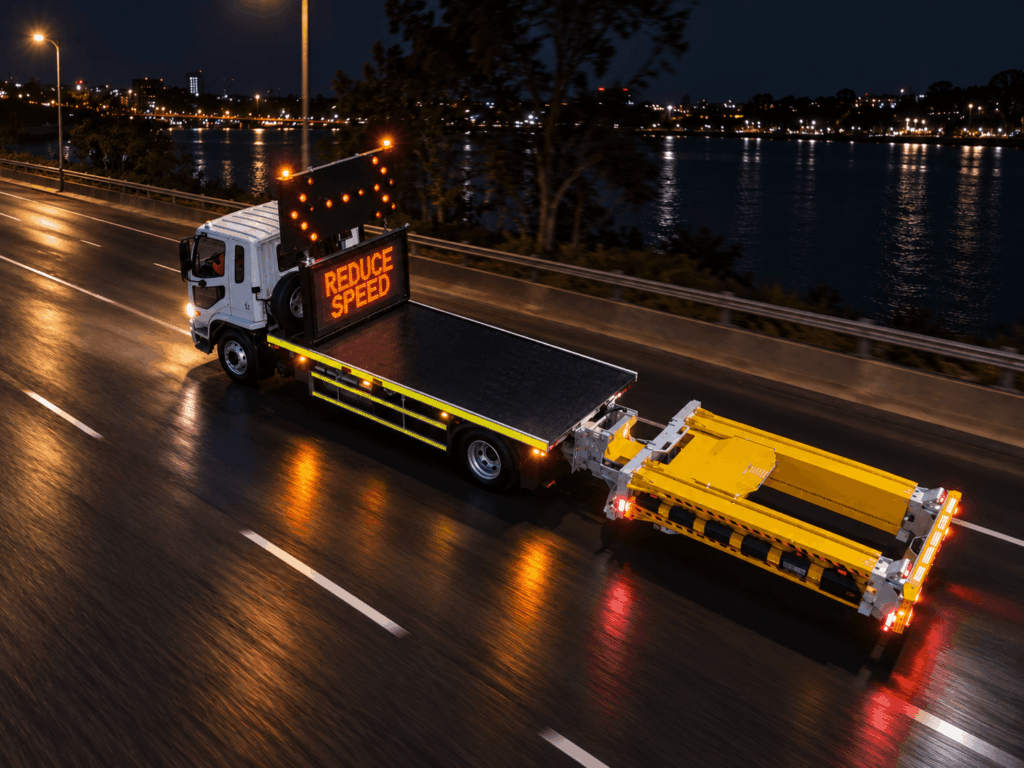
To protect the end of a temporary work zone, road crews deploy a shadow vehicle equipped with a truck-mounted attenuator (TMA), a crash cushion mounted on the rear of a truck that absorbs the energy of an errant vehicle before it reaches workers. This setup is the standard method for end-of-zone protection on active roadways. The sections below answer the most common questions about how this protection works, what equipment is involved, and who is responsible for putting it in place.
What equipment is used to protect the end of a work zone?
The primary equipment used to protect the end of a work zone is a shadow vehicle fitted with a truck-mounted attenuator. The shadow vehicle parks or travels slowly at the rear of the work zone, absorbing impact energy if a driver fails to slow down or change lanes in time. Supporting equipment includes arrow boards, variable message signs, and reflective markings that guide traffic away from the hazard.
Together, these elements form a layered protection system. The TMA handles the physical crash event. The arrow board and signs handle the behavioral side, warning drivers well in advance that the lane configuration is changing. In many jurisdictions, both elements are required simultaneously rather than as alternatives to each other.
Other equipment commonly deployed at the terminal end of a work zone includes:
- Truck-Mounted Attenuators (TMAs) for impact absorption
- Arrow boards to direct traffic away from the work area
- Variable Message Signs (VMS) for early warning and real-time messaging
- Reflective chevron markings on the shadow vehicle for visibility
- Rumble strips or rumble mats to alert inattentive drivers before they reach the zone
What is a Truck-Mounted Attenuator and how does it work?
A truck-mounted attenuator is a crash cushion system bolted to the rear of a slow-moving or stationary truck that absorbs the kinetic energy of an impacting vehicle, reducing the severity of the crash and protecting workers behind it. The attenuator deforms on impact in a controlled way, slowing the errant vehicle progressively rather than stopping it abruptly.
When a vehicle strikes the TMA, the cushion structure collapses in a managed sequence, dissipating energy across a longer distance and time than a rigid barrier would allow. This controlled deformation is what keeps impact forces within survivable limits for the occupants of the striking vehicle, and it keeps the shadow truck from being pushed into the work crew.
Most truck attenuators are hydraulically operated. The operator deploys the cushion from a cab-mounted controller, lowering it into the operational position while the truck is moving. After an impact, the damaged cushion element is typically replaced, and the truck returns to service. Modern systems are designed for fast, repeatable deployment so that downtime after a strike is minimized.
TMAs are tested and certified against crash standards such as MASH 2016 (Manual for Assessing Safety Hardware) at specific test levels. Test Level 3 (TL-3), for example, covers impacts at 100 km/h (62 mph), which is the standard applied to most highway work zones.
What’s the difference between a TMA and a crash cushion?
A TMA (truck-mounted attenuator) is a mobile crash cushion mounted on a vehicle, while a crash cushion in the broader sense refers to any energy-absorbing device placed in front of a fixed hazard. The key difference is mobility: a TMA travels with the work zone, whereas a static crash cushion is anchored to a specific location such as the nose of a gore area or a concrete barrier end.
Both serve the same fundamental purpose, absorbing crash energy to protect people and infrastructure, but they are used in different contexts. Static crash cushions protect permanent or semi-permanent hazards. TMAs protect moving or temporary work zones where the hazard location changes from day to day or hour to hour.
A secondary distinction is replaceability. After a static crash cushion is struck, it must be repaired or replaced in place, which can take time and create additional hazard. A TMA-equipped shadow truck can be driven away from the scene, and in some designs, the damaged cushion element can be swapped out and the truck returned to service relatively quickly.
It is also worth noting that the term “crash cushion” is sometimes used informally to describe the attenuator element of a TMA itself. When Verdegro refers to the cushion on a TMA, it means the deformable energy-absorbing component that mounts to the rear of the vehicle, not a separate static device.
How far back should the shadow vehicle be from the work crew?
The shadow vehicle should be positioned between the work crew and oncoming traffic, maintaining a buffer distance that gives workers time to react if the truck is struck and pushed forward. The exact buffer distance depends on the applicable traffic control standard in your jurisdiction, but most guidelines specify a minimum separation of at least 30 to 50 meters between the rear of the shadow vehicle and the nearest worker.
The logic behind the buffer is straightforward: even with a TMA absorbing much of the impact energy, the shadow vehicle will travel forward some distance after a strike. The maximum roll-ahead distance is a defined parameter in crash testing. For example, a MASH-tested TMA specifies the maximum distance the truck can travel forward after impact, and the buffer zone must be at least as long as that distance to keep workers out of the collision path.
In practice, crew supervisors should always consult the traffic control plan for the specific project and the manufacturer’s documentation for the TMA in use. Roll-ahead distances vary between TMA models, and the correct buffer depends on the actual system deployed. Positioning the shadow vehicle too close to the crew defeats the purpose of the protection entirely.
What signs and signals are required at the end of a work zone?
At the end of a temporary work zone, the minimum required signage typically includes an arrow board on the shadow vehicle, end-of-road-work signs, and, where applicable, variable message signs providing advance warning. The specific requirements depend on the national or regional traffic control manual that governs the project, such as the MUTCD in the United States or equivalent standards in Europe.
The arrow board mounted on the shadow vehicle is particularly important because it actively directs traffic away from the work area in real time. Arrow boards can display a chevron pattern, a flashing arrow, or a sequential arrow depending on the situation and the standard being followed.
Common signage and signaling requirements at the terminal end of a work zone include:
- Arrow board on the shadow vehicle, visible from a sufficient advance distance
- End of road work sign placed at the downstream end of the zone
- Speed limit transition signs if the speed restriction is being lifted
- Variable Message Signs (VMS) for advance warning, especially at high-speed locations
- Reflective markings and chevrons on the shadow vehicle for nighttime and low-visibility conditions
All signs and signals must meet retroreflectivity requirements for nighttime visibility and must be positioned so that drivers have adequate time to respond before reaching the work area.
Who is responsible for work zone end protection on a project?
Responsibility for work zone end protection typically falls on the prime contractor or the party designated in the project’s traffic control plan. On publicly funded road projects, the contracting authority sets the minimum requirements, but the contractor is responsible for implementing and maintaining them throughout the life of the project.
In practice, this responsibility is often shared across several roles:
- The project traffic control supervisor ensures the TMA and shadow vehicle are correctly positioned and operational before work begins each shift
- The shadow vehicle operator is responsible for maintaining position, keeping the arrow board active, and deploying the attenuator correctly
- The site supervisor or foreman monitors overall compliance with the traffic control plan
- The equipment owner or rental company is responsible for ensuring the TMA is in serviceable condition and correctly certified
When a TMA is involved in a crash, the documentation trail matters. The TMA must hold valid crash test certification for the applicable standard, such as MASH 2016 TL-3, and that certification must match the conditions of use. If an uncertified or improperly deployed system is in use at the time of an incident, liability can shift significantly. Keeping certification records, deployment logs, and maintenance records current is part of the contractor’s responsibility on any compliant project.
How We Help with Work Zone End Protection
At Verdegro, we design and manufacture truck-mounted attenuators that give road crews reliable, certified protection at the end of active work zones. Our TMA lineup includes two purpose-built systems, each tested and approved to MASH 2016 TL-3 standards:
- Armadillo TMA, our newest truck attenuator, introduced in 2026. It uses a single-cushion design with no sensors or electronic components, only a hydraulic power pack. This makes it lighter, more compact, and mechanically simpler than multi-stage systems. It deploys in under 20 seconds while the truck is moving at 80 km/h, and its upright transport position leaves the full flatbed accessible. The Armadillo is fully MASH 2016 TL-3 approved and carries multiple international patents.
- VanGuard TMA, the world’s first TMA designed for closed vans, available in rear-mounted, top-mounted, and swing-mounted configurations. It handles impacts at up to 80 km/h and can be fitted with arrow boards and VMS signs to cover both protection and signaling requirements from a single vehicle.
Both systems are compatible with our Mobitrack tracking module, which provides real-time GPS location data and integrates directly with safety alert platforms including Waze, Google Maps, Flitsmeister, and national traffic control systems. This means approaching drivers receive automatic warnings before they reach your shadow vehicle, adding a behavioral safety layer on top of the physical protection.
We also supply arrow boards and complete crash protection systems that meet country-specific retroreflectivity and signaling requirements, so you can equip your shadow vehicle fully from a single source.
If you want to discuss which TMA fits your fleet, your vehicle weight class, or your project’s certification requirements, contact us directly and we will help you find the right solution.
Related Articles
- How can contractors make roadwork safety vehicles more versatile?
- What is the role of an impact protection vehicle in temporary traffic management?
- What are signs that a truck mounted attenuator needs to be replaced?
- What is the average lifespan of a truck mounted attenuator?
- What happens if a vehicle crashes into a truck mounted attenuator?