
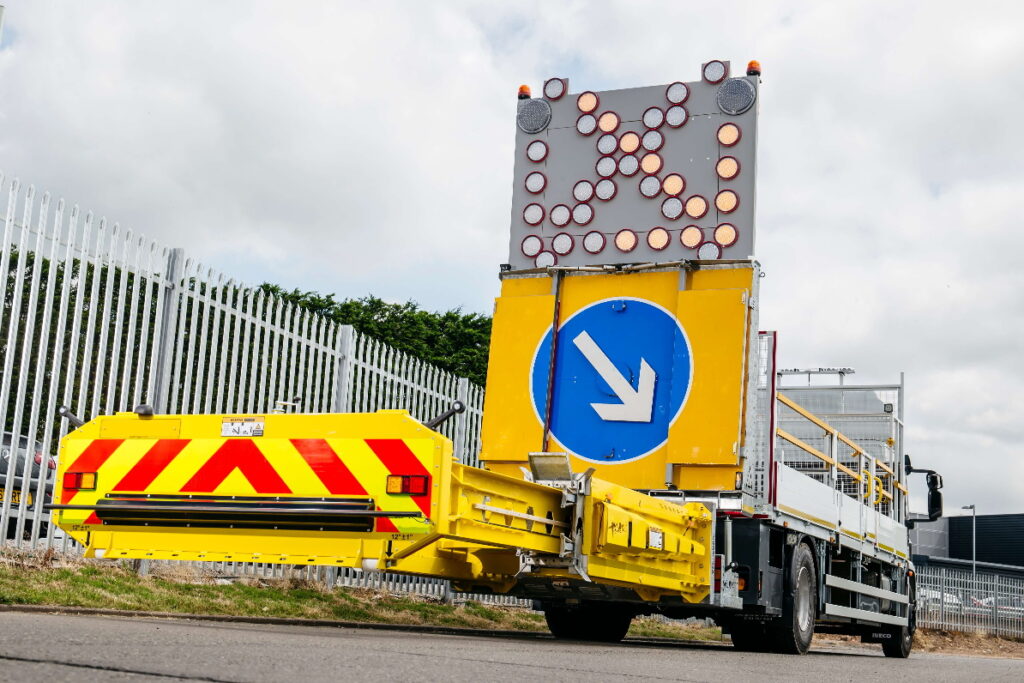
When a vehicle crashes into a truck mounted attenuator, the TMA absorbs the collision energy through a controlled deformation process, dramatically reducing the force transferred to the striking vehicle’s occupants and protecting the work zone crew ahead. The attenuator acts as a sacrificial buffer, designed to crush progressively so that impact energy dissipates rather than transmits. The sections below walk through exactly what happens to the vehicle, the occupants, the host truck, and the TMA itself.
How does a truck mounted attenuator absorb a crash impact?
A truck mounted attenuator absorbs a crash impact by collapsing in a controlled, progressive sequence. The attenuator’s internal structure, typically a series of aluminum or steel cartridges, honeycomb panels, or hydraulic cylinders, crushes from the rear forward. This staged deformation converts the kinetic energy of the striking vehicle into heat and deformation energy, slowing the vehicle down over a longer distance and at a lower deceleration rate than a rigid barrier would produce.
The physics behind this process are straightforward. A vehicle traveling at highway speed carries a large amount of kinetic energy. If that energy stops suddenly, the occupants experience extreme deceleration forces. A TMA extends the stopping distance by even a fraction of a second, and that extension dramatically reduces the peak force on the vehicle’s occupants. The attenuator’s progressive crush is engineered to keep deceleration within survivable limits defined by crash test standards.
Most modern TMAs also incorporate a redirective function. If a vehicle strikes the attenuator at an angle, guide rails or side panels redirect the vehicle away from the work zone rather than allowing it to penetrate the protected area. This combination of energy absorption and redirection is what makes a TMA fundamentally different from simply parking a heavy truck at the rear of a work zone.
What happens to the occupants of the striking vehicle?
Occupants of a vehicle that strikes a truck mounted attenuator experience a significant but controlled deceleration. Because the TMA crushes progressively, the occupant’s body decelerates over a longer time interval than it would in a rigid collision. This reduces peak chest, head, and neck loads. In a properly designed and tested TMA, occupants in a belted vehicle traveling within the attenuator’s rated speed have a high probability of surviving with reduced injury.
The outcome depends on several factors:
- Impact speed: TMAs are rated to specific test levels. A strike within the rated speed range produces predictable, tested results. A strike well above the rated speed increases the risk of the attenuator bottoming out before all energy is absorbed.
- Angle of impact: A head-on strike is the most favorable scenario for energy absorption. An oblique strike introduces lateral forces that the TMA’s redirection features must manage.
- Occupant restraint: Seatbelt use directly affects injury outcome. An unbelted occupant can continue moving forward inside the vehicle cabin even after the vehicle decelerates.
- Vehicle size and mass: A heavier vehicle carries more kinetic energy at the same speed, which places greater demand on the attenuator’s crush capacity.
Crash testing under standards like MASH 2016 measures occupant risk using metrics such as the Occupant Impact Velocity and the Ridedown Acceleration. These values must fall within defined limits for an attenuator to receive approval, giving you quantifiable confidence in the protection level.
What happens to the host vehicle and its driver during a TMA impact?
During a TMA impact, the host vehicle, the truck carrying the attenuator, absorbs a forward push from the collision. The TMA is typically mounted to the truck’s rear via a shear bolt or breakaway connection system designed to allow the attenuator to move forward and absorb energy before transmitting force to the host truck frame. This connection limits the impulse transferred to the host vehicle and, critically, to the truck driver seated in the cab.
The driver of the host vehicle will feel a sudden forward jolt. In well-designed systems, the force transmitted to the cab is reduced substantially compared to what it would be if the truck were struck directly. However, the driver still experiences a real impact event. Work zone operators are trained to expect this possibility and are instructed to keep their seatbelts fastened at all times when the truck is deployed in a live traffic environment.
After the impact, the host vehicle may have moved forward several meters depending on the collision force and whether the parking brake was engaged. Some TMA systems include features that lock the host vehicle’s brakes automatically at deployment, reducing forward displacement. The truck itself may sustain frame damage if the impact force exceeded the attenuator’s rated capacity or if the mounting system transferred residual energy to the chassis.
What does a TMA look like after a crash?
After a crash, a truck mounted attenuator typically shows significant visible deformation. The rear panels are crushed, buckled, or completely collapsed. Internal cartridges or energy-absorbing elements are compressed, and guide rails may be bent or displaced. In a moderate to high-speed impact, the attenuator can be reduced to a fraction of its original length. This destruction is intentional; it is evidence that the system worked as designed.
The degree of damage scales with impact severity. A low-speed glancing blow may leave the TMA largely intact with minor panel damage. A full-speed centered impact at the attenuator’s rated test speed will typically destroy the energy-absorbing core entirely. In either case, the visible damage to the TMA represents energy that did not reach the occupants of the striking vehicle or the workers ahead.
Debris from the collapsed attenuator may scatter across the road surface, creating a secondary hazard. Incident response protocols require the work zone to be secured, debris cleared, and traffic managed before any assessment or recovery begins.
Can a truck mounted attenuator be used again after a crash?
Whether a truck mounted attenuator can be reused after a crash depends entirely on the severity of the impact and the specific system design. Some TMAs are designed as fully reusable systems where the energy-absorbing cartridges can be replaced in the field, returning the unit to service relatively quickly. Others are single-use systems where a significant impact requires returning the entire attenuator to the manufacturer or a certified repair facility for assessment and rebuild.
Regardless of system type, no TMA should be returned to service after a crash without a formal inspection. Even if external damage appears minor, internal components may have sustained deformation that compromises their ability to perform in a subsequent impact. Structural welds, mounting brackets, hydraulic components, and guide rail alignments all require inspection by a qualified technician.
Operators should follow the manufacturer’s post-crash protocol, which typically includes:
- Removing the TMA from service immediately after any impact event
- Documenting the damage with photographs before any components are moved
- Contacting the manufacturer or authorized service provider for inspection guidance
- Replacing all damaged or deformed energy-absorbing elements before redeployment
- Verifying that the host vehicle mounting points are undamaged and correctly torqued
Redeploying a damaged TMA without inspection puts both road workers and future road users at serious risk. The attenuator’s rated performance is only guaranteed when all components are in their original, undamaged condition.
What MASH standards govern TMA crash performance?
TMA crash performance in the United States is governed primarily by the Manual for Assessing Safety Hardware (MASH), the current edition being MASH 2016. MASH defines the test conditions, vehicle types, impact speeds, and occupant risk criteria that a TMA must meet to receive Federal Highway Administration (FHWA) acceptance. Test Level 3 (TL-3) is the most common rating for highway-deployed TMAs, covering impacts up to 100 km/h with a 2,000 kg vehicle.
MASH 2016 replaced the earlier NCHRP-350 standard, introducing updated test vehicles that better reflect the current vehicle fleet and more stringent occupant risk metrics. Products tested only to NCHRP-350 are still in use but are no longer accepted for new federally funded projects in the US, making MASH 2016 compliance the current benchmark for procurement decisions.
Key performance criteria under MASH include:
- Structural adequacy: The TMA must contain and redirect the vehicle without allowing dangerous penetration into the work zone
- Occupant risk: Occupant Impact Velocity and Ridedown Acceleration values must remain within defined limits
- Vehicle trajectory: After impact, the vehicle must exit the system within a defined exit box, preventing it from entering oncoming lanes or the protected work area
Outside the US, similar standards apply. European markets reference EN 1317 for road restraint systems, and individual countries may have additional national requirements. Buyers operating across multiple markets should verify that their attenuator holds acceptance documentation for each jurisdiction where it will be deployed.
How Verdegro Helps with Truck Mounted Attenuator Protection
We design and manufacture a range of truck mounted attenuators built to meet the demands described throughout this article. Our TMA lineup includes the TMA-US 100K, TTMA-US 100K, LTMA-US 70K, and BLADE TMA, all tested and approved to NCHRP-350 TL-3 and MASH 2016. Each system is engineered to absorb crash energy progressively, protect host vehicle drivers, and give you confidence that the attenuator will perform as tested when it matters most.
Here is what our TMA systems offer:
- MASH 2016 and NCHRP-350 TL-3 approval, backed by FHWA acceptance letters for use on federally funded projects
- Reusable designs with field-replaceable energy-absorbing cartridges, reducing downtime after an impact event
- Optional integrated accessories including LED arrow boards, full-color VMS displays, and hydraulic LED-lift masts for complete work zone visibility
- Robust mounting systems engineered to limit force transfer to the host vehicle frame and cab
- Support for road construction contractors and traffic management operators across international markets
If you are specifying a TMA for a new project, replacing aging equipment, or need to verify compliance for a specific jurisdiction, we are here to help. Contact us to discuss your requirements and find the right system for your work zone.
Related Articles
- Can one impact protection vehicle be used for different types of roadwork?
- When do you need a full-size impact protection vehicle?
- When does a mobile work zone need a crash protection vehicle?
- What is an arrow board add-on for a truck mounted attenuator?
- What is CEN/TS 16786 for truck mounted attenuators?