
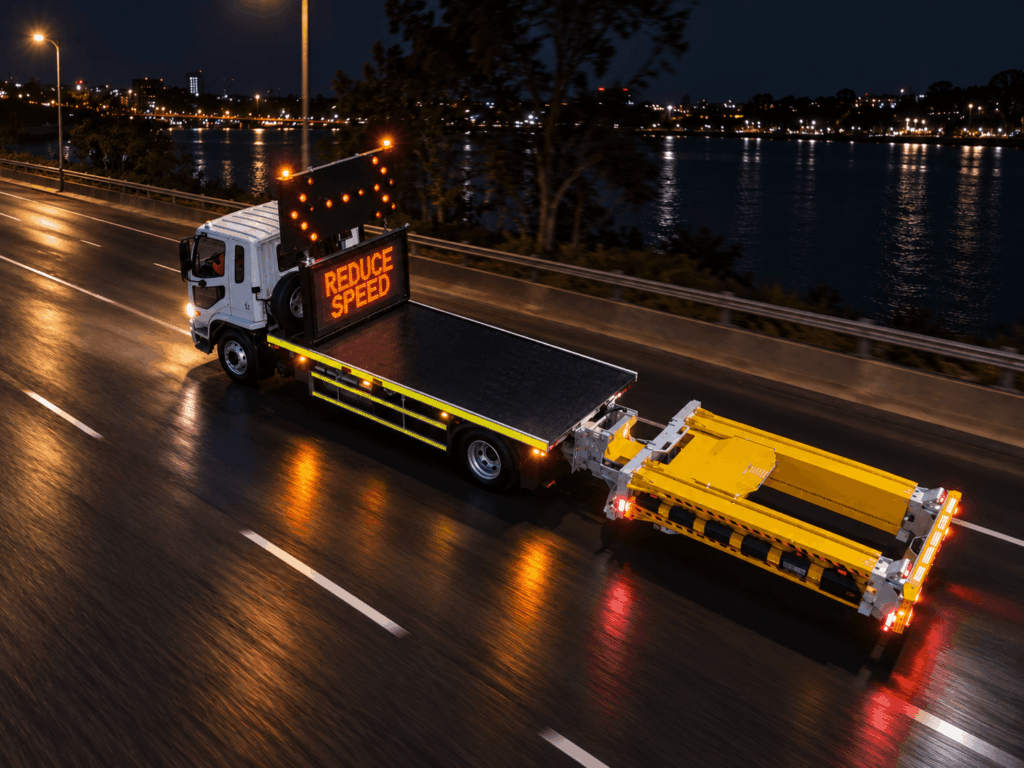
The main difference between impact protection for vans and trucks comes down to the size and weight of the vehicle, which determines how much crash energy the attenuator can absorb. Van-mounted systems are designed for lighter vehicles operating in lower-speed or urban environments, while truck-mounted attenuators are built for highway-speed work zones where impact forces are significantly greater. The right choice depends on the speed limit, road type, and applicable safety standards for your project.
What types of vehicles are used as impact protection vehicles in work zones?
Work zones use two main categories of impact protection vehicles: vans fitted with van-mounted attenuators and trucks fitted with truck-mounted attenuators (TMAs). The vehicle type determines the level of protection it can provide, how it is deployed, and which road environments it is suited for. Both types carry a crash cushion at the rear that absorbs the energy of an errant vehicle before it reaches workers or equipment.
Van-based impact protection vehicles are typically closed vans in the L3H2 class. They are more maneuverable and easier to position in tighter spaces, making them a practical option for urban roadworks, lower-speed roads, and maintenance tasks where a full-size truck would be impractical.
Truck-based impact protection vehicles use heavier support trucks, typically starting at around 7,000 kg. Their greater mass allows them to mount larger, more robust attenuator systems capable of absorbing high-energy impacts at highway speeds. These vehicles are the standard choice for motorway and expressway work zones where traffic travels at 80 km/h or above.
What is a Truck Mounted Attenuator and how does it work?
A Truck Mounted Attenuator (TMA) is a crash cushion system mounted to the rear of a support truck that absorbs the kinetic energy of an impacting vehicle, protecting both the work zone crew and the occupants of the errant vehicle. The attenuator acts as a buffer between live traffic and the stationary or slow-moving work zone, redirecting and dissipating crash forces rather than transferring them rigidly to the host vehicle.
When a vehicle strikes the attenuator at speed, the cushion structure deforms in a controlled way. This deformation converts kinetic energy into heat and mechanical work, slowing the impacting vehicle progressively rather than abruptly. The result is a significant reduction in peak deceleration forces on the occupants of the striking vehicle, which directly reduces the severity of injuries.
Modern TMAs are hydraulically operated, deploying from a transport position into a horizontal operational position in seconds. Many systems can deploy while the host vehicle is moving, allowing crews to set up protection quickly without stopping traffic. Once deployed, the attenuator extends behind the truck, creating a defined crash zone that keeps workers safe further up the road.
What are the key differences between van-mounted and truck-mounted attenuators?
The key differences between van-mounted and truck-mounted attenuators are vehicle weight, impact speed capacity, physical size, and the road environments they are certified for. Van-mounted systems are lighter and more compact but are limited in the impact energy they can absorb, while truck-mounted attenuators are heavier, larger, and certified for high-speed highway conditions.
The table below summarizes the most important distinctions:
- Host vehicle weight: Van systems use closed vans (L3H2 class); TMA systems require trucks from approximately 7,000 kg upward
- Impact speed rating: Van attenuators are typically rated for impacts up to 80 km/h (50 mph); truck-mounted attenuators meet MASH TL-3 at 100 km/h (62 mph)
- Physical footprint: Van systems are more compact and suited to narrow urban roads; TMAs are larger and designed for wide highway lanes
- Deployment mechanism: Both use hydraulic operation, but TMA systems are built for rapid deployment at speed on live motorways
- Certification scope: TMAs carry full MASH 2016 TL-3 certification covering multiple crash test scenarios; van systems meet relevant standards for their speed class
- Operational flexibility: Van systems offer greater maneuverability and are easier to reposition in complex urban work zones
Neither system is universally superior. The correct choice is determined by the speed environment and the certification requirements of the project.
Which impact protection vehicle is required for highway work zones?
Highway work zones require a truck-mounted attenuator mounted on a sufficiently heavy support truck. This is because motorway traffic speeds, typically 80 to 130 km/h, generate impact forces that exceed what a van-mounted system is designed to absorb. Regulatory bodies and road authorities in most countries mandate TMA use on high-speed roads to meet crash test performance standards.
The specific requirement is usually tied to the applicable crash test standard for the country or region. In the United States, the FHWA requires compliance with MASH 2016 for federally funded projects. In the UK, the TD49/07 standard applies, including optional 110 km/h testing. European countries follow their own national requirements, but MASH 2016 TL-3 is increasingly recognized internationally as the benchmark for highway-speed attenuator performance.
The host truck must also meet minimum weight thresholds. An attenuator that is not mounted on a heavy enough vehicle cannot perform as tested, because the truck’s mass is a critical part of the energy absorption system. Using an undersized vehicle effectively invalidates the system’s crash performance.
What safety standards apply to van and truck impact protection systems?
Van and truck impact protection systems are evaluated against crash test standards that define the speed, angle, and mass of test impacts the system must survive while keeping occupant deceleration within safe limits. The most widely referenced standards are MASH 2016 (Manual for Assessing Safety Hardware) in the US and TD49/07 in the UK, with MASH increasingly adopted internationally.
MASH 2016 Test Levels
MASH 2016 defines Test Level 3 (TL-3) as the standard for highway-speed attenuators. TL-3 requires the system to perform across a series of crash scenarios, including head-on impacts and angled impacts at 100 km/h (62 mph). A fully compliant TMA must pass tests 3-50, 3-51, 3-52, and 3-53 as a minimum, with optional test 3-54 available for additional certification. Each test evaluates structural performance, occupant risk, and post-crash vehicle behavior.
Standards for Van-Mounted Systems
Van-mounted attenuators are tested at lower impact speeds appropriate to their operational environment. A van attenuator rated to 80 km/h (50 mph) is tested to confirm it absorbs that level of impact within acceptable limits. These systems are not tested to TL-3 highway standards and must not be deployed in environments where those standards are required. Always verify the specific certification of any system against the requirements of your project’s governing authority.
CE marking and EMC compliance are additional requirements in European markets, confirming that the electrical and electronic components of the system meet European safety directives.
How do you choose the right impact protection vehicle for a project?
You choose the right impact protection vehicle by matching the system’s certified performance to the speed limit and road type of your work zone, then confirming it meets the regulatory requirements that apply to your project. Start with the posted speed limit, identify the applicable crash test standard, and select a system that holds the correct certification for that standard.
Work through these steps when making your selection:
- Identify the speed environment: Is the work zone on a motorway, expressway, urban road, or rural road? The posted speed limit determines the minimum test level required.
- Check the applicable standard: Find out which crash test standard governs your project, whether that is MASH 2016, TD49/07, or a national equivalent. Confirm the required test level.
- Match certification to requirement: Only use systems that hold documented certification for the required standard. Request official crash test certifications and verify them.
- Confirm host vehicle compatibility: Check that your truck or van meets the minimum and maximum weight requirements specified by the attenuator manufacturer. Weight is a critical performance variable.
- Consider operational practicalities: Evaluate lane width, deployment speed, access to the truck flatbed, and whether arrow boards or VMS signs need to be integrated.
- Account for tracking and compliance needs: Some projects require GPS tracking or integration with traffic management systems. Confirm whether your chosen system supports these capabilities.
If your project spans multiple road types, you may need different systems for different sections. A van-mounted attenuator suitable for urban maintenance work will not meet the requirements of the adjacent motorway interchange.
How Verdegro Helps with Impact Protection for Vans and Trucks
We manufacture crash protection systems for both vans and trucks, giving you a complete range of certified solutions across different road environments and speed classes.
For vans, our VanGuard TMA is the world’s first TMA designed specifically for closed vans. It is available in three versions:
- Rear Mounted: The cushion unfolds into a 90-degree operational position with a total length of 2,160 mm and a width of 1,830 mm
- Top Mounted: The cushion slides down from the roof into the operational position, keeping the rear doors fully accessible
- Swing Mounted: A rotation bracket allows the cushion to swing sideways, leaving rear doors accessible in both transport and operational positions
The VanGuard holds two patents, withstands impacts at speeds up to 80 km/h, and is fully customizable in RAL color, arrow board configuration, and VMS signage. It works with vans from Renault, Mercedes, Iveco, Opel, and other brands.
For trucks, our Armadillo TMA is our newest innovation, introduced in 2026 and fully tested and approved to MASH 2016 TL-3 at 100 km/h. Key advantages include:
- Single-stage deployment in under 20 seconds while driving at 80 km/h
- Compact width of 2,300 mm for operation in narrow lanes
- No sensors or electronic feedback components, reducing maintenance and failure risk
- Compatible with support trucks from 7,228 kg to 12,475 kg
- Full MASH 2016 TL-3 certification with official crash test documentation and CE marking
Both systems are optionally compatible with Mobitrack, our GPS tracking module that integrates with safety alert platforms including Waze, Google, and Flitsmeister, giving you real-time location data and status monitoring through our Mobilityplanner portal.
If you want to discuss which system fits your project requirements, contact our team and we will help you identify the right solution.
Related Articles
- How do you select safety vehicles for different road maintenance tasks?
- Why is Verdegro's truck mounted attenuator called Armadillo?
- What is the safe following distance behind a truck mounted attenuator?
- What maintenance schedule do truck mounted attenuator manufacturers recommend?
- What is the biggest market for truck mounted attenuators?