
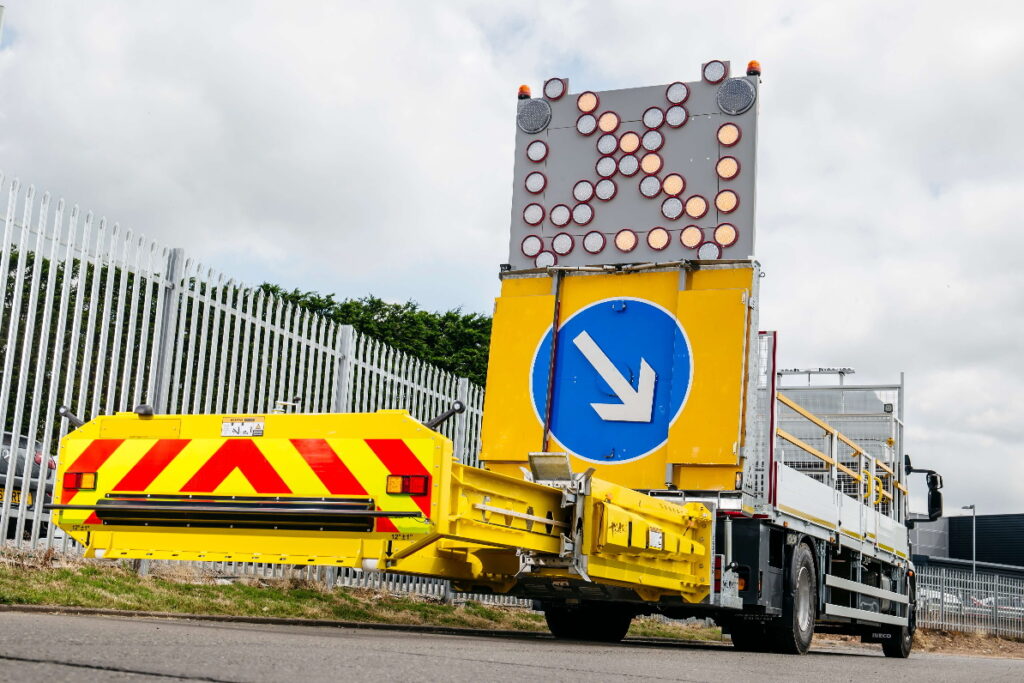
A heavier truck mounted attenuator does not automatically offer better protection. What determines protection is whether the TMA meets the required crash test standard for the impact conditions you expect, not how much it weighs. Weight plays a role in performance, but it is one factor among several, and a well-engineered lighter system can match or exceed the safety performance of a heavier one.
This matters because work zone operators often assume mass equals safety, which can lead to over-specifying equipment or overlooking better-suited alternatives. The sections below unpack how weight, test standards, and design all interact when you are choosing the right TMA for your operation.
What actually determines how much protection a TMA provides?
The protection a truck mounted attenuator provides is determined by its ability to absorb and redirect crash energy within defined limits, as verified through standardized crash testing. The TMA’s structural design, energy-absorption mechanism, and the weight of the host vehicle all contribute to this, but none of these factors works in isolation. A TMA is only as protective as its tested and certified performance under the relevant standard.
Crash cushion systems work by collapsing in a controlled way during an impact, decelerating the striking vehicle gradually rather than bringing it to an abrupt stop. The occupant risk values measured during testing, which reflect the forces experienced by vehicle occupants, are what regulators use to determine whether a TMA passes or fails. A product that achieves low occupant risk values within a controlled deceleration is performing well, regardless of its raw weight.
Other factors that directly influence protection include:
- Mounting configuration: How the TMA attaches to the host truck affects how impact forces transfer through the system.
- Host vehicle weight: The truck itself acts as an anchor, and minimum host vehicle weight requirements are specified per test standard.
- Impact angle and speed: TMAs are tested at specific angles and speeds, so protection is only guaranteed within those tested conditions.
- Maintenance and deployment state: A damaged or incorrectly deployed TMA will not perform as tested.
How does weight affect a truck mounted attenuator’s crash performance?
Weight affects a truck mounted attenuator’s crash performance primarily through the host vehicle, not the attenuator itself. A heavier host truck provides more resistance during impact, reducing the likelihood of the entire vehicle being pushed forward into the work zone. The TMA’s own weight influences its structural behavior during collapse, but the relationship between mass and safety is not linear.
A heavier TMA is not inherently safer. What matters is how the system’s mass and structure work together to manage energy. An attenuator that is too heavy for its mounting system can actually create problems, including stress on the truck frame and reduced vehicle maneuverability, which affects how safely the host vehicle can be positioned and operated in live traffic.
At the same time, a TMA that is too light for the tested impact conditions may not absorb enough energy before bottoming out, which transfers excessive force to the impacting vehicle. This is why crash testing under standardized conditions, rather than weight specifications alone, is the reliable measure of performance.
What’s the difference between MASH test levels for truck mounted attenuators?
MASH test levels define the speed and vehicle mass conditions under which a TMA is crash tested. MASH 2016 (Manual for Assessing Safety Hardware) is the current standard in the United States, replacing the older NCHRP 350 standard. Within MASH, test levels differ by the severity of the simulated impact, with higher test levels representing heavier vehicles and higher speeds.
For truck mounted attenuators, the two most referenced test levels are:
- TL-2: Tests at lower speeds and with lighter impacting vehicles, suitable for lower-speed work zones such as urban or residential roads.
- TL-3: Tests at higher speeds with heavier impacting vehicles, required for highway and high-speed work zone applications.
Choosing the right test level is not about selecting the highest available. It is about matching the TMA’s tested performance to the actual conditions of your work zone. Deploying a TL-2 certified TMA on a high-speed motorway would leave workers underprotected, while a TL-3 system on a low-speed urban project adds unnecessary cost and weight without a corresponding safety benefit.
MASH 2016 is stricter than NCHRP 350 in several respects, including updated vehicle weights that better reflect current traffic. Products certified under MASH 2016 have been tested against more demanding conditions, which is why MASH-certified crash systems are now the expected standard for federally funded projects in the US.
Can a lighter TMA meet the same safety standards as a heavier one?
Yes, a lighter TMA can meet the same safety standards as a heavier one, provided it has been tested and certified under the same test level. Certification is based on performance during a standardized crash test, not on the product’s weight. A lighter system that passes MASH TL-3 testing offers the same certified level of protection as a heavier system that passes the same test.
Modern materials and engineering have made it possible to design compact, lightweight attenuators that absorb and redirect crash energy effectively. Lighter systems also offer practical advantages:
- Lower payload means a wider range of host vehicles qualify, reducing fleet costs.
- Reduced truck weight improves fuel efficiency and maneuverability on site.
- Easier mounting and dismounting speeds up deployment in time-sensitive work zones.
The important check is always to verify that the specific TMA you are evaluating holds a current acceptance letter or certification for the test level required by your project or jurisdiction. A lighter product without the relevant certification is not equivalent to a heavier one that has it.
What other factors should you consider when choosing a truck mounted attenuator?
Beyond weight and test level, several practical factors should guide your TMA selection. The right attenuator for your operation depends on your host vehicle fleet, the nature of your work zones, regulatory requirements in your region, and what additional functionality you need on site.
Key considerations include:
- Host vehicle compatibility: Each TMA has a minimum and sometimes maximum host vehicle weight. Confirm your trucks fall within the specified range.
- Regulatory acceptance: In the US, federally funded projects require FHWA acceptance. Confirm the TMA holds a current FHWA acceptance letter under the applicable standard.
- Integrated visibility equipment: Many TMAs can be fitted with LED arrow boards, variable message signs, or hydraulic lift masts, reducing the number of separate vehicles you need in a work zone.
- Ease of maintenance: Attenuators sustain impacts and need to be repaired or replaced. Consider how quickly replacement parts are available and how straightforward the repair process is.
- Operational environment: High-frequency deployment in urban areas has different demands than long-duration highway work. Some systems are optimized for one context over the other.
Total cost of ownership is also worth calculating. A lower purchase price can be offset by higher maintenance costs, longer deployment times, or the need for a larger host vehicle. Evaluating these factors together gives you a more accurate picture than comparing sticker prices or weights alone.
How Verdegro Helps You Choose the Right Truck Mounted Attenuator
We manufacture a range of truck mounted attenuators designed and tested to meet current international crash safety standards, including MASH 2016 and NCHRP 350 TL-3. Our TMA lineup includes the TMA-US 100K, TTMA-US 100K, LTMA-US 70K, and BLADE TMA, each suited to different host vehicle configurations and operational requirements. All of our systems hold FHWA acceptance letters, so you can deploy them on federally funded projects with confidence.
What sets our systems apart beyond certification:
- Modular accessory options: Integrate LED arrow boards, full-color VMS displays, and hydraulic LED-lift masts directly onto the TMA, consolidating equipment on a single vehicle.
- Range of host vehicle compatibility: Our lineup covers different minimum vehicle weight requirements, giving you flexibility across your fleet.
- Durable construction: Built for repeated deployment in demanding road construction and traffic management environments.
- Remote monitoring: Through our Mobilityplanner platform, you can track your equipment’s status and location in real time.
If you are comparing options or need guidance on which system fits your host vehicles and project requirements, get in touch with us and we will help you find the right match.
Related Articles
- What features should you compare when buying a truck mounted attenuator?
- Can a trailer truck mounted attenuator be towed by any vehicle?
- How do you maintain a truck mounted attenuator?
- What is the most popular truck mounted attenuator model for highway work?
- What speed can you safely crash into a truck mounted attenuator at?