
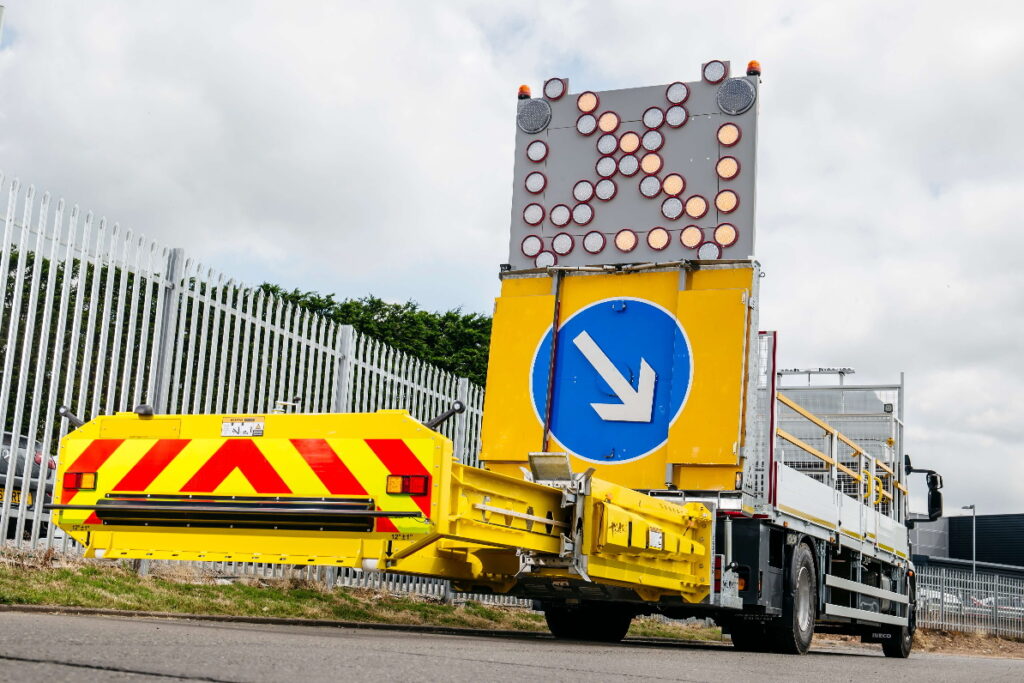
The most popular truck-mounted attenuator model for highway work zones in 2026 is generally a MASH 16-compliant, truck-mounted crash cushion rated for Test Level 3 (TL-3), capable of absorbing impacts from vehicles up to 5,000 kg at highway speeds. Contractors and highway agencies worldwide gravitate toward TL-3-rated models because they meet the most current federal and international safety standards while offering the flexibility to mount on standard work trucks. The questions below unpack what separates leading TMA models, how compliance works, and which features highway professionals prioritize most.
Which TMA models dominate highway work zones worldwide?
The TMA models that dominate highway work zones are MASH 2016 TL-3-certified crash cushion systems designed to mount on the rear of a host truck and absorb high-speed rear-end impacts. In North America and internationally, models that carry FHWA acceptance under MASH 16 hold the strongest position because government agencies and state DOTs increasingly require this certification for active work zone deployment.
Across major highway projects, the most commonly specified configurations share a few characteristics: they are truck-mounted (rather than trailer-based), they meet TL-3 impact performance, and they include integrated lighting such as LED arrow boards. Models in the 70,000 to 100,000 lb gross vehicle weight range tend to be the most versatile, fitting a wide range of host trucks used by road construction contractors and traffic management operators.
Demand for models with optional add-ons, including Variable Message Sign (VMS) displays and hydraulic LED-lift masts, has grown significantly as work zone communication requirements become more demanding. These integrated systems allow a single shadow truck to serve multiple safety functions simultaneously.
What makes a TMA model MASH 16 compliant?
A TMA model is MASH 16 compliant when it has been crash-tested and accepted under the Manual for Assessing Safety Hardware (MASH) 2016 guidelines, which replaced the older NCHRP-350 standard. MASH 16 compliance requires the attenuator to pass a series of defined impact tests at specific speeds and angles, demonstrating that it absorbs energy predictably and minimizes injury risk to both the impacting vehicle occupants and workers in the work zone.
For highway-speed applications, Test Level 3 (TL-3) is the relevant benchmark. This test level simulates an impact from a 2,270 kg (5,000 lb) vehicle at 100 km/h (62 mph). A model that passes TL-3 under MASH 16 receives an FHWA acceptance letter, which is the document highway agencies use to verify eligibility for federally funded projects.
It is important to note that NCHRP-350 acceptance does not automatically qualify a product for projects that require MASH 16. If you are specifying or procuring truck-mounted attenuators for government contracts, always confirm that the model holds a current FHWA acceptance letter under MASH 2016 rather than the older standard.
How does TMA energy absorption capacity affect model selection?
Energy absorption capacity directly determines which host truck a TMA can be paired with and at what speed it provides certified protection. A TMA’s ability to absorb kinetic energy from an impacting vehicle depends on both the design of the attenuator itself and the mass of the host truck. Heavier host trucks generally allow the system to absorb more energy without reaching the limits of the attenuator’s deformation zone.
This is why TMA models are typically rated by the minimum gross vehicle weight (GVW) of the host truck. A model rated for a 70,000 lb host truck and one rated for a 100,000 lb host truck may both carry TL-3 certification, but they are not interchangeable. Deploying a TMA on a truck lighter than the minimum rated weight reduces the system’s ability to absorb impact energy correctly, which can compromise both compliance and real-world protection.
When you select a TMA model, match the energy absorption rating to your available fleet. If your work trucks vary in size across different projects, look for a model range that covers multiple GVW classes so you maintain certified performance across your entire operation.
What’s the difference between a shadow truck TMA and an attenuator trailer?
A shadow truck TMA is a crash cushion mounted directly to the rear of a work truck, which then drives slowly ahead of a work crew to provide a moving buffer. An attenuator trailer is a separate trailer unit towed behind a vehicle and used primarily as a stationary or semi-stationary impact protection device at a fixed work zone location.
The practical differences affect deployment, flexibility, and certification requirements:
- Shadow truck TMAs move with the work crew and are ideal for mobile operations such as line striping, pothole patching, or any task where the protection zone travels along the road.
- Attenuator trailers are better suited for fixed-point protection, such as at the upstream end of a lane closure taper, where a stationary barrier is needed for an extended period.
- Shadow truck TMAs require the host truck to meet minimum GVW specifications for the crash test to remain valid. Attenuator trailers have their own independent crash-test certifications.
- Truck-mounted systems typically offer faster setup and teardown, which reduces traffic disruption on high-speed roads.
For most active highway construction environments, a truck-mounted system provides more operational flexibility. Attenuator trailers are a useful complement when you need stationary protection at a fixed hazard point over a longer duration.
Which TMA features do highway contractors prioritize?
Highway contractors prioritize MASH 16 certification, host truck compatibility, integrated LED lighting, and ease of mounting and removal when selecting a TMA model. Beyond basic compliance, the features that make a system practical on an active job site carry significant weight in procurement decisions.
The most commonly requested features include:
- LED arrow boards: Integrated directional warning displays that communicate lane closures and merge instructions to approaching drivers without requiring a separate vehicle.
- Hydraulic lift masts: Raise the arrow board or VMS to a height visible over traffic, improving advance warning distance.
- Variable Message Signs (VMS): Full-color programmable displays that allow real-time messaging, which is increasingly required on major highway projects.
- Quick-mount systems: Attachment mechanisms that allow the TMA to be transferred between host trucks without specialized equipment, reducing downtime.
- Compact transport profile: Systems that fold or collapse for transport help contractors move equipment between job sites efficiently.
Contractors working across multiple jurisdictions also look for models that hold acceptance in both US and European markets, since this simplifies procurement and reduces the number of different systems a fleet needs to maintain.
When should a work zone use a TMA versus other impact protection methods?
A work zone should use a truck-mounted attenuator when workers are performing tasks directly exposed to live traffic at highway speeds, particularly in mobile or semi-mobile operations where the protection zone moves along the road. TMAs are the appropriate choice when a stationary barrier, cone taper, or channelizing device alone cannot provide adequate protection against an errant high-speed vehicle.
Use a TMA when:
- Work crews are operating within or immediately adjacent to a live travel lane at speeds above 45 mph (70 km/h).
- The work zone moves progressively along the road, making fixed barriers impractical.
- Project specifications or government contract requirements mandate MASH 16-certified impact protection.
- The risk of a rear-end vehicle intrusion into the work space is high due to road geometry, traffic volume, or limited sight distance.
For fully closed road sections, stationary concrete barriers or water-filled barriers may be sufficient. For low-speed urban environments below 45 mph, alternative channelizing devices may meet local requirements. However, on high-speed highways where workers face direct exposure to traffic, a certified crash protection system provides a level of energy absorption that no passive device can match.
How Verdegro Supports Your TMA Selection
We manufacture a range of truck-mounted attenuators built to meet the demands of highway work zones worldwide. Our TMA lineup includes models tested and approved under both NCHRP-350 TL-3 and MASH 2016, giving you certified options for different project requirements and host truck configurations.
Our current TMA range includes:
- TMA-US 100K: Designed for host trucks with a minimum GVW of 100,000 lb, MASH 16 TL-3 certified.
- TTMA-US 100K: A towable TMA variant for fixed or semi-stationary deployment on high-speed roads.
- LTMA-US 70K: Suited for lighter host trucks at 70,000 lb GVW, expanding deployment flexibility for contractors with mixed fleets.
- BLADE TMA: A compact, efficient design for operations where profile and weight are primary considerations.
All models are available with optional integrated LED arrow boards, hydraulic LED-lift masts, and full-color VMS displays, so your shadow truck can handle impact protection and traffic communication in a single deployment. We hold multiple FHWA acceptance letters under MASH 16, which means our systems qualify for federally funded highway projects in the US and meet comparable international standards.
If you are evaluating which TMA model fits your fleet and project requirements, get in touch with us and we will help you match the right system to your host truck specifications, certification needs, and operational conditions.
Related Articles
- Which countries require CEN/TS 16786-certified truck mounted attenuators?
- What is the difference between the Blade and Armadillo truck mounted attenuator?
- What is CEN/TS 16786 for truck mounted attenuators?
- What is the difference between a truck mounted attenuator and an arrow board?
- Which countries require MASH-certified truck mounted attenuators?