
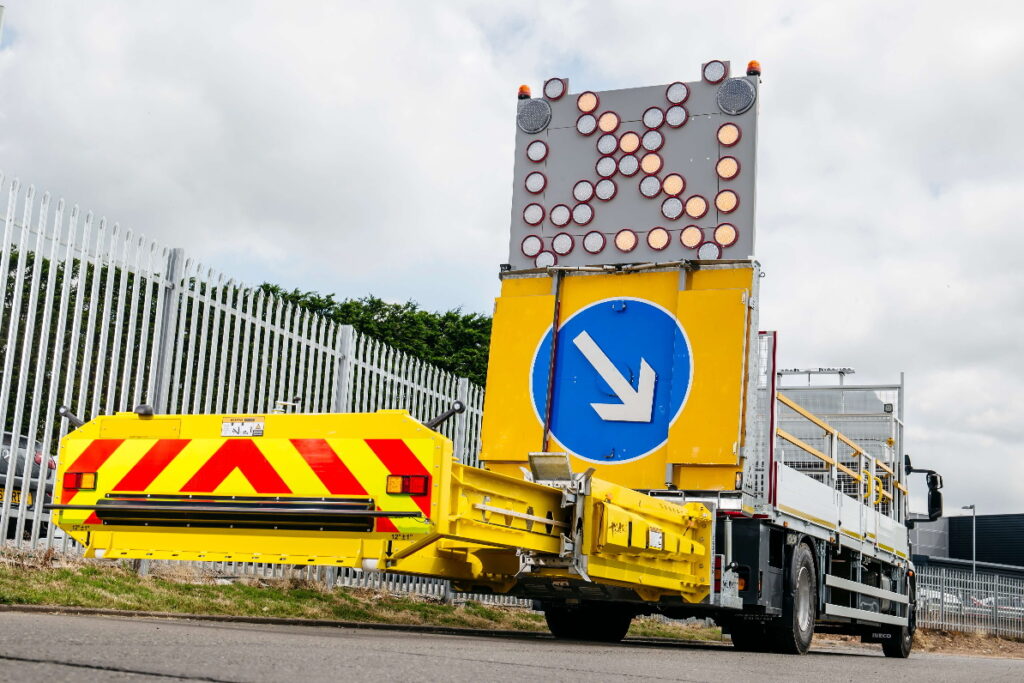
A trailer-mounted attenuator gives you a dedicated crash cushion that travels behind a tow vehicle, absorbing impact energy in active work zones without permanently occupying a work truck. It offers a more flexible and often more affordable alternative to a truck-mounted attenuator (TMA), particularly when you need to protect multiple sites with a single piece of equipment. The sections below answer the most common questions professionals ask before choosing between these two systems.
How does a trailer-mounted attenuator differ from a truck-mounted one?
A trailer-mounted attenuator is a standalone crash cushion unit towed behind a separate vehicle, while a truck-mounted attenuator bolts directly to the rear of a host truck. The core difference is independence: the trailer can be unhitched and left in position at a work zone, freeing the tow vehicle for other tasks on the same site or on a different one entirely.
Both systems serve the same fundamental purpose: absorbing the energy of an errant vehicle before it reaches workers. However, a truck-mounted attenuator keeps the host truck committed to shadow vehicle duty for as long as the work zone is active. A trailer-mounted unit, once positioned, does not require a vehicle to remain attached. This distinction has real operational consequences for contractors managing multiple simultaneous work zones or limited equipment fleets.
From a structural standpoint, trailer-mounted attenuators are generally heavier and larger than their truck-mounted counterparts because they must be self-supporting. Truck-mounted systems benefit from the host vehicle’s mass and are typically more compact, which makes them well suited to mobile operations where the shadow vehicle moves continuously with the crew.
What makes a trailer-mounted attenuator more cost-effective?
A trailer-mounted attenuator can reduce overall fleet costs because one tow vehicle can serve multiple trailers across different sites, rather than dedicating an entire truck to a single protection role. When a truck is committed as a shadow vehicle with a TMA attached, it cannot perform other work. A trailer, by contrast, can be unhitched and left in place while the tow vehicle returns to productive use.
The cost advantage becomes clearest in long-duration work zones. Road maintenance or utility crews that occupy the same location for days or weeks benefit from leaving a trailer-mounted unit in position overnight or across shifts, without paying for a driver or truck to stand by. Over a project lifecycle, this operational flexibility translates directly into reduced labor and equipment hours.
Maintenance costs are also worth considering. Because the trailer is not permanently integrated with a host vehicle, repairs or inspections can be carried out without taking a truck out of service. The two assets are maintained independently, which simplifies scheduling and reduces downtime.
How quickly can a trailer-mounted attenuator be deployed?
A trailer-mounted attenuator can typically be deployed within minutes. The tow vehicle positions the trailer at the desired location, the operator unhitches it, and the unit is ready to provide protection. No specialized rigging or heavy lifting equipment is required, and most modern trailer-mounted systems include leveling supports or stabilizers that take seconds to engage.
Setup speed depends on site conditions and the specific model, but the process is straightforward enough for a two-person crew to complete efficiently. If the trailer includes integrated accessories such as an LED arrow board or a variable message sign, those can be activated during or immediately after positioning, consolidating setup time for the entire advance warning area.
Retrieval is equally fast. The tow vehicle backs up to the trailer, hitches on, and drives away. This makes trailer-mounted attenuators practical for work zones that open and close daily, such as overnight lane closures on highways.
What safety standards do trailer-mounted attenuators meet?
Trailer-mounted attenuators are tested and certified to the same crash safety standards as truck-mounted systems, primarily NCHRP 350 and MASH 2016 (Manual for Assessing Safety Hardware). In the United States, compliance with these standards is required for use on federally funded roadways, and the Federal Highway Administration (FHWA) issues acceptance letters confirming that a product meets the relevant test level.
MASH 2016 is the most current standard and sets rigorous requirements for impact speed, vehicle mass, and occupant risk criteria. Products tested to MASH 2016 have been evaluated under updated protocols that better reflect modern vehicle fleets and real-world crash conditions. When specifying a trailer-mounted attenuator for a public works contract, confirming that the product holds a current FHWA acceptance letter under MASH 2016 is the most reliable way to verify compliance.
Test Level 3 (TL-3) is the most common certification for highway work zone attenuators, covering impacts at speeds up to 100 km/h (62 mph). Some applications on lower-speed roads may accept TL-2 certification, but highway and motorway projects typically require TL-3 as a minimum.
When should a work zone use a trailer-mounted attenuator instead of other protection?
A trailer-mounted attenuator is the better choice when the work zone is stationary for an extended period, when the tow vehicle needs to be freed for other tasks, or when the site requires a self-contained crash protection unit that can remain in place across multiple shifts. It is particularly well suited to fixed-point operations such as bridge maintenance, utility work, or lane closures that persist overnight.
Choose a truck-mounted attenuator instead when the work crew moves continuously along the road, such as during line painting, pothole patching, or vegetation cutting. In those scenarios, the shadow vehicle travels with the crew and a permanently attached TMA provides continuous moving protection that a trailer cannot replicate.
Consider the following factors when deciding:
- Duration: Long-duration stationary work zones favor trailer-mounted units; short or mobile operations favor truck-mounted systems.
- Fleet size: Smaller fleets benefit from the tow-vehicle flexibility a trailer provides.
- Site access: Tight or complex sites may limit trailer maneuverability, making a compact TMA more practical.
- Multi-site operations: One tow vehicle can service multiple trailer-mounted attenuators across different locations on the same day.
- Overnight presence: Trailers can remain on site without a vehicle, reducing overnight equipment costs.
How Verdegro Can Help You Choose the Right Attenuator
We manufacture a range of truck-mounted attenuators tested and certified to both NCHRP 350 TL-3 and MASH 2016, including the TMA-US 100K, TTMA-US 100K, LTMA-US 70K, and BLADE TMA. Each system is designed for road construction contractors and traffic management operators who need certified, durable crash protection without compromise.
Our attenuator systems can be configured with optional accessories to meet the specific demands of your work zone:
- LED arrow boards for clear lane guidance
- Full-color variable message sign (VMS) displays for dynamic messaging
- Hydraulic LED-lift masts for elevated visibility in low-light conditions
We hold multiple FHWA acceptance letters under MASH 2016, so you can specify our products on federally funded projects with confidence. Whether you are managing a single highway closure or coordinating traffic safety across a large infrastructure program, we can help you match the right system to your operational requirements.
If you want to discuss which attenuator configuration fits your next project, contact our team and we will work through the details with you.
Related Articles
- How do you request a quote for a truck mounted attenuator?
- What is a trailer light truck mounted attenuator and when is it used?
- What is CEN/TS 16786 for truck mounted attenuators?
- What is the difference between a truck mounted attenuator and a trailer truck mounted attenuator?
- What happens if you use a non-certified truck mounted attenuator?